
Panneggio
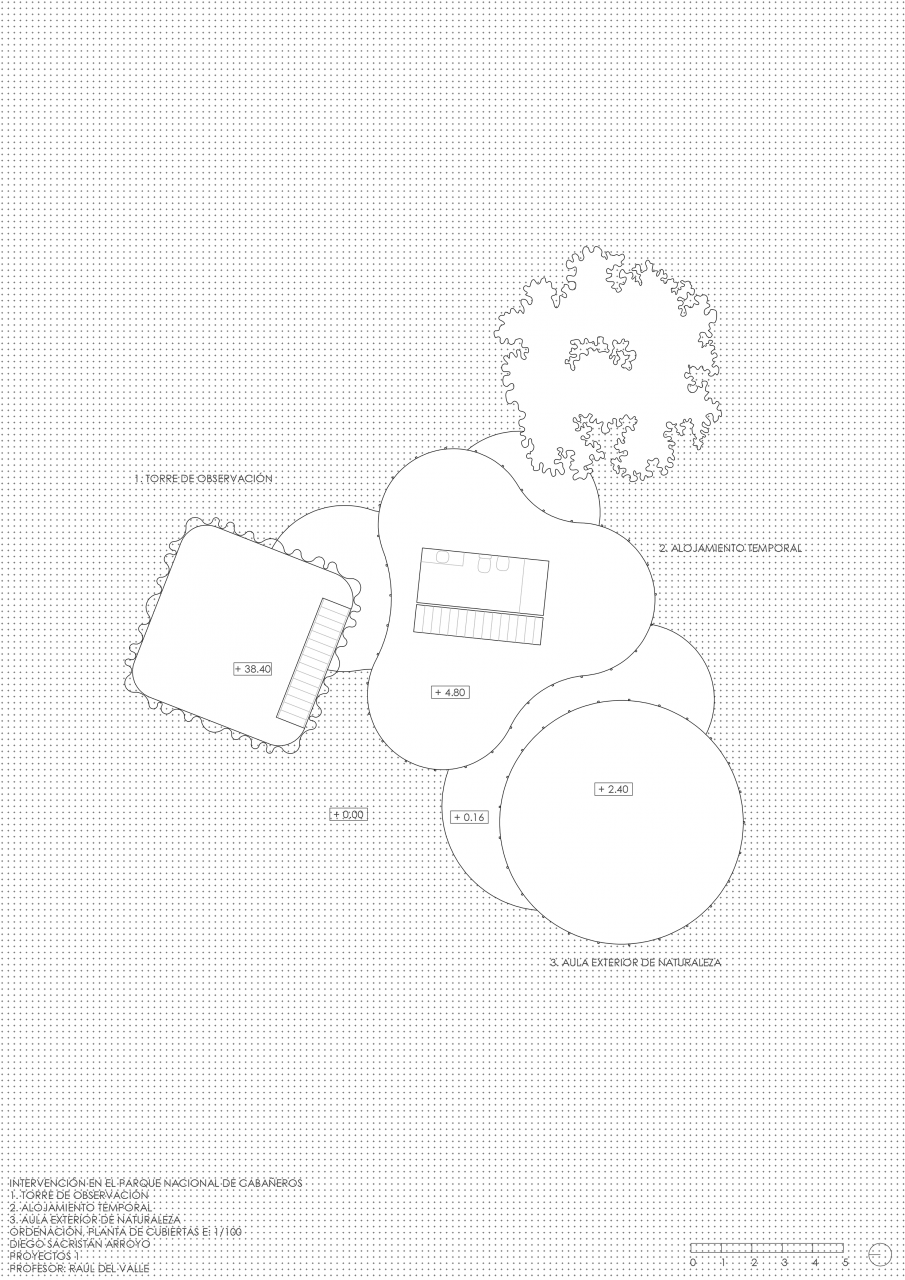
The course consisted of the design of an architectural complex located in the Cabañeros National Park. It consists of an observation tower, a temporary accommodation for a researcher and an outdoor nature classroom.
The proposed project is based on the analysis of the baroque features and concepts hidden behind the apparent simplicity and formal clarity of the ethereal architecture of SANAA, which is brought into relation with the canonical works of the italian seicento to generate an architectural artifice capable of responding to the singularity of the landscape in which it’s inserted.
The idea of continuity and the understanding of the column as a shaping element of space are put at the service of the uniformity of the environment to generate the façade of the complex. It is a façade that focuses its attention on the observation of the place, looking for different visual mechanisms to establish a dialogue between transparency and opacity.
The main idea in the composition of the façade is the way in which the curvilinear layout of the horizontal planes produces the distortion of the rhythmic continuity of the columnar order in favor of the contrast between the punctual and the continuous.
Other mechanisms present in the project to achieve this dialogue between transparency and opacity are the use of glass, which produces spatial distortion through the symmetry of the reflection; and the visual superposition of folded planes, achieving different stages of transparency.
The latter acquires great relevance in the observation tower. Its aluminum deployé covering hangs from it like a large curtain, producing through its folds a series of vibrations and changing rhythms that accompany and filter the gaze.
The vertical development of the tower follows a strict modulation that is only altered when meeting the ground, to allow the passage of users; and when meeting the sky, to guarantee a clear view of the entire landscape.
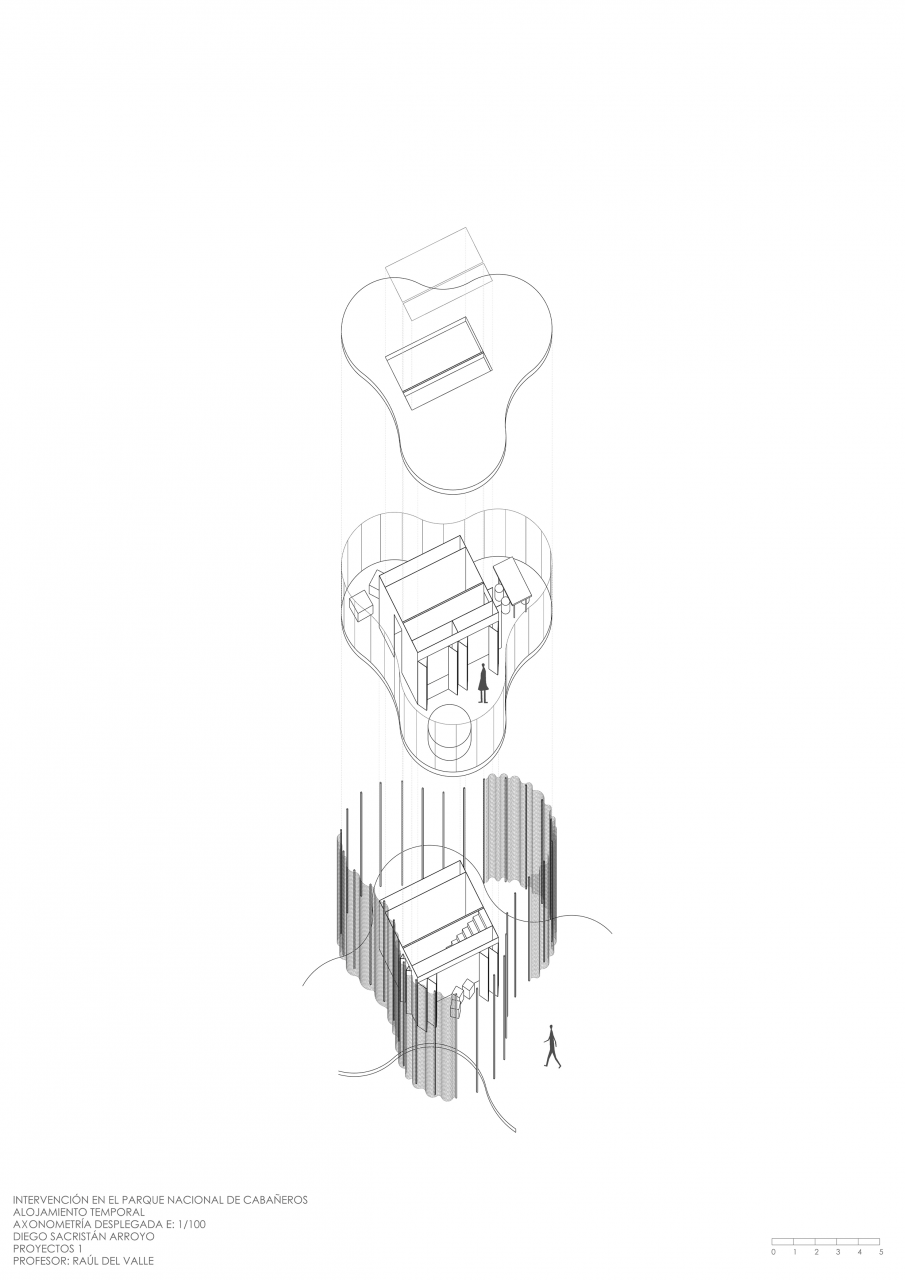
The house raises its piano nobile 2.40 meters high, to make it coincide with the virtual plane already existing in the National Park, defined by the lowest level of the crown of the holm oaks that characterize it so much, enhancing this unique feature. In addition, it's located attached to one of the park's own holm oaks and incorporates it within itself, giving it architectural value in the form of a nature wall.
The spatial configuration of the house is free, since dependencies are within a central prismatic volume, also made of reflective aluminum, which generates a "hall of the mirrors", although in this case in a perimeter way, rescuing the idea of the engawa that surrounds traditional japanese houses and which SANAA uses so much in its architecture.
Conceived as a monopter temple, the outdoor nature classroom is intended to contemplate the beauty of the landscape and learn about it. By being partially supported on the lower platform, a gap is generated inside allowing a greater visibility from the seats, which can freely change their position, as well as being stored in the space provided for it. Two mobile metal panels accompany this space, for, if desired, controlling the gaze or lighting.
In conclusion, the project is based on the fold as a mechanism to manipulate the perception of the space through the different elements, thus achieving a dialogue between transparency and opacity. In this way, an architecture that places its emphasis on the observation of the place through the architecture itself is created.
The proposed project is based on the analysis of the baroque features and concepts hidden behind the apparent simplicity and formal clarity of the ethereal architecture of SANAA, which is brought into relation with the canonical works of the italian seicento to generate an architectural artifice capable of responding to the singularity of the landscape in which it’s inserted.
The idea of continuity and the understanding of the column as a shaping element of space are put at the service of the uniformity of the environment to generate the façade of the complex. It is a façade that focuses its attention on the observation of the place, looking for different visual mechanisms to establish a dialogue between transparency and opacity.
The main idea in the composition of the façade is the way in which the curvilinear layout of the horizontal planes produces the distortion of the rhythmic continuity of the columnar order in favor of the contrast between the punctual and the continuous.
Other mechanisms present in the project to achieve this dialogue between transparency and opacity are the use of glass, which produces spatial distortion through the symmetry of the reflection; and the visual superposition of folded planes, achieving different stages of transparency.
The latter acquires great relevance in the observation tower. Its aluminum deployé covering hangs from it like a large curtain, producing through its folds a series of vibrations and changing rhythms that accompany and filter the gaze.
The vertical development of the tower follows a strict modulation that is only altered when meeting the ground, to allow the passage of users; and when meeting the sky, to guarantee a clear view of the entire landscape.
The house raises its piano nobile 2.40 meters high, to make it coincide with the virtual plane already existing in the National Park, defined by the lowest level of the crown of the holm oaks that characterize it so much, enhancing this unique feature. In addition, it's located attached to one of the park's own holm oaks and incorporates it within itself, giving it architectural value in the form of a nature wall.
The spatial configuration of the house is free, since dependencies are within a central prismatic volume, also made of reflective aluminum, which generates a "hall of the mirrors", although in this case in a perimeter way, rescuing the idea of the engawa that surrounds traditional japanese houses and which SANAA uses so much in its architecture.
Conceived as a monopter temple, the outdoor nature classroom is intended to contemplate the beauty of the landscape and learn about it. By being partially supported on the lower platform, a gap is generated inside allowing a greater visibility from the seats, which can freely change their position, as well as being stored in the space provided for it. Two mobile metal panels accompany this space, for, if desired, controlling the gaze or lighting.
In conclusion, the project is based on the fold as a mechanism to manipulate the perception of the space through the different elements, thus achieving a dialogue between transparency and opacity. In this way, an architecture that places its emphasis on the observation of the place through the architecture itself is created.






- 00 - Description
- 01 - Ground floor
- 02 - First floor
- 03 - Roof floor
- 04 - West elevation
- 05 - Complex axonometric
- 06 - Tower axonometric
- 07 - House axonometric
- 08 - Classroom axo
- 09 - Collages
- 10 - Model
- 11 - Video