
Aprendiendo de Grecia
First proyect:
In this course, a series of exercises set in Greece have been proposed. In the first exercise, we were located in Epidaurus. The program involved designing a set for the play "Electra" by Sophocles. "Electra" is a play of constant tension in which revenge haunts various members of a family. The Mycenaean King Agamemnon sacrifices one of his daughters to secure victory in the Trojan War. Upon his return after fourteen years, his wife and her lover assassinate him for the deed he committed before departing. Electra, his other daughter, upon learning of her father's death, harbors hatred towards her mother throughout the play and yearns for a revenge that seems never to arrive.
This theater was built around 350 BC to host the Asclepeia, a competition in honor of the healing god Asclepius. The theater seamlessly adapts to Mount Cynortion, creating small terraces for the seating. The theater has a height difference of 24 meters and a diameter of 135 meters. The peculiarity of Epidaurus lies in its shape, as three centers give form to a theater that encloses the orchestra, focusing attention on the center. From my perspective, the project's difficulty lies in this geometry. The original stage was fixed, had two levels, and served as a backdrop. Occasionally, some actors would go up to the second level, but the entire play took place in the orchestra. The landscape is an element that welcomes us and places us in a location but does not form part of the theatrical spectacle.
The project draws two diagonals that coincide with the two side entrances, and from these limits, arches are generated with the same footprint as the theater. The project aligns with the shape of the theater but establishes a separation that allows us to differentiate the two actions. The new stage is a 14-meter-high staircase that closes the theater, avoiding visual distractions. The play unfolds in the orchestra and on the new tiered seating, which, in an upward direction, follows Electra's interpretation until reaching the last section where that revenge we talked about at the beginning is fulfilled.
Second proyect:
In the second proyect we worked in Mycenae, where Agamemnon ruled. In this exercise, we were assigned an architect; in my case, it was Alvar Aalto. The program involved the reconstruction of the palace for Agamemnon, but with the language of Alvar Aalto. The acropolis of Mycenae is strategically located between two mountains, with a wide view over Argolis. The construction of this acropolis dates back to 1600-1100 BC. The acropolis housed the main workshops, worship areas, and the most recognized individuals, aside from the king. On the other hand, the polis was situated at the foot of this hill. The palace occupied the highest point and was visible from all directions. The acropolis adapts to the topography, and that's why it takes on that shape. On one side, it has a deep ravine, and on the opposite side, a less pronounced one. The Greeks placed primary importance on the access to places and created filters and preliminary routes.
The acropolis of Mycenae welcomes us with the grand entrance of the lions; subsequently, it leads us confined between two walls until a certain point where it begins to make turns to overcome heights, gradually bringing us closer to the palace. The crucial aspect is that from the moment we cross the entrance, we see the palace, and this happens in all possible movements within the acropolis. The way they constructed the acropolis follows a hierarchy and grants favorable conditions to those places of greater importance.
The most important space in the palace was the megaron, where the throne was located. To reach the throne room, you first passed through a colonnade that alternated a void; in the next filter, two voids interrupted the directionality by placing a pillar on the axis and then a single void. These interruptions and movements had a defensive quality, but at the same time, a different spatial perception, as you were entering a palace. Secondly, a wall indicated the direction, but this wall created turns generated by the adaptation to the terrain. Afterward, you entered a covered space to access a courtyard from which you could contemplate Argolis and the Aegean Sea. This entire process was necessary to finally meet the King in the megaron. Due to the importance of this place, it is decided to preserve it in the new palace project.
The main idea of the project is the resurgence of a volume that encloses a space (which provides routes and movement throughout the palace) left open on the north side to establish an access staircase. The most important space is the connecting space to which all these volumes converge. A series of trapezoidal pavilions are created that ascend in elevation the further south they are. These pavilions have a small courtyard with a porticoed space prior to the room. In the southwest corner, there would be more private rooms for guests with independent access. On the axis with the arrival, there would be an event space with halls; connected to this space would be all the facilities of the palace. The king's room would be on another level with its access to the megaron or throne room. The megaron rises above the other bodies, housing the throne room at elevation -0.0 and a contemplation space at elevation +6.0. In turn, this last space would be equipped with a lantern that adds grandeur to this leisure area. The project manages to scale the palace from a close perspective or the user, but from a distant perspective, it aims to be sensed as a continuation of the hill that is not aggressive.
Third proyect:
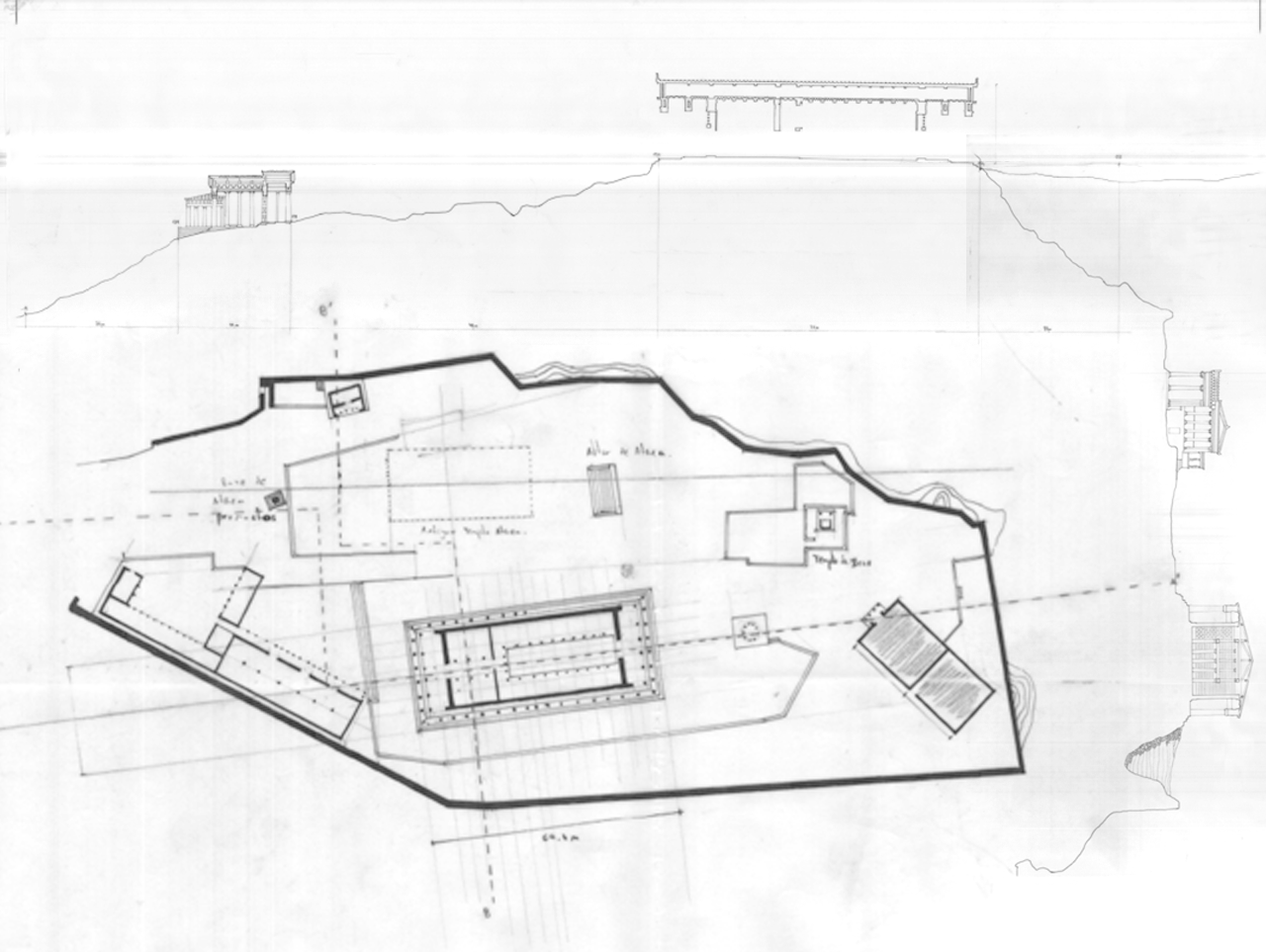
Finally, we find ourselves at the summit of Greek creation: the Acropolis of Athens. The program in this project consists of creating a temple for Zeus, the father of Athena. As we approach the Acropolis, we observe that we are facing a place of pure beauty. The understanding of this beauty eludes us; however, we observe it and try to bring our knowledge to a point that allows us to generate our temple. The project arises from a conception of the space of the Acropolis as more organized.
At the beginning of the "promenade architecturale," as Le Corbusier termed it, we encounter the propylaea. This space is an entrance created through panels that bring us closer to the most important site in all of Athens. This discovery of what we do not know requires belief and expectation on the part of the observer. The end is as important as the means to reach that end. I believe that without the means, the end would not be achieved, or perhaps it would, but in a different way.
At the end of the propylaea, we would be greeted by a 15-meter-high statue of Athena Promachos. On the other hand, we are granted a view of the Parthenon in perspective. At this moment, astonishment is generated, an aspiration to know, to understand that monument that pleases our eyes but needs to be contemplated.
Having contemplated the golden ratio, we approach the Parthenon to try to unveil this temple that intrigues us. On the journey, the Parthenon accompanies us on its long side, and the Erechtheion with the Caryatids remains motionless as we pass. They are aware that we have entered a sacred place; perhaps we should not be there, but they show no complaint, although they witness everything.
Once we turn our backs on the warriors, the guided tour comes to an end, and we proceed to the entrance of the temple of Athena, defender of the polis. At this moment, something remarkable or perhaps strange for the spectator occurs. After all the effort to reach the temple, at the last moment when the short side and thus the entrance would be revealed, we simply turn around the corner. The space is left open, and this produces an approach in the simplest and quickest way. I do not think this is ideal. The scale of the Parthenon is large, and I believe it should be viewed from a distance.
The project stems from an attempt to reorganize this space. The route of the Panathenaic procession is captured, and two possible approaches to the Parthenon are created, both passing through the new temple of Zeus. The first route hugs the north wall, crosses the Erechtheion, and passes transversely through the temple of Zeus. The second route is the one mentioned earlier, accompanied by the Erechtheion and the long side of the Parthenon until reaching the temple of Zeus, which we encounter head-on. "Zeus welcomes us and allows us to see his daughter in the most beautiful way."
"Will we ever see our defender? Our ancestors claim to have seen the place where she resided, but she was no longer there. We have done everything as we should, I do not understand. We passed through the propylaea filter, saw the house of our mother as she wished it, and the silent warriors did not tell us anything. Zeus must appear, only he can grant us access to his daughter's chamber."
In this course, a series of exercises set in Greece have been proposed. In the first exercise, we were located in Epidaurus. The program involved designing a set for the play "Electra" by Sophocles. "Electra" is a play of constant tension in which revenge haunts various members of a family. The Mycenaean King Agamemnon sacrifices one of his daughters to secure victory in the Trojan War. Upon his return after fourteen years, his wife and her lover assassinate him for the deed he committed before departing. Electra, his other daughter, upon learning of her father's death, harbors hatred towards her mother throughout the play and yearns for a revenge that seems never to arrive.
This theater was built around 350 BC to host the Asclepeia, a competition in honor of the healing god Asclepius. The theater seamlessly adapts to Mount Cynortion, creating small terraces for the seating. The theater has a height difference of 24 meters and a diameter of 135 meters. The peculiarity of Epidaurus lies in its shape, as three centers give form to a theater that encloses the orchestra, focusing attention on the center. From my perspective, the project's difficulty lies in this geometry. The original stage was fixed, had two levels, and served as a backdrop. Occasionally, some actors would go up to the second level, but the entire play took place in the orchestra. The landscape is an element that welcomes us and places us in a location but does not form part of the theatrical spectacle.
The project draws two diagonals that coincide with the two side entrances, and from these limits, arches are generated with the same footprint as the theater. The project aligns with the shape of the theater but establishes a separation that allows us to differentiate the two actions. The new stage is a 14-meter-high staircase that closes the theater, avoiding visual distractions. The play unfolds in the orchestra and on the new tiered seating, which, in an upward direction, follows Electra's interpretation until reaching the last section where that revenge we talked about at the beginning is fulfilled.
Second proyect:
In the second proyect we worked in Mycenae, where Agamemnon ruled. In this exercise, we were assigned an architect; in my case, it was Alvar Aalto. The program involved the reconstruction of the palace for Agamemnon, but with the language of Alvar Aalto. The acropolis of Mycenae is strategically located between two mountains, with a wide view over Argolis. The construction of this acropolis dates back to 1600-1100 BC. The acropolis housed the main workshops, worship areas, and the most recognized individuals, aside from the king. On the other hand, the polis was situated at the foot of this hill. The palace occupied the highest point and was visible from all directions. The acropolis adapts to the topography, and that's why it takes on that shape. On one side, it has a deep ravine, and on the opposite side, a less pronounced one. The Greeks placed primary importance on the access to places and created filters and preliminary routes.
The acropolis of Mycenae welcomes us with the grand entrance of the lions; subsequently, it leads us confined between two walls until a certain point where it begins to make turns to overcome heights, gradually bringing us closer to the palace. The crucial aspect is that from the moment we cross the entrance, we see the palace, and this happens in all possible movements within the acropolis. The way they constructed the acropolis follows a hierarchy and grants favorable conditions to those places of greater importance.
The most important space in the palace was the megaron, where the throne was located. To reach the throne room, you first passed through a colonnade that alternated a void; in the next filter, two voids interrupted the directionality by placing a pillar on the axis and then a single void. These interruptions and movements had a defensive quality, but at the same time, a different spatial perception, as you were entering a palace. Secondly, a wall indicated the direction, but this wall created turns generated by the adaptation to the terrain. Afterward, you entered a covered space to access a courtyard from which you could contemplate Argolis and the Aegean Sea. This entire process was necessary to finally meet the King in the megaron. Due to the importance of this place, it is decided to preserve it in the new palace project.
The main idea of the project is the resurgence of a volume that encloses a space (which provides routes and movement throughout the palace) left open on the north side to establish an access staircase. The most important space is the connecting space to which all these volumes converge. A series of trapezoidal pavilions are created that ascend in elevation the further south they are. These pavilions have a small courtyard with a porticoed space prior to the room. In the southwest corner, there would be more private rooms for guests with independent access. On the axis with the arrival, there would be an event space with halls; connected to this space would be all the facilities of the palace. The king's room would be on another level with its access to the megaron or throne room. The megaron rises above the other bodies, housing the throne room at elevation -0.0 and a contemplation space at elevation +6.0. In turn, this last space would be equipped with a lantern that adds grandeur to this leisure area. The project manages to scale the palace from a close perspective or the user, but from a distant perspective, it aims to be sensed as a continuation of the hill that is not aggressive.
Third proyect:
Finally, we find ourselves at the summit of Greek creation: the Acropolis of Athens. The program in this project consists of creating a temple for Zeus, the father of Athena. As we approach the Acropolis, we observe that we are facing a place of pure beauty. The understanding of this beauty eludes us; however, we observe it and try to bring our knowledge to a point that allows us to generate our temple. The project arises from a conception of the space of the Acropolis as more organized.
At the beginning of the "promenade architecturale," as Le Corbusier termed it, we encounter the propylaea. This space is an entrance created through panels that bring us closer to the most important site in all of Athens. This discovery of what we do not know requires belief and expectation on the part of the observer. The end is as important as the means to reach that end. I believe that without the means, the end would not be achieved, or perhaps it would, but in a different way.
At the end of the propylaea, we would be greeted by a 15-meter-high statue of Athena Promachos. On the other hand, we are granted a view of the Parthenon in perspective. At this moment, astonishment is generated, an aspiration to know, to understand that monument that pleases our eyes but needs to be contemplated.
Having contemplated the golden ratio, we approach the Parthenon to try to unveil this temple that intrigues us. On the journey, the Parthenon accompanies us on its long side, and the Erechtheion with the Caryatids remains motionless as we pass. They are aware that we have entered a sacred place; perhaps we should not be there, but they show no complaint, although they witness everything.
Once we turn our backs on the warriors, the guided tour comes to an end, and we proceed to the entrance of the temple of Athena, defender of the polis. At this moment, something remarkable or perhaps strange for the spectator occurs. After all the effort to reach the temple, at the last moment when the short side and thus the entrance would be revealed, we simply turn around the corner. The space is left open, and this produces an approach in the simplest and quickest way. I do not think this is ideal. The scale of the Parthenon is large, and I believe it should be viewed from a distance.
The project stems from an attempt to reorganize this space. The route of the Panathenaic procession is captured, and two possible approaches to the Parthenon are created, both passing through the new temple of Zeus. The first route hugs the north wall, crosses the Erechtheion, and passes transversely through the temple of Zeus. The second route is the one mentioned earlier, accompanied by the Erechtheion and the long side of the Parthenon until reaching the temple of Zeus, which we encounter head-on. "Zeus welcomes us and allows us to see his daughter in the most beautiful way."
"Will we ever see our defender? Our ancestors claim to have seen the place where she resided, but she was no longer there. We have done everything as we should, I do not understand. We passed through the propylaea filter, saw the house of our mother as she wished it, and the silent warriors did not tell us anything. Zeus must appear, only he can grant us access to his daughter's chamber."




- 00 - Description
- 01 - Initial estate
- 02 - sketch of Epidauro
- 03 - first proyect
- 04 - Initial estate
- 05 - Sketch of Micenas 1
- 06 - Sketch of Micenas 2
- 07 - Second proyect
- 08 - Initial state Athens
- 09 - Sketch of Athens
- 10 - Third proyect
- 11 - Video