
Costuras del paisaje
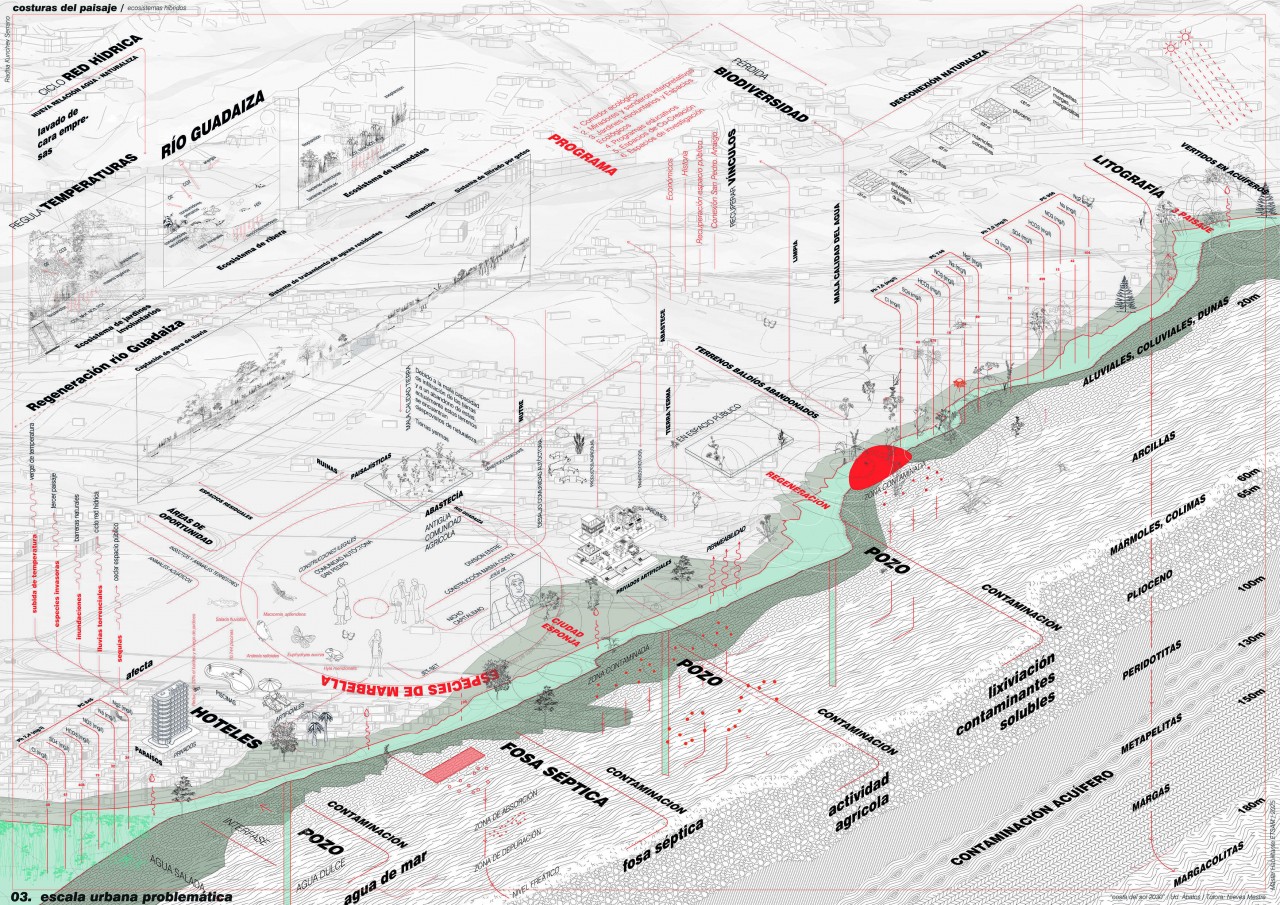
In the 1980s, Marbella became a symbol of consumerism. Urban development catered more to private interests than to social needs, dismantling public life and displacing the local community. In this process, San Pedro de Alcántara—originally an agricultural colony—saw its land occupied, often illegally, by hotels and luxury homes. This left behind neglected and purposeless spaces, now slowly reclaimed by nature.
The project starts from this urban and ecological crisis to propose a new way of understanding and stitching the territory back together. The Guadaiza River, currently threatened by illegal construction, drought, wastewater, and outdated regulations, is reimagined as a central axis of transformation. The intervention reconnects the river with the mountains and the urban fabric, restoring biodiversity and activating forgotten areas.
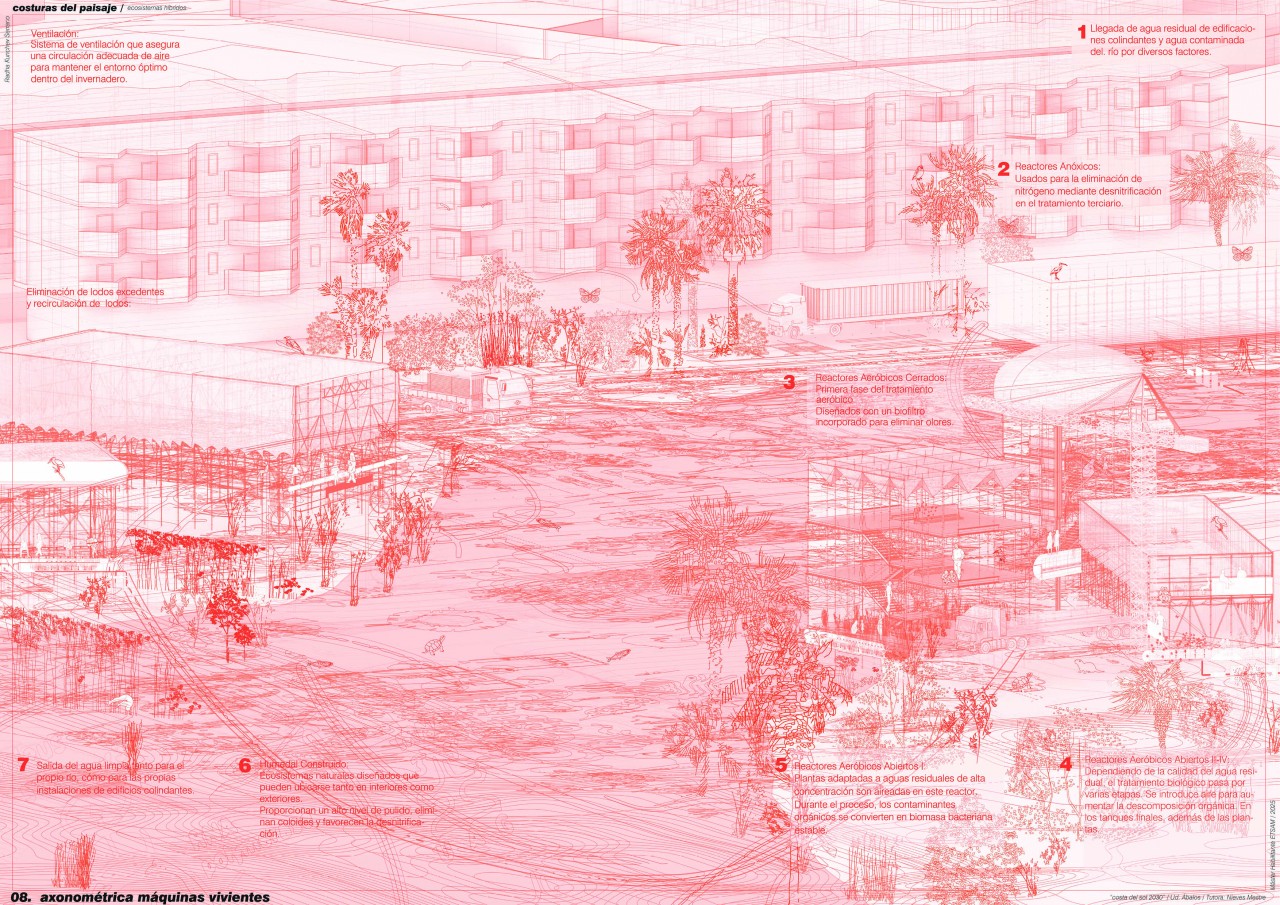
The proposal includes natural infrastructures like artificial wetlands, which act as flood barriers while regenerating the ecosystem. These systems treat wastewater, stormwater, and polluted river water through natural processes, and the clean water is reused by the university and nearby homes, closing an ecological loop.
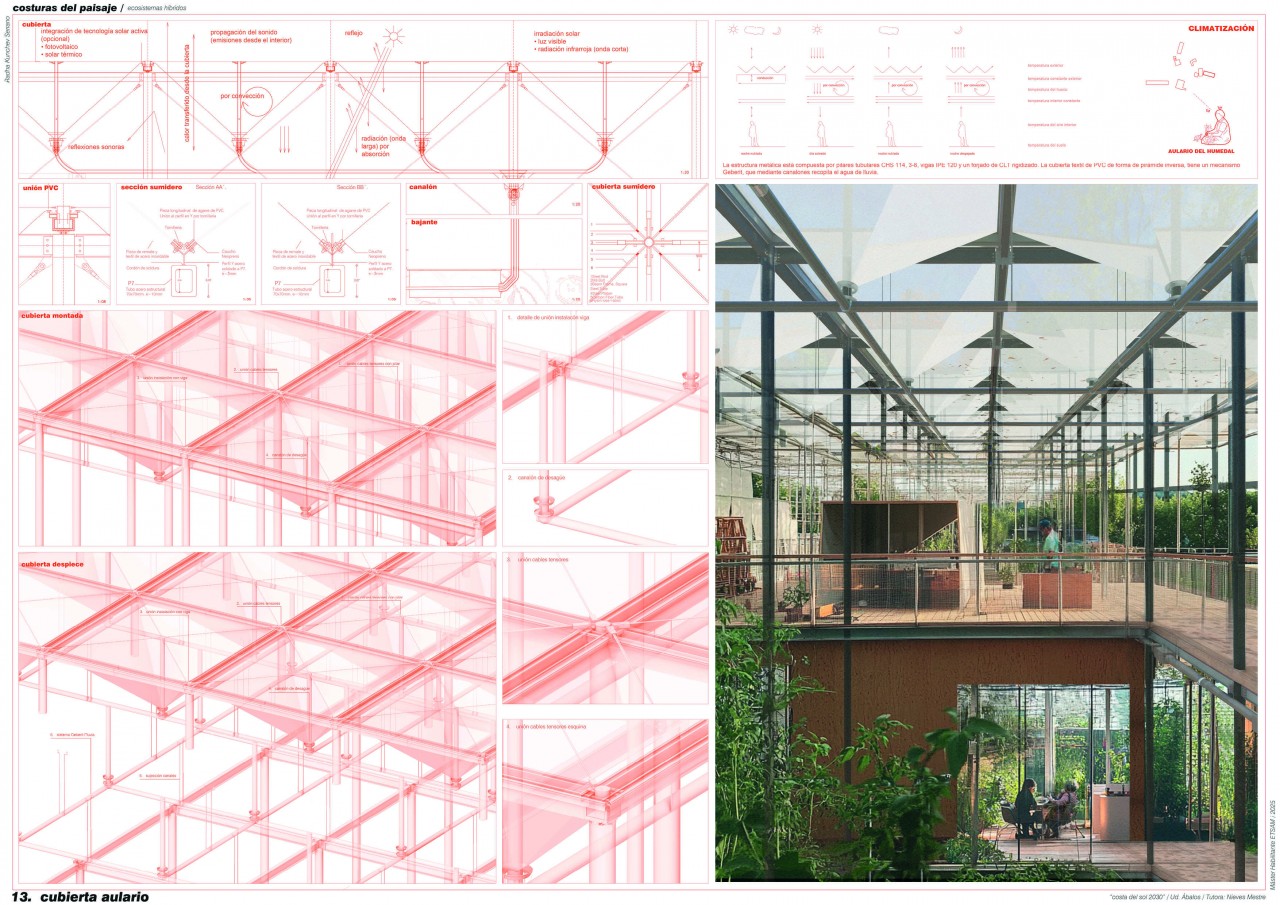
Architecture adapts to the environment: buildings with integrated purification systems, modular and dismantlable structures that respond to the climate and river levels, and textile roofs that collect rainwater and regulate temperature. Spaces are not fixed—they evolve with the seasons, pollution levels, and user needs.
The central building, a wetlands classroom complex, combines a metal structure with CLT wood floors and both natural and technical water purification systems. Its design responds to spatial and ecological demands, integrating rainwater collection, cross ventilation, microclimates, and a hybrid purification system with filters and floating elements that adjust to water levels.
The project seeks to transform the relationship between the city and water, creating a nature-culture or a third landscape.
The project starts from this urban and ecological crisis to propose a new way of understanding and stitching the territory back together. The Guadaiza River, currently threatened by illegal construction, drought, wastewater, and outdated regulations, is reimagined as a central axis of transformation. The intervention reconnects the river with the mountains and the urban fabric, restoring biodiversity and activating forgotten areas.
The proposal includes natural infrastructures like artificial wetlands, which act as flood barriers while regenerating the ecosystem. These systems treat wastewater, stormwater, and polluted river water through natural processes, and the clean water is reused by the university and nearby homes, closing an ecological loop.
Architecture adapts to the environment: buildings with integrated purification systems, modular and dismantlable structures that respond to the climate and river levels, and textile roofs that collect rainwater and regulate temperature. Spaces are not fixed—they evolve with the seasons, pollution levels, and user needs.
The central building, a wetlands classroom complex, combines a metal structure with CLT wood floors and both natural and technical water purification systems. Its design responds to spatial and ecological demands, integrating rainwater collection, cross ventilation, microclimates, and a hybrid purification system with filters and floating elements that adjust to water levels.
The project seeks to transform the relationship between the city and water, creating a nature-culture or a third landscape.







- 00 - Description
- 01 - Cover
- 02 - Urban scale
- 03 - Hydraulic network
- 04 - Water treatment
- 05 - Climate and temporal
- 06 - Sections
- 07 - Floor plan
- 08 - Axonometry
- 09 - Filter section
- 10 - Exploded axonometry
- 11 - Sectional axonometry
- 12 - Constructive section
- 13 - Roof
- 14 - Filtering mechanisms
- 15 - Structures
- 16 - Knolling
- 17 - Image
- 18 - Video