
ECOTO-VIA Hacia el ACAR
An Archaeological Infrastructure for Times of Crisis
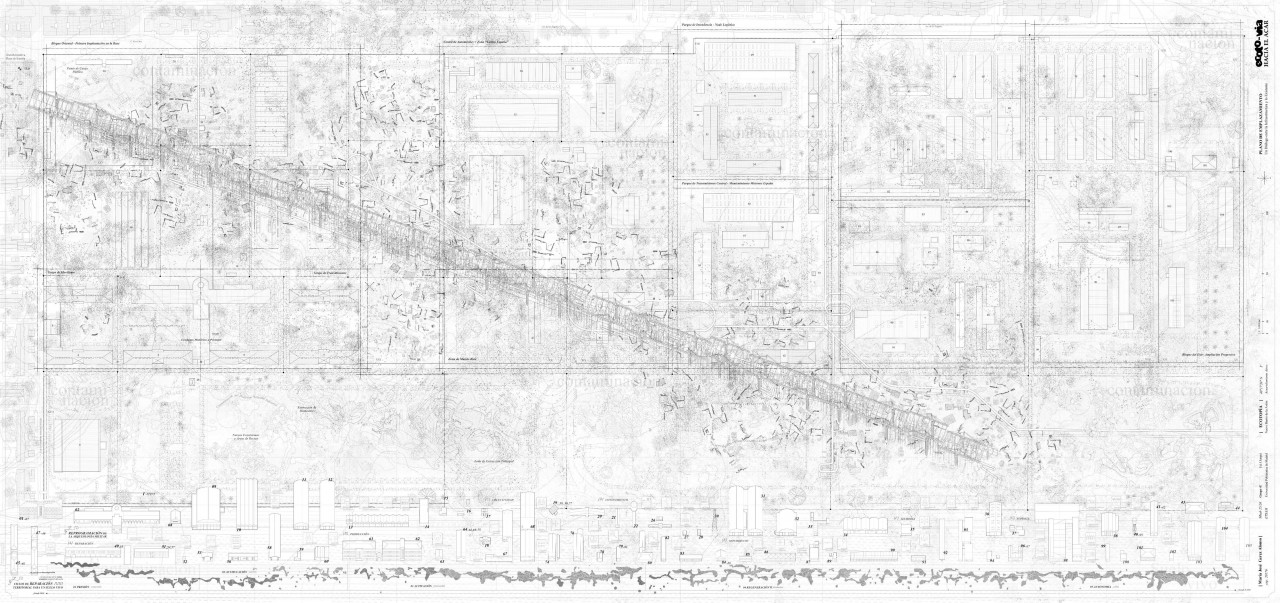
There was a time when Getafe was divided in two.
Not by an explicit border, but by a silent fracture.
One half expanded relentlessly, while the other remained suspended in time, enclosed behind walls that no longer belonged to its history.
One half saturated; the other fertile.
One half exhausted; the other full of latent potential.
One half without soil; the other made entirely of it.
Until the city began to turn inward.
People approached the walls as if looking at a forbidden landscape.
They wanted to enter.
They wanted to breathe.
They longed for the landscape beyond.
When the boundary finally disappeared, it was not only the land that was released, but also a possibility.
Not the possibility of occupying it once again, but of repairing it.
Of understanding that damaged ground can breathe again, and that architecture does not necessarily have to impose itself upon the land, but rather accompany its recovery.
From this premise emerges a system capable of working with what already exists, repairing what has been damaged, and enabling new forms of life without erasing the accumulated layers of the territory.
Thus, The Line was born.
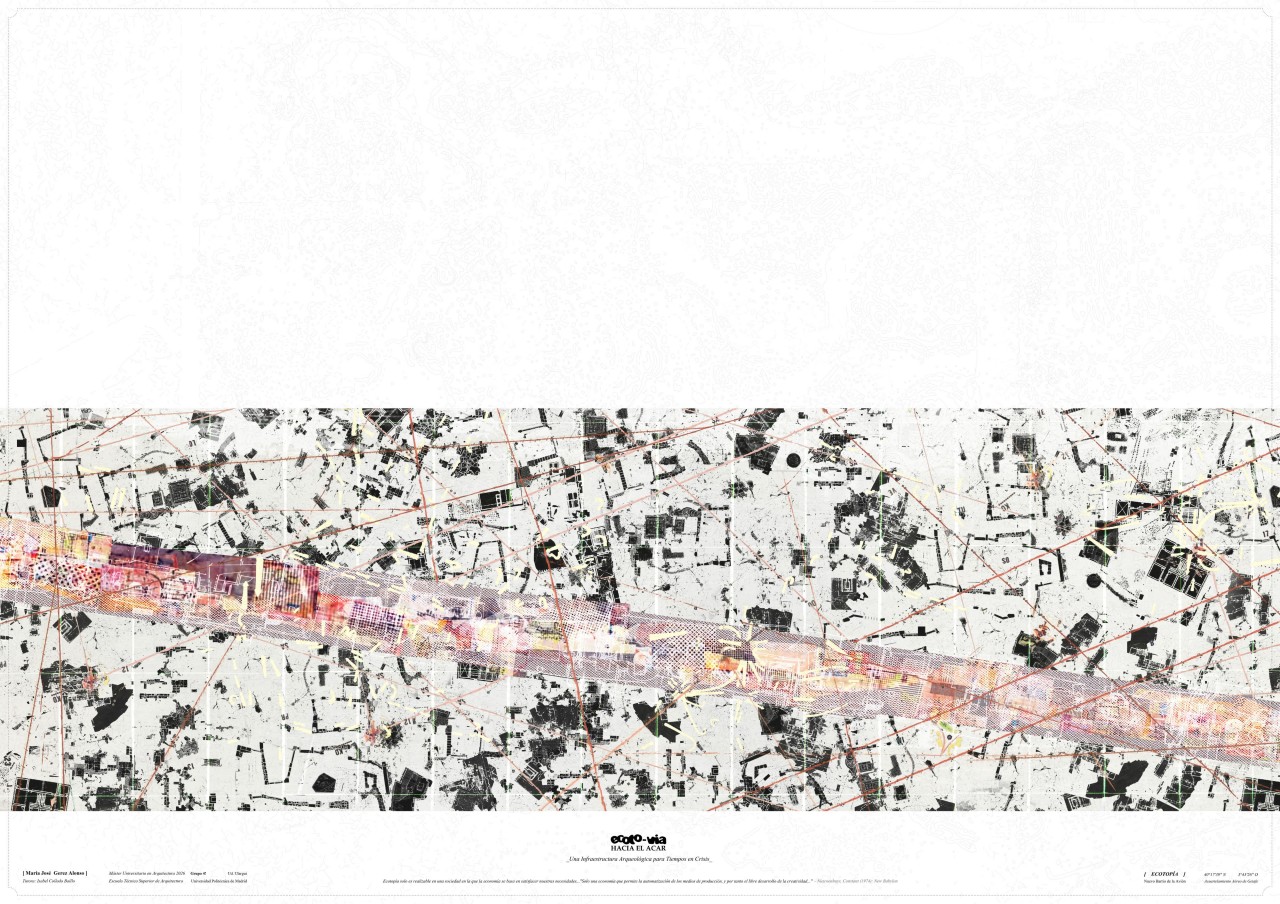
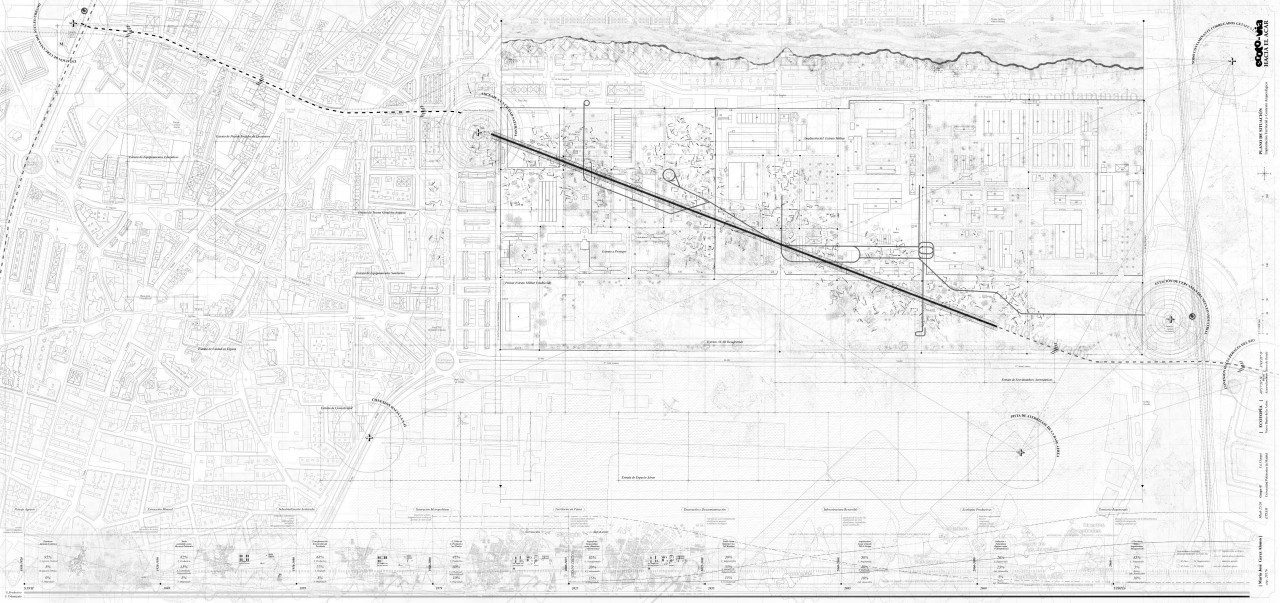
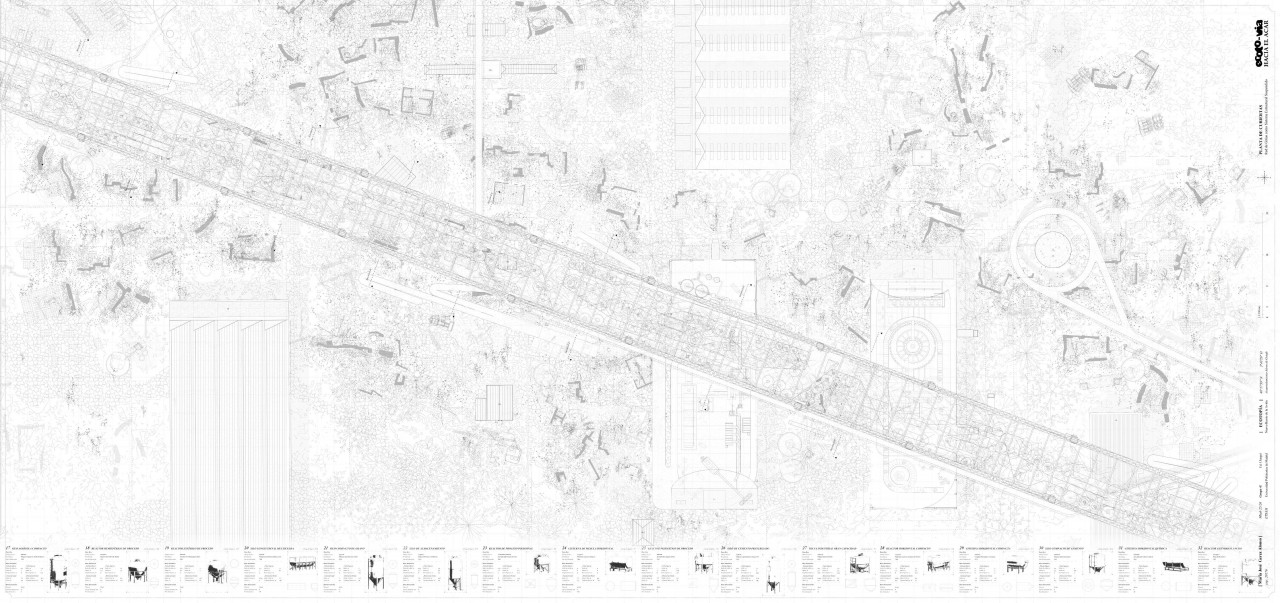
A lightweight, elevated and continuous structure crossing the former military airfield without imposing permanent weight upon the ground.
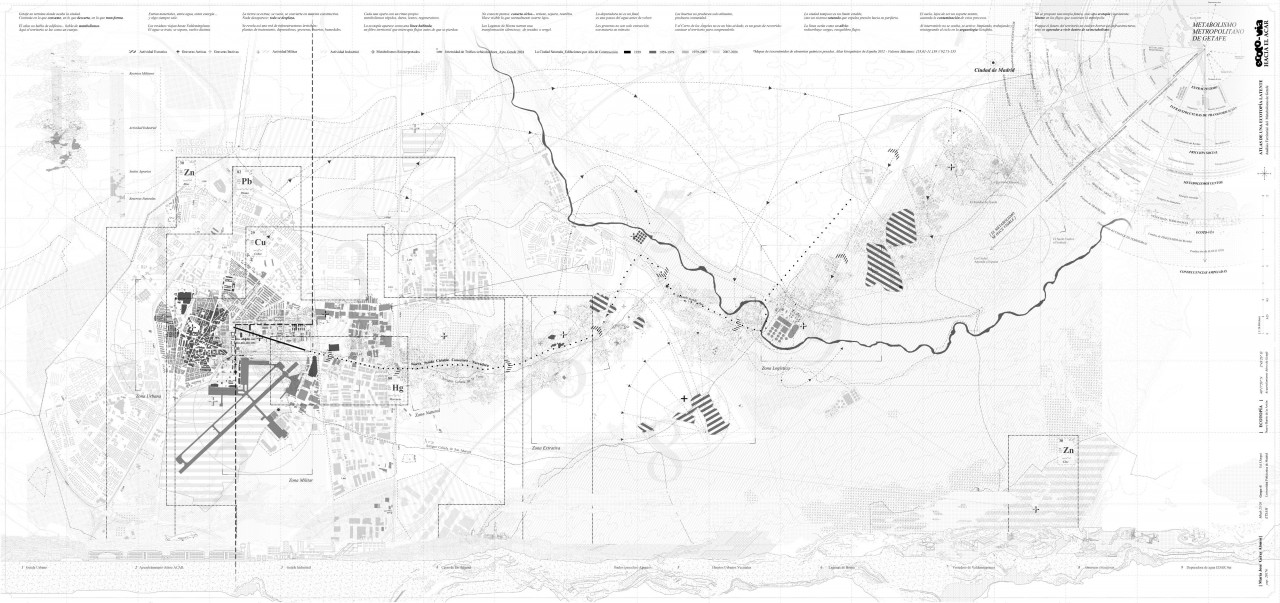
Because Getafe does not end where the city ends. It continues through what it consumes, what it discards and what it transforms, revealing the invisible infrastructures that sustain metropolitan life.
The Line does not simply connect places.
It connects cycles.
It retains, separates and reuses.
It makes visible what usually happens out of sight.
It does not land.
It accompanies.
It does not colonise.
It supports.
A territorial spine that allows contaminated and enclosed ground to breathe again while, above it, new forms of life emerge.
The Line does not touch in order to dominate.
It touches in order to care.
It becomes a territorial filter, interpreting flows before they disappear, continuously transforming private systems into collective ones.
Beneath it, the ground is not urbanised.
It is regenerated.
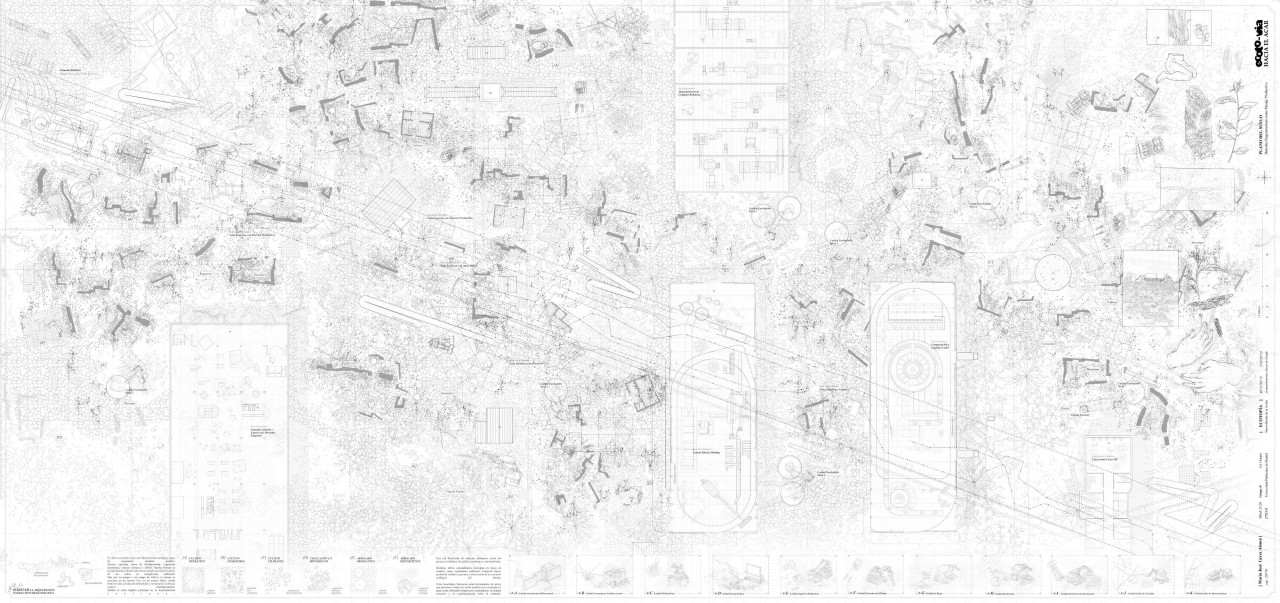
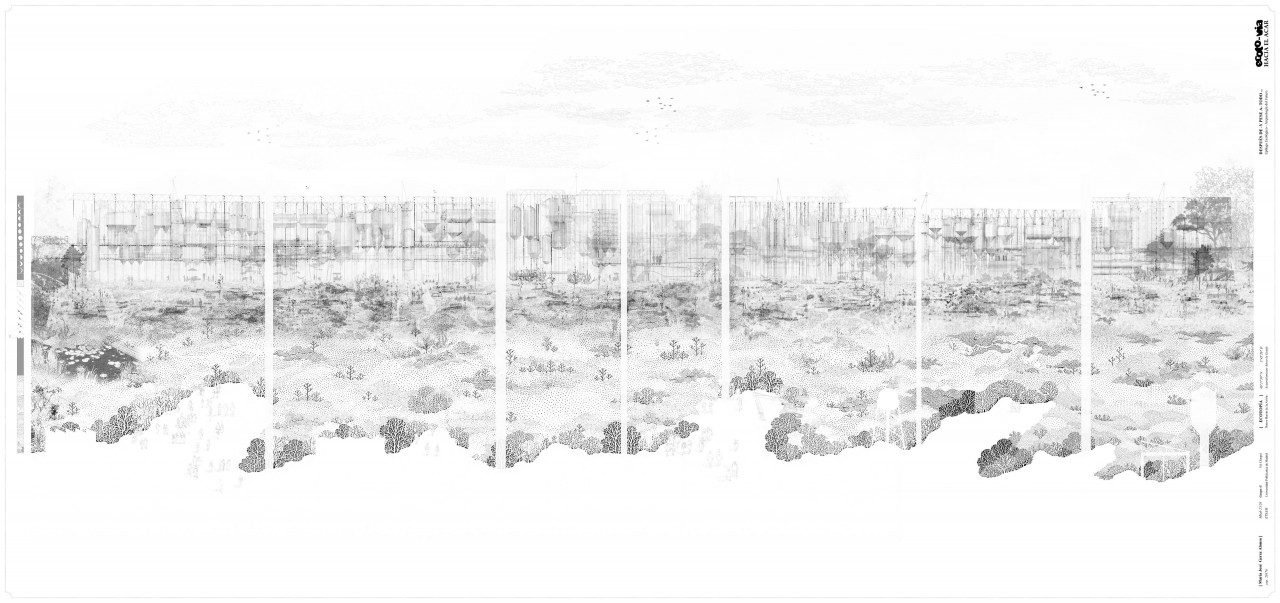
Where industrialisation and abandonment once prevailed, terraces, drainage systems and productive gardens appear.
Small autonomous machines move across the landscape like contemporary gardeners, removing contaminated soil, classifying it, remediating it and returning it clean to the ground.
They sow.
They irrigate.
They care.
Below, the land is cultivated, repaired and regenerated.
Above, life is produced and inhabited.
To inhabit this place means accepting change as a natural condition.
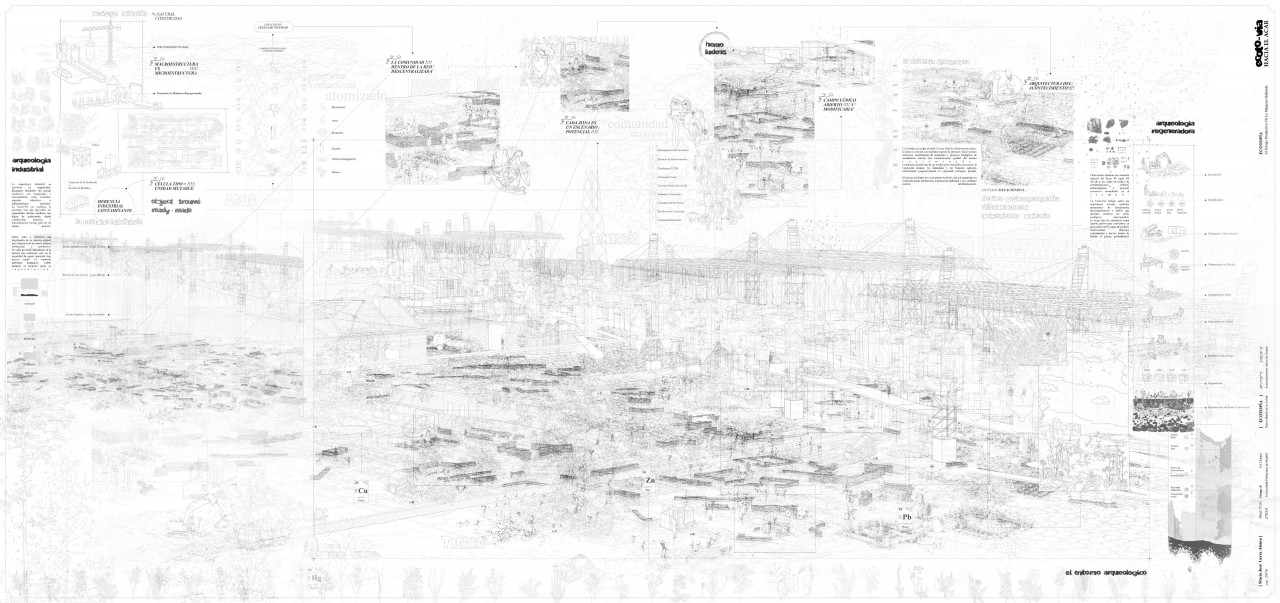
Just as the soil continuously transforms, housing also abandons its fixed and permanent condition. Domesticity is distributed across a shared infrastructure that reprogrammes inherited structures while reusing the silos left behind by the very industrial activity that once contaminated this territory.
The Line is simultaneously narrative, process and cycle:
Cleaning.
Cultivating.
Inhabiting.
Transforming.
Beginning again.
It reconciles industry and nature.
Machines and everyday life.
There is no longer a "good" half and a "bad" half.
There is only a living strip transforming the former boundary into a new centre.
The former military compound is no longer an empty void or a scar.
It becomes an infrastructure of care.
The Line does not enclose.
It invites.
Those who enter do so willingly:
to live by cultivating rather than consuming;
to produce by reusing rather than exploiting;
to inhabit by sustaining rather than defending.
This Ecotopia emerges from a condition increasingly present in contemporary cities.
For decades we have built according to the same logic:
growth,
occupation,
production.
This model has left behind vast latent territories:
former industrial, military and logistical landscapes suspended between what they once were and what they have yet to become.
At the same time, they face urgent challenges: the loss of fertile soil, contamination inherited from decades of industrial activity, dependence on external productive systems, and the growing separation between ecological cycles and everyday life.
These places are usually regarded as reserves for future urban expansion, when perhaps their greatest value lies precisely in not being occupied once again.
Can architecture become a tool for repair rather than occupation?
Can a degraded territory recover its ecological capacity without losing the memory of what it once was?
Can infrastructure generate new ways of inhabiting while accompanying ecological regeneration?
The ambition is no longer to build a machine for growth.
It is to build a machine for repair.
A new Way.
An Ecoto-Way towards the ACAR.
D
But if The Line is a path...
where does it lead?
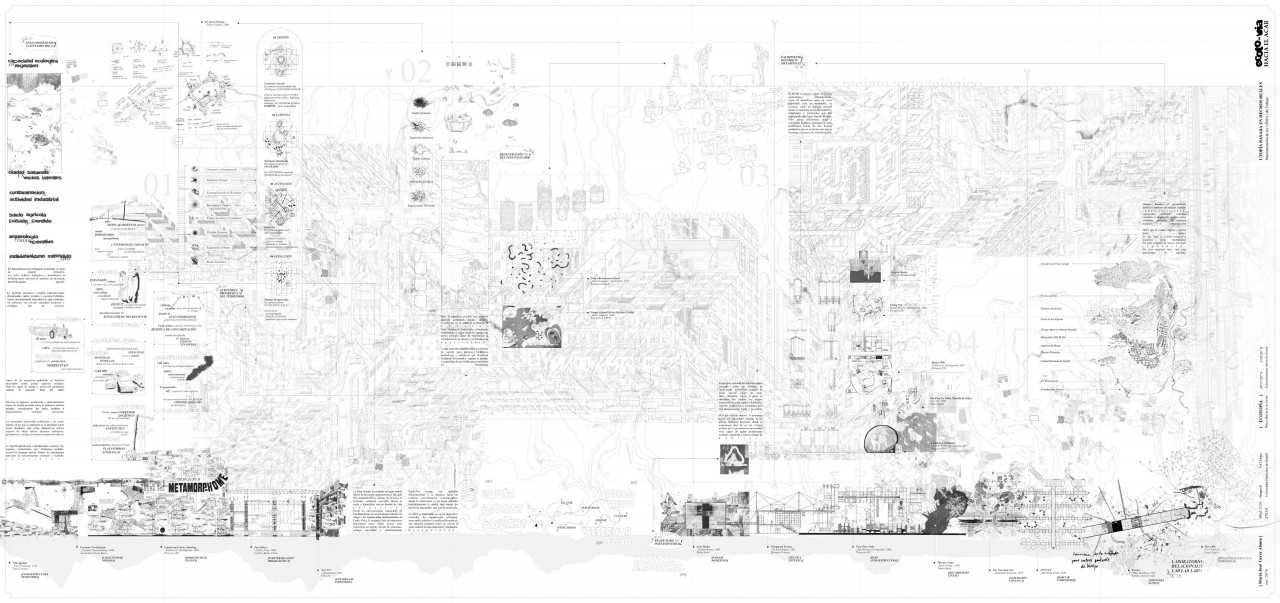
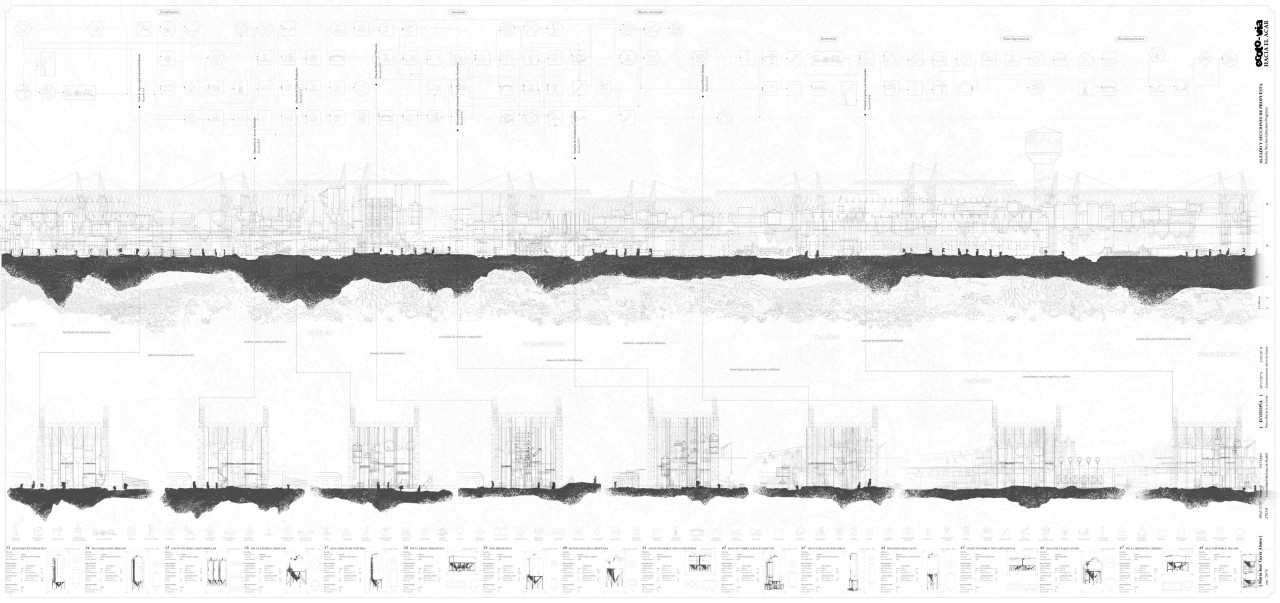
The Line is simultaneously a route, a habitable infrastructure and a metabolic system.
It organises the ecological, productive and social processes required to regenerate the territory, transforming them into a new way of living while reinterpreting the metropolitan metabolism of the site itself.
Rather than proposing a distant utopia, the project reveals an ecotopia already latent within the hidden flows that sustain the contemporary metropolis.
The intervention does not conceal the ground.
It activates it.
The site is reincorporated into productive cycles through an archaeological logic that does not erase existing traces, but reactivates them.
Vegetation, paths and territorial layouts are preserved as the project's ecological framework.
Former military warehouses become spaces for research, production, storage and exchange.
Inherited industrial artefacts become part of a new territorial infrastructure.
Archaeology is no longer understood as a collection of static ruins.
It becomes an operative system.
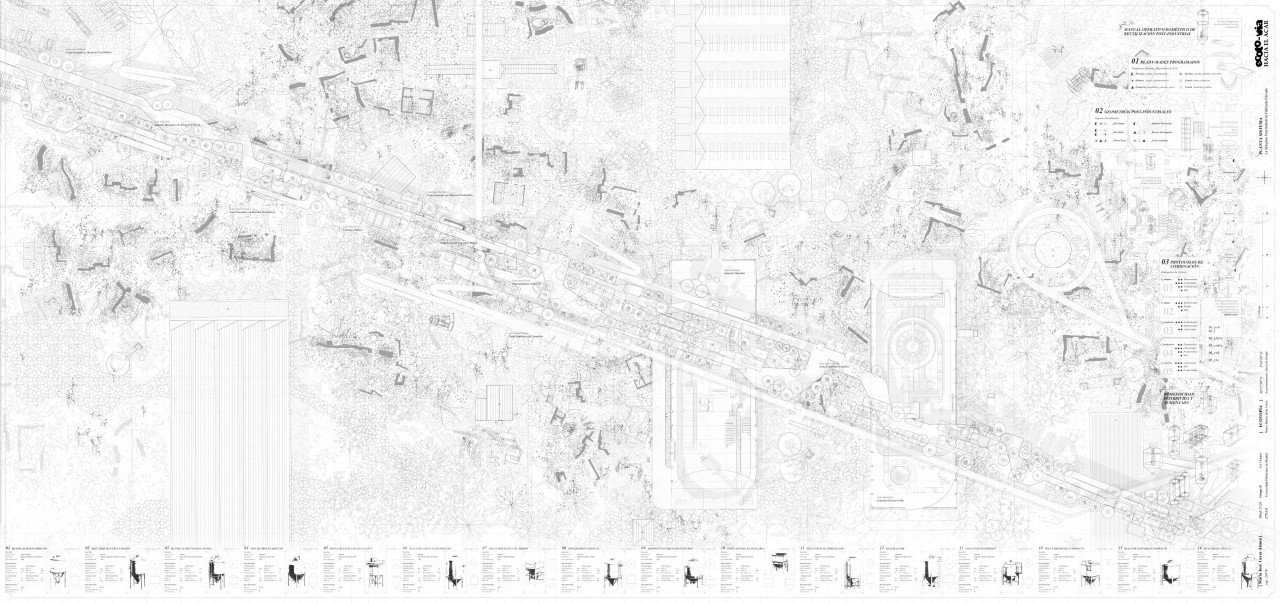
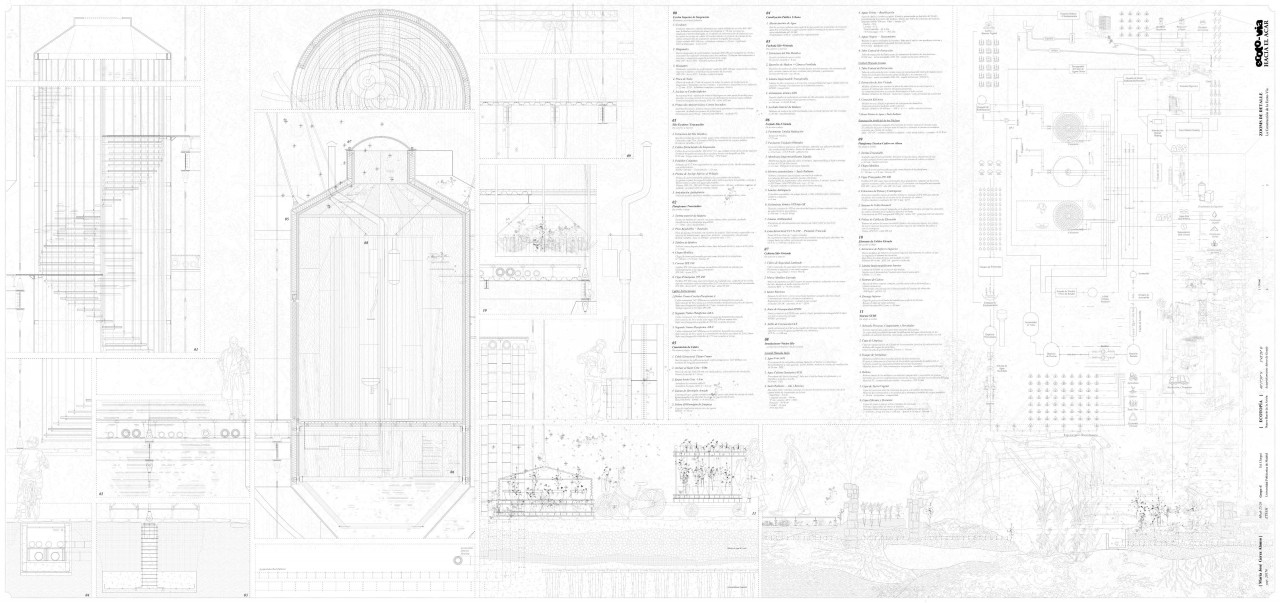
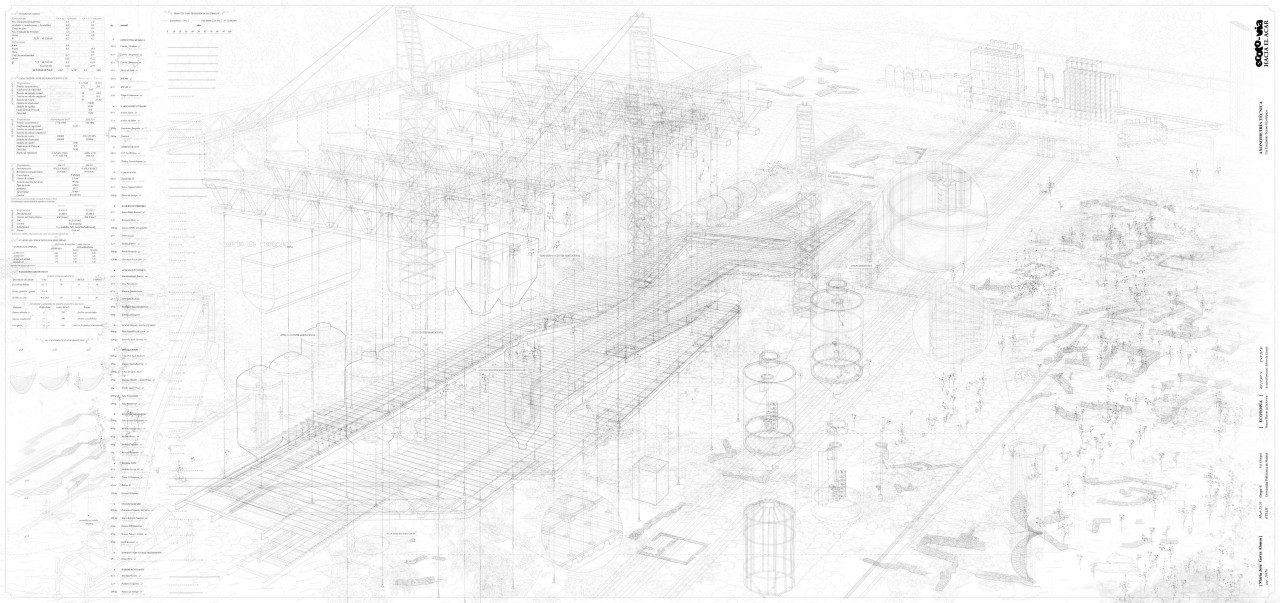
Across this regenerated landscape extends an almost two-kilometre-long linear infrastructure connecting ecological and productive nodes.
Its construction follows the same principle that defines the project:
to introduce as little new material as possible.
Rather than building, it assembles and reprogrammes.
Steel truss systems recovered from nearby industrial estates become structural supports.
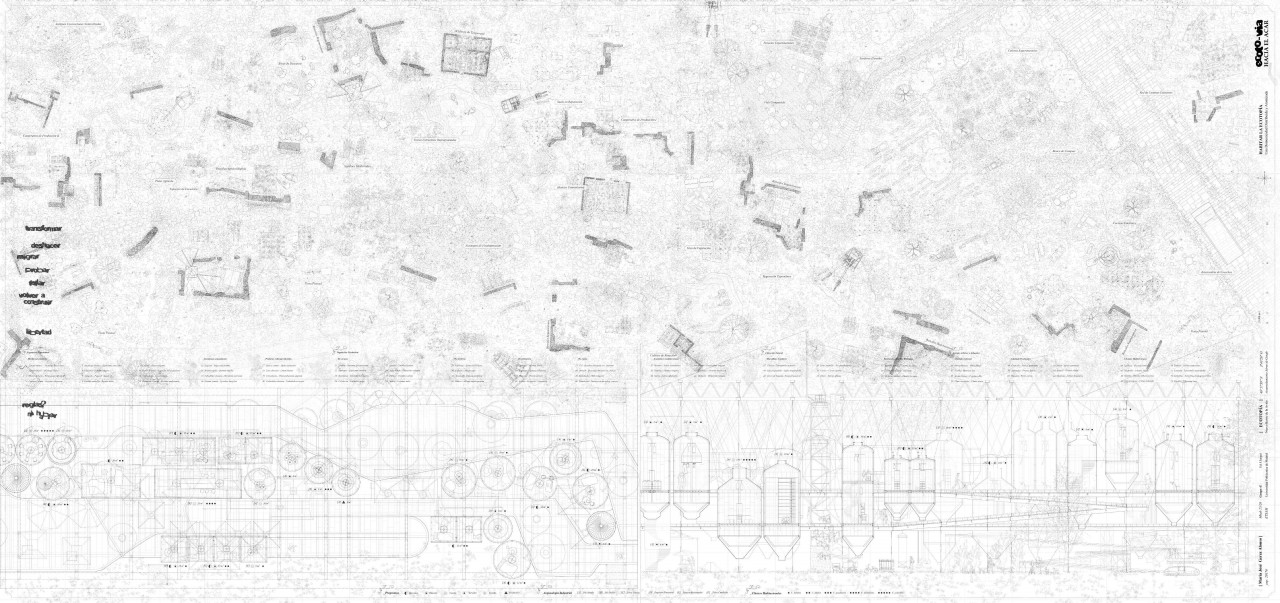
Former industrial silos are transformed into housing.
Existing warehouses accommodate new collective programmes.
Suspended post-industrial platforms stitched together by structural cables connect every component without significantly disturbing the regenerated ground.
The ready-made becomes architecture.
The Ecotopia accommodates an itinerant community of several hundred inhabitants participating in a shared system of production, exchange and care.
Yet inhabiting it does not simply mean occupying a dwelling.
It also means inhabiting the regenerated landscape itself.
Agricultural terraces restore Getafe's productive heritage while becoming spaces for cultivation, collective labour and everyday life.
Constructed wetlands and phytoremediation ponds regenerate water.
Sustainable drainage systems and pedestrian networks connect fields, infrastructure and existing buildings.
Even the excavation voids created during soil remediation become public spaces for gathering and rest.
The landscape is no longer the backdrop of the project.
It becomes one of its principal domestic spaces.
Housing therefore ceases to function as a self-contained unit.
Life unfolds within reprogrammed silos transformed into adaptable micro-dwellings of less than 30 square metres, organised around a central service core containing essential infrastructure.
Each capsule accommodates only one primary domestic programme:
sleeping, hygiene, productive work, shared services or collective facilities.
Neighbourhoods emerge not from individual houses or repetition, but from the aggregation of these specialised units.
Daily life is therefore organised through an atomised and Kitchenless domestic model.
Cooking no longer belongs to the private dwelling.
It becomes an entirely collective activity.
Food grown beneath The Line is prepared and shared above it, reconnecting production, preparation and consumption within a single territorial cycle.
To inhabit means to participate.
Participation unfolds continuously along The Line.
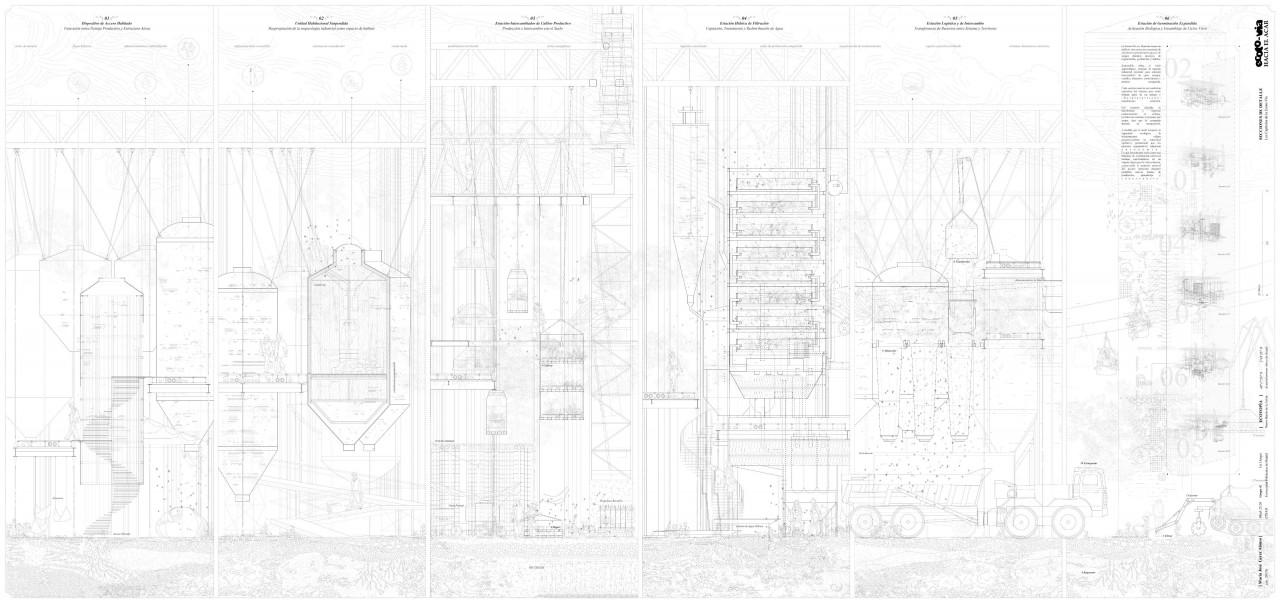
A sequence of specialised stations structures the Ecotopia:
Housing nodes,
productive platforms,
phytoremediation systems,
logistical exchanges,
research,
and exchange.
Each performs a specific role, yet all belong to one continuous metabolic chain.
Nothing disappears.
Everything is transformed.
Yet the most important condition of The Line is that it is conceived knowing that one day it will no longer be needed.
As the landscape progressively recovers its fertility and ecological autonomy, the infrastructure begins to withdraw.
Its components are dismantled, reused and relocated.
Architecture completes its task and steps aside.
Because the ambition was never to create a permanent object.
Its purpose was to restore the territory's capacity to sustain life.
The Ecoto-Vía therefore represents a transition.
A future in which industry ceases to be a source of contamination and becomes a resource...
and where progress is measured not by how much we are capable of building,
but by how much we are capable of regenerating.
There was a time when Getafe was divided in two.
Not by an explicit border, but by a silent fracture.
One half expanded relentlessly, while the other remained suspended in time, enclosed behind walls that no longer belonged to its history.
One half saturated; the other fertile.
One half exhausted; the other full of latent potential.
One half without soil; the other made entirely of it.
Until the city began to turn inward.
People approached the walls as if looking at a forbidden landscape.
They wanted to enter.
They wanted to breathe.
They longed for the landscape beyond.
When the boundary finally disappeared, it was not only the land that was released, but also a possibility.
Not the possibility of occupying it once again, but of repairing it.
Of understanding that damaged ground can breathe again, and that architecture does not necessarily have to impose itself upon the land, but rather accompany its recovery.
From this premise emerges a system capable of working with what already exists, repairing what has been damaged, and enabling new forms of life without erasing the accumulated layers of the territory.
Thus, The Line was born.
A lightweight, elevated and continuous structure crossing the former military airfield without imposing permanent weight upon the ground.
Because Getafe does not end where the city ends. It continues through what it consumes, what it discards and what it transforms, revealing the invisible infrastructures that sustain metropolitan life.
The Line does not simply connect places.
It connects cycles.
It retains, separates and reuses.
It makes visible what usually happens out of sight.
It does not land.
It accompanies.
It does not colonise.
It supports.
A territorial spine that allows contaminated and enclosed ground to breathe again while, above it, new forms of life emerge.
The Line does not touch in order to dominate.
It touches in order to care.
It becomes a territorial filter, interpreting flows before they disappear, continuously transforming private systems into collective ones.
Beneath it, the ground is not urbanised.
It is regenerated.
Where industrialisation and abandonment once prevailed, terraces, drainage systems and productive gardens appear.
Small autonomous machines move across the landscape like contemporary gardeners, removing contaminated soil, classifying it, remediating it and returning it clean to the ground.
They sow.
They irrigate.
They care.
Below, the land is cultivated, repaired and regenerated.
Above, life is produced and inhabited.
To inhabit this place means accepting change as a natural condition.
Just as the soil continuously transforms, housing also abandons its fixed and permanent condition. Domesticity is distributed across a shared infrastructure that reprogrammes inherited structures while reusing the silos left behind by the very industrial activity that once contaminated this territory.
The Line is simultaneously narrative, process and cycle:
Cleaning.
Cultivating.
Inhabiting.
Transforming.
Beginning again.
It reconciles industry and nature.
Machines and everyday life.
There is no longer a "good" half and a "bad" half.
There is only a living strip transforming the former boundary into a new centre.
The former military compound is no longer an empty void or a scar.
It becomes an infrastructure of care.
The Line does not enclose.
It invites.
Those who enter do so willingly:
to live by cultivating rather than consuming;
to produce by reusing rather than exploiting;
to inhabit by sustaining rather than defending.
This Ecotopia emerges from a condition increasingly present in contemporary cities.
For decades we have built according to the same logic:
growth,
occupation,
production.
This model has left behind vast latent territories:
former industrial, military and logistical landscapes suspended between what they once were and what they have yet to become.
At the same time, they face urgent challenges: the loss of fertile soil, contamination inherited from decades of industrial activity, dependence on external productive systems, and the growing separation between ecological cycles and everyday life.
These places are usually regarded as reserves for future urban expansion, when perhaps their greatest value lies precisely in not being occupied once again.
Can architecture become a tool for repair rather than occupation?
Can a degraded territory recover its ecological capacity without losing the memory of what it once was?
Can infrastructure generate new ways of inhabiting while accompanying ecological regeneration?
The ambition is no longer to build a machine for growth.
It is to build a machine for repair.
A new Way.
An Ecoto-Way towards the ACAR.
D
But if The Line is a path...
where does it lead?
The Line is simultaneously a route, a habitable infrastructure and a metabolic system.
It organises the ecological, productive and social processes required to regenerate the territory, transforming them into a new way of living while reinterpreting the metropolitan metabolism of the site itself.
Rather than proposing a distant utopia, the project reveals an ecotopia already latent within the hidden flows that sustain the contemporary metropolis.
The intervention does not conceal the ground.
It activates it.
The site is reincorporated into productive cycles through an archaeological logic that does not erase existing traces, but reactivates them.
Vegetation, paths and territorial layouts are preserved as the project's ecological framework.
Former military warehouses become spaces for research, production, storage and exchange.
Inherited industrial artefacts become part of a new territorial infrastructure.
Archaeology is no longer understood as a collection of static ruins.
It becomes an operative system.
Across this regenerated landscape extends an almost two-kilometre-long linear infrastructure connecting ecological and productive nodes.
Its construction follows the same principle that defines the project:
to introduce as little new material as possible.
Rather than building, it assembles and reprogrammes.
Steel truss systems recovered from nearby industrial estates become structural supports.
Former industrial silos are transformed into housing.
Existing warehouses accommodate new collective programmes.
Suspended post-industrial platforms stitched together by structural cables connect every component without significantly disturbing the regenerated ground.
The ready-made becomes architecture.
The Ecotopia accommodates an itinerant community of several hundred inhabitants participating in a shared system of production, exchange and care.
Yet inhabiting it does not simply mean occupying a dwelling.
It also means inhabiting the regenerated landscape itself.
Agricultural terraces restore Getafe's productive heritage while becoming spaces for cultivation, collective labour and everyday life.
Constructed wetlands and phytoremediation ponds regenerate water.
Sustainable drainage systems and pedestrian networks connect fields, infrastructure and existing buildings.
Even the excavation voids created during soil remediation become public spaces for gathering and rest.
The landscape is no longer the backdrop of the project.
It becomes one of its principal domestic spaces.
Housing therefore ceases to function as a self-contained unit.
Life unfolds within reprogrammed silos transformed into adaptable micro-dwellings of less than 30 square metres, organised around a central service core containing essential infrastructure.
Each capsule accommodates only one primary domestic programme:
sleeping, hygiene, productive work, shared services or collective facilities.
Neighbourhoods emerge not from individual houses or repetition, but from the aggregation of these specialised units.
Daily life is therefore organised through an atomised and Kitchenless domestic model.
Cooking no longer belongs to the private dwelling.
It becomes an entirely collective activity.
Food grown beneath The Line is prepared and shared above it, reconnecting production, preparation and consumption within a single territorial cycle.
To inhabit means to participate.
Participation unfolds continuously along The Line.
A sequence of specialised stations structures the Ecotopia:
Housing nodes,
productive platforms,
phytoremediation systems,
logistical exchanges,
research,
and exchange.
Each performs a specific role, yet all belong to one continuous metabolic chain.
Nothing disappears.
Everything is transformed.
Yet the most important condition of The Line is that it is conceived knowing that one day it will no longer be needed.
As the landscape progressively recovers its fertility and ecological autonomy, the infrastructure begins to withdraw.
Its components are dismantled, reused and relocated.
Architecture completes its task and steps aside.
Because the ambition was never to create a permanent object.
Its purpose was to restore the territory's capacity to sustain life.
The Ecoto-Vía therefore represents a transition.
A future in which industry ceases to be a source of contamination and becomes a resource...
and where progress is measured not by how much we are capable of building,
but by how much we are capable of regenerating.
- 00 - Description
- 01 - Ecoto-Via
- 02 - Utopia ??
- 03 - Atlas_LatentEcotopia
- 04 - Saturated_Context
- 05 - Ecotopian_Site
- 06 - Ecotopia
- 07 - Regenerated_Ground
- 08 - Archaeolog_Dwelling
- 09 - Metabolic_Chain
- 10 - PostIndustr_Machine
- 11 - Arch_ReadyMade
- 12 - Metabolic_Stations
- 13 - Construction_System
- 14 - Techn-eco_Assemblage
- 15 - Ecological_Epilogue
- 16 - References_Catalogue
- 17 - Video