
FLABELLUM
The lack of infrastructure hinders the development of industry, so employment is scarce. This lack of employment favours the rural exodus. Young people leave the village for the city and consequently the population ages, and as the population decreases, services are reduced. All this triggers a crisis that culminates in the abandonment and disappearance of the municipality. We are talking about Empty Spain. Despite the citizens' movements and platforms that have arisen, the problem continues to this day and the villages continue to disappear.
After the visit to the site, the territory and its structure are analysed and several cartographies are made.
The project takes place in Valpuesta, a small village located on the border between Burgos and Álava, with a census of 14 inhabitants, although the actual number of inhabitants is higher due to second homes.
Its landscape is dominated by green valleys, deep forests and large mountains. On the other hand, Valpuesta is the true birthplace of Castilian.
From an architectural point of view, its great collegiate church and a defensive tower with its parade ground stand out.
Great value is found in the surroundings of the Abandoned Tower.
It is in this context that Flabellum was born, a project that recovers and modifies this environment with the creation of a housing complex and a Food Management laboratory that aims to help relaunch the lost agriculture in the area.
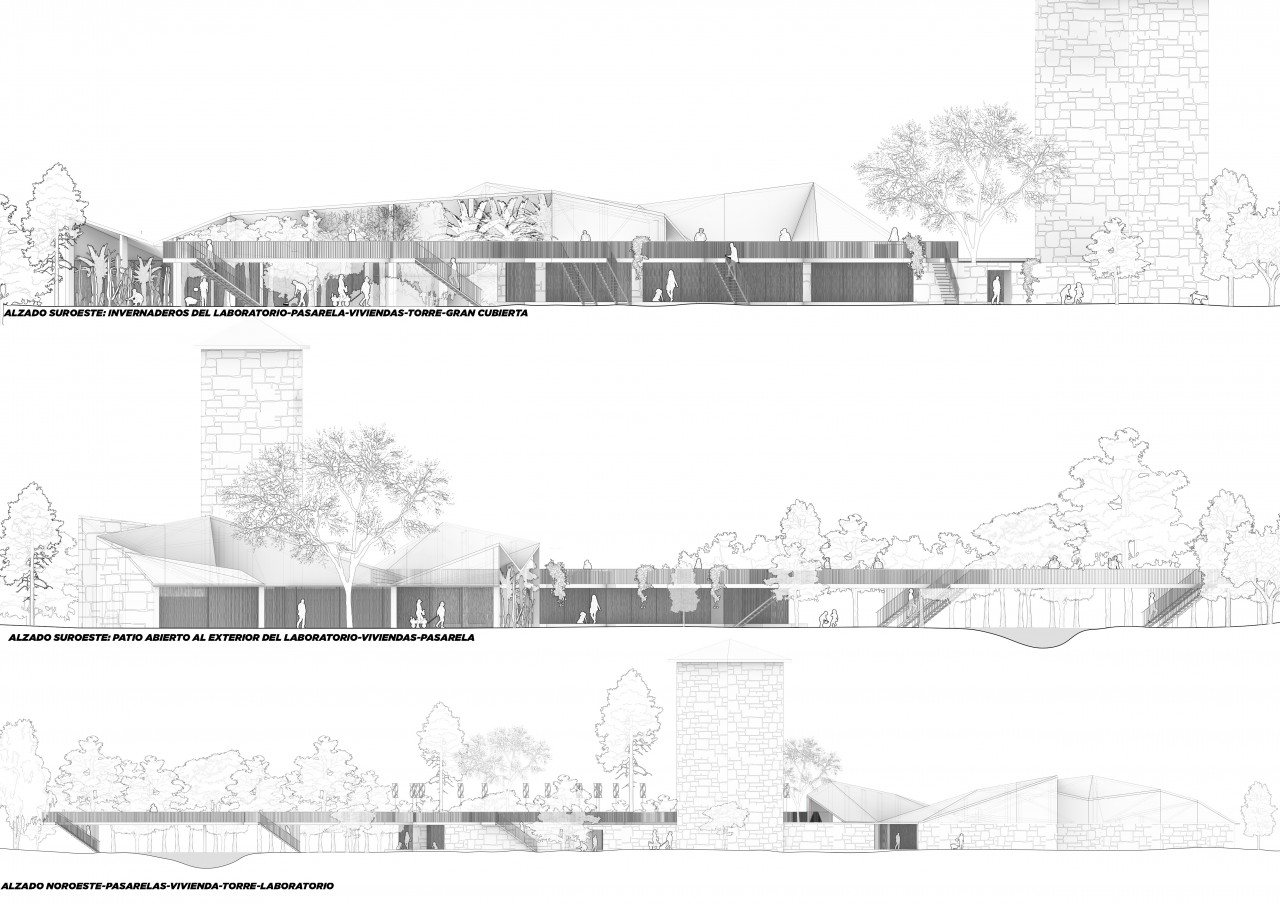
The project begins with the removal of part of the wall of the parade ground and plays with the pre-existence, linking the defensive complex with the Mioma Stream through a fan-shaped floor plan structured into different segments, different sectors. This allows for a dynamic vision, with all the dwellings opening either onto the stream or onto the parade ground. The triangulation of the floor plan has an added advantage: the privacy of each of the dwellings, as none of them face each other.
Behind the last dwelling is a new gajo (which houses the laboratory) following the same geometry in principle. This geometry is broken as the laboratory takes on its own shape. It is made up of two interconnected wings which, when joined together, extend the parade ground (of a private nature) and form a new public courtyard, open to the landscape. The west wing, closer to the stream, blends in with nature by means of a greenhouse. The east wing is closed to the village by a stone wall that gives continuity to the tower, forming a homogeneous elevation. The shape of the roof is noteworthy, as it is similar to the profile of the mountains that dominate the landscape.
The dwellings are for the laboratory workers. Each sector or gajo occupies two dwellings separated by a small interior courtyard that facilitates cross ventilation, provides greater luminosity to the interior and defines a plant urn. In addition, the respective bathrooms are located around the courtyard, which allows them to have natural light and ventilation. The interior space is open-plan and versatile, given that the perimeter is inhabited by means of the fitted wall. The transition between the interior and exterior space is resolved by means of folding doors that give a panoramic view of the landscape and can be attenuated by bamboo screens that form an ethereal limit.
Finally, the roof of the dwellings is made walkable and communal, allowing the programme to emerge according to the needs of the moment. From this, footbridges emerge that fly over the stream and allow passage between the areas separated by the stream. These walkways are also accessible from level 0 via stairs.
To complete the project, the interior space of the Tower is rehabilitated by creating different levels, different social spaces with double and triple height, which gives it a greater spatiality.
In short, this is a project that connects the new architecture with the old tower, allowing access to the forest separated by the stream and recovering the emblem of the tower by changing its profile and replacing the old wall with a new front featuring the architecture of the dwellings and the laboratory.
After the visit to the site, the territory and its structure are analysed and several cartographies are made.
The project takes place in Valpuesta, a small village located on the border between Burgos and Álava, with a census of 14 inhabitants, although the actual number of inhabitants is higher due to second homes.
Its landscape is dominated by green valleys, deep forests and large mountains. On the other hand, Valpuesta is the true birthplace of Castilian.
From an architectural point of view, its great collegiate church and a defensive tower with its parade ground stand out.
Great value is found in the surroundings of the Abandoned Tower.
It is in this context that Flabellum was born, a project that recovers and modifies this environment with the creation of a housing complex and a Food Management laboratory that aims to help relaunch the lost agriculture in the area.
The project begins with the removal of part of the wall of the parade ground and plays with the pre-existence, linking the defensive complex with the Mioma Stream through a fan-shaped floor plan structured into different segments, different sectors. This allows for a dynamic vision, with all the dwellings opening either onto the stream or onto the parade ground. The triangulation of the floor plan has an added advantage: the privacy of each of the dwellings, as none of them face each other.
Behind the last dwelling is a new gajo (which houses the laboratory) following the same geometry in principle. This geometry is broken as the laboratory takes on its own shape. It is made up of two interconnected wings which, when joined together, extend the parade ground (of a private nature) and form a new public courtyard, open to the landscape. The west wing, closer to the stream, blends in with nature by means of a greenhouse. The east wing is closed to the village by a stone wall that gives continuity to the tower, forming a homogeneous elevation. The shape of the roof is noteworthy, as it is similar to the profile of the mountains that dominate the landscape.
The dwellings are for the laboratory workers. Each sector or gajo occupies two dwellings separated by a small interior courtyard that facilitates cross ventilation, provides greater luminosity to the interior and defines a plant urn. In addition, the respective bathrooms are located around the courtyard, which allows them to have natural light and ventilation. The interior space is open-plan and versatile, given that the perimeter is inhabited by means of the fitted wall. The transition between the interior and exterior space is resolved by means of folding doors that give a panoramic view of the landscape and can be attenuated by bamboo screens that form an ethereal limit.
Finally, the roof of the dwellings is made walkable and communal, allowing the programme to emerge according to the needs of the moment. From this, footbridges emerge that fly over the stream and allow passage between the areas separated by the stream. These walkways are also accessible from level 0 via stairs.
To complete the project, the interior space of the Tower is rehabilitated by creating different levels, different social spaces with double and triple height, which gives it a greater spatiality.
In short, this is a project that connects the new architecture with the old tower, allowing access to the forest separated by the stream and recovering the emblem of the tower by changing its profile and replacing the old wall with a new front featuring the architecture of the dwellings and the laboratory.




- 00 - Description
- 01 - ÁNALISIS
- 02 - DIAGRAMAS
- 03 - PLANTA DELCONJUNTO
- 04 - ALZADOS
- 05 - INTERIOR
- 06 - NUEVOFRENTEDELATORRE
- 07 - VIVIENDA Y PASARELA
- 08 - ESPACIOSOCIALESTORRE
- 09 - DETALLES MAQUETA
- 10 - MAQUETA
- 11 - Video