
HORIZONTE ONDULADO
"The Undulating Horizon" is an architectural and landscape proposal located at Mallón Beach, in the north of Arousa Island, based on a fundamental premise: not to build over the landscape, but to repair it. In this site, marked by the legacy of industry—where two former factories once discharged waste into the sea—the project emerges as a gesture of environmental, cultural, and social restoration.
The intervention begins with a process of cleaning and demolishing the polluting structures, viewing these scars on the land as an opportunity to establish a new way of inhabiting the site. From there, the project takes shape as a museum of Galician naval history whose mission is not only to preserve and exhibit, but also to regenerate the territory, revitalize local culture, and reestablish the bond between people, the sea, and the forest.
The first gesture is a landscape one: a reforestation with native species—maritime pine and eucalyptus—that restores density to the ecosystem and activates new ecological relationships. The architecture, far from interrupting this process, adapts to it. It rises on stilts, lifting itself from the ground and allowing vegetation to grow between its elements, letting the terrain breathe freely.
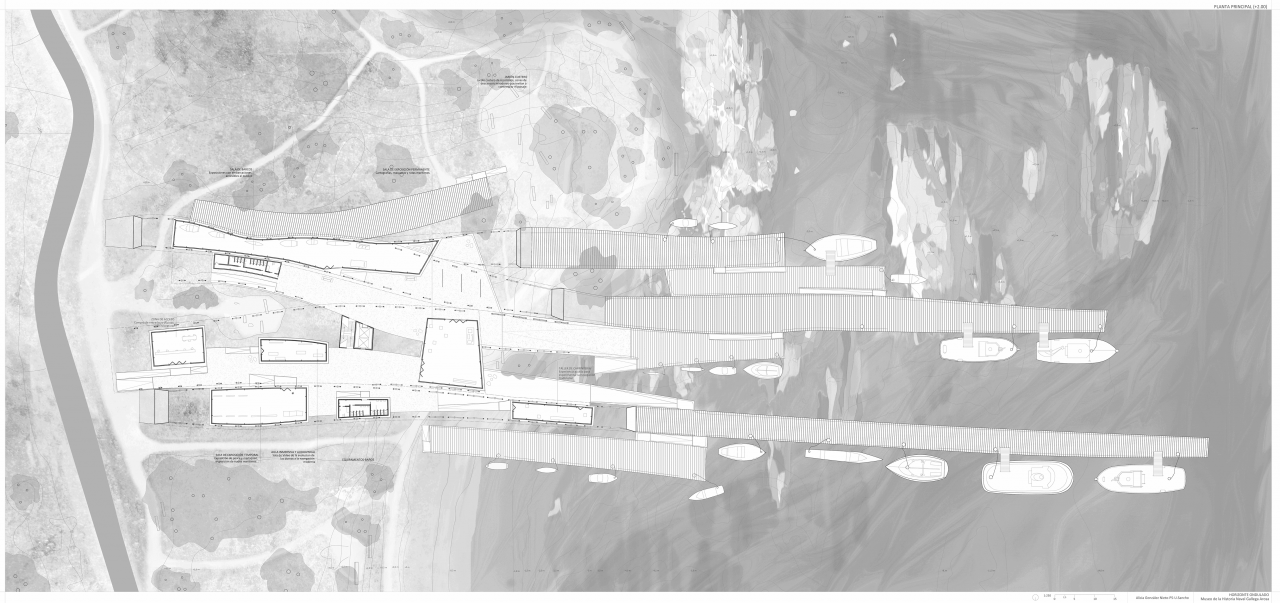
The project is organized into three superimposed planes: the ground plane, where a garden of pathways guides visitors through natural spaces from the forest to the sea; an intermediate plane, formed by elevated platforms that house the various museum rooms and services; and an upper plane, consisting of curved walkable roofs that blend into the landscape. These culminate in piers projecting over the water, where the "boat garden" is located—an open-air exhibition space with real boats of different sizes and eras.
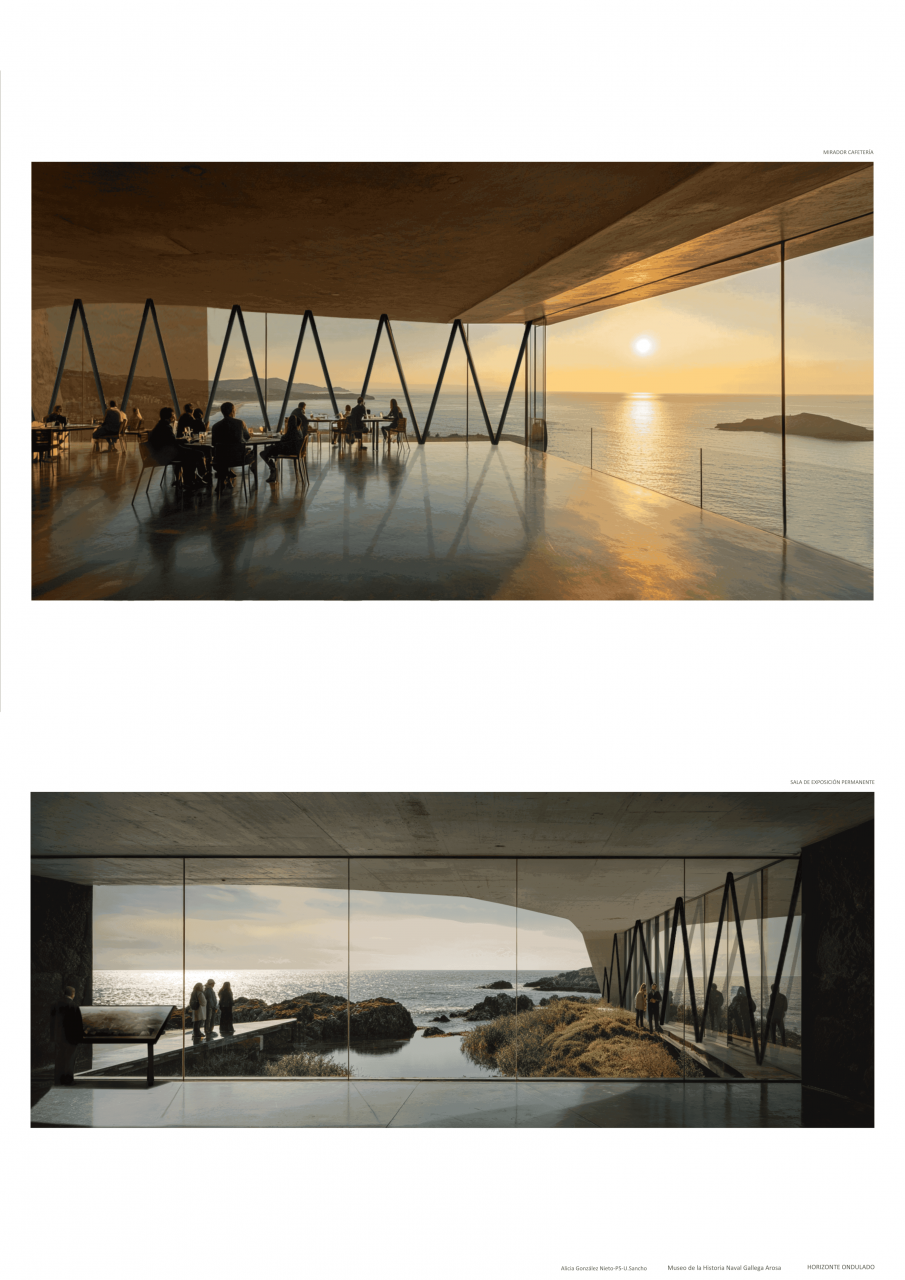
In plan, the architecture is expressed through interwoven bands that adapt to the topography, generating covered and uncovered, interior and exterior spaces. The façades, mostly glazed, are designed to maintain a constant and direct relationship with the surroundings.
More than a building, the museum is conceived as a journey. Every space—from the exhibition halls to the auditorium or the café-viewpoint—forms part of a fluid experience, always open to the landscape.
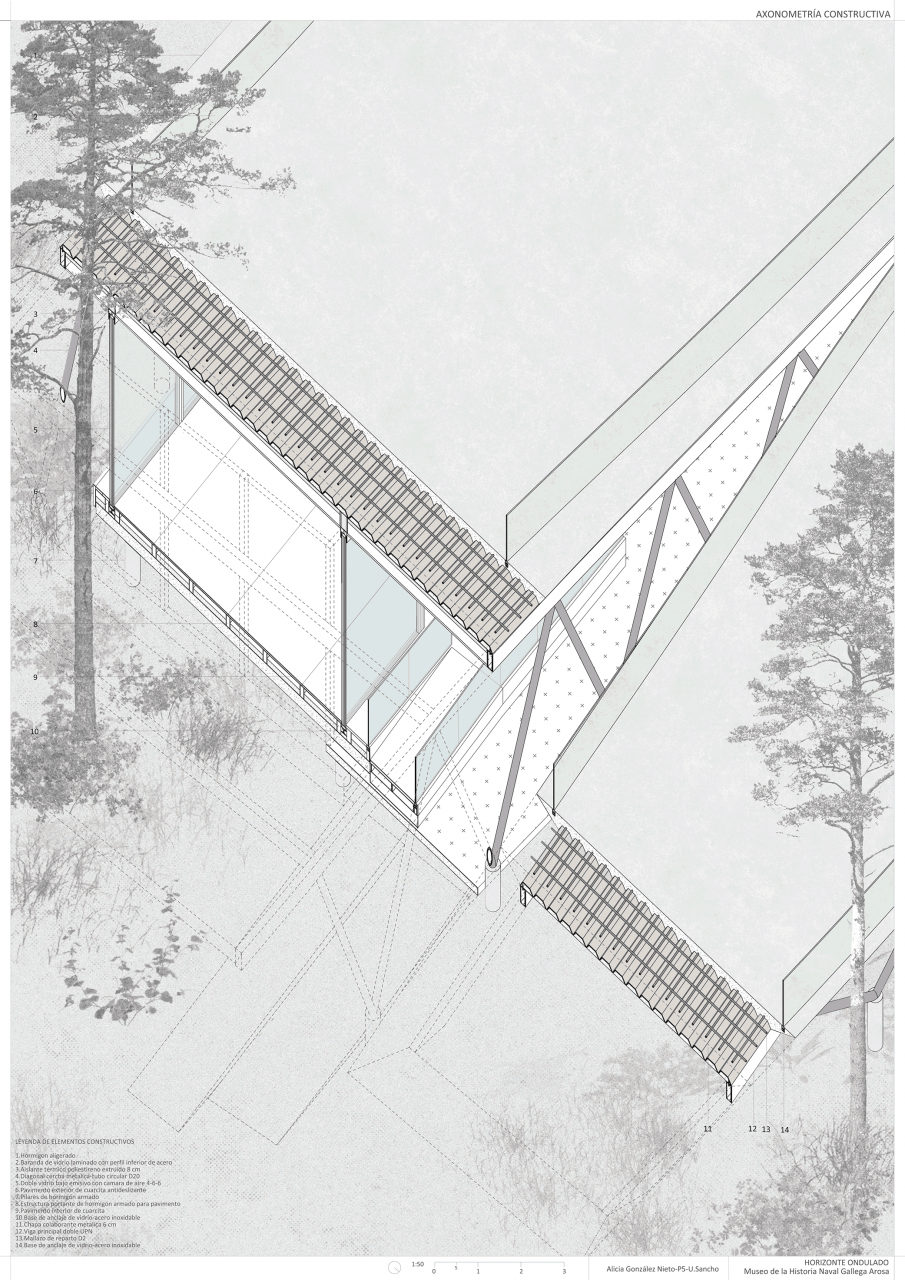
The structure reinforces this idea of lightness and integration: metal trusses and concrete piles minimize contact with the ground, while on the piers, the wooden structure evokes the traditional Galician stilt houses, reducing visual impact on the sea.
"The Undulating Horizon" does not seek to impose itself on the territory, but to engage in dialogue with it. Vegetation passes through it, visitors traverse it, and the architecture accompanies them, framing the landscape without ever enclosing it.
The intervention begins with a process of cleaning and demolishing the polluting structures, viewing these scars on the land as an opportunity to establish a new way of inhabiting the site. From there, the project takes shape as a museum of Galician naval history whose mission is not only to preserve and exhibit, but also to regenerate the territory, revitalize local culture, and reestablish the bond between people, the sea, and the forest.
The first gesture is a landscape one: a reforestation with native species—maritime pine and eucalyptus—that restores density to the ecosystem and activates new ecological relationships. The architecture, far from interrupting this process, adapts to it. It rises on stilts, lifting itself from the ground and allowing vegetation to grow between its elements, letting the terrain breathe freely.
The project is organized into three superimposed planes: the ground plane, where a garden of pathways guides visitors through natural spaces from the forest to the sea; an intermediate plane, formed by elevated platforms that house the various museum rooms and services; and an upper plane, consisting of curved walkable roofs that blend into the landscape. These culminate in piers projecting over the water, where the "boat garden" is located—an open-air exhibition space with real boats of different sizes and eras.
In plan, the architecture is expressed through interwoven bands that adapt to the topography, generating covered and uncovered, interior and exterior spaces. The façades, mostly glazed, are designed to maintain a constant and direct relationship with the surroundings.
More than a building, the museum is conceived as a journey. Every space—from the exhibition halls to the auditorium or the café-viewpoint—forms part of a fluid experience, always open to the landscape.
The structure reinforces this idea of lightness and integration: metal trusses and concrete piles minimize contact with the ground, while on the piers, the wooden structure evokes the traditional Galician stilt houses, reducing visual impact on the sea.
"The Undulating Horizon" does not seek to impose itself on the territory, but to engage in dialogue with it. Vegetation passes through it, visitors traverse it, and the architecture accompanies them, framing the landscape without ever enclosing it.




- 00 - Description
- 01 - Context and Program
- 02 - Main Floor Plan
- 03 - 1st / 2st Floor Plan
- 04 - Longitudinal Section
- 05 - Cross Sections
- 06 - Communication sectio
- 07 - Exploded Axonometry
- 08 - Constructive Axo
- 09 - Photomontages
- 10 - Images