
HyperBricoleur
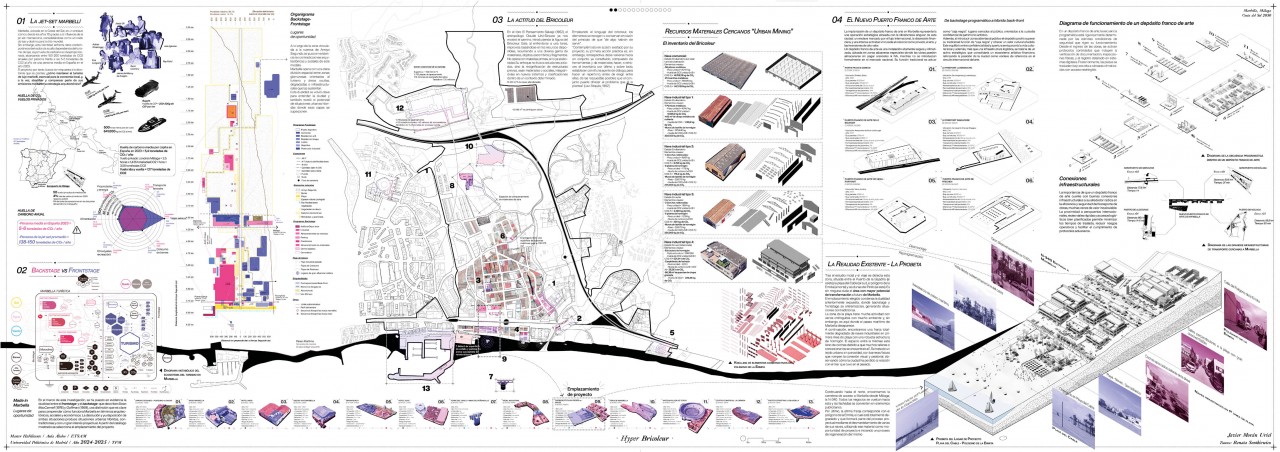
Since the 1970s, Marbella has become an emblematic international luxury destination, shaped by the presence of the global jet set. However, behind this glamorous image lies a more complex urban and social reality. Drawing on Dean MacCannell’s theory of frontstage and backstage, the project investigates the contradictions between Marbella’s tourist-oriented facades and the hidden infrastructural zones that sustain them. These tensions reveal a valuable design opportunity in the hybrid spaces where both realities coexist.
The chosen site—between the Ermita industrial estate and the Bajadilla port—perfectly encapsulates these contradictions. A degraded beachfront lined with obsolete warehouses and tourist beach bars is fragmented by physical and natural barriers, yet its location by Cable Beach offers strong regenerative potential. Previous large-scale redevelopment projects proposed total demolition and the imposition of generic models, but were later overturned by the courts. In contrast, this proposal takes a different approach: instead of erasing what exists, it seeks to work with it, reinterpreting and reprogramming the pre-existing material and spatial conditions.
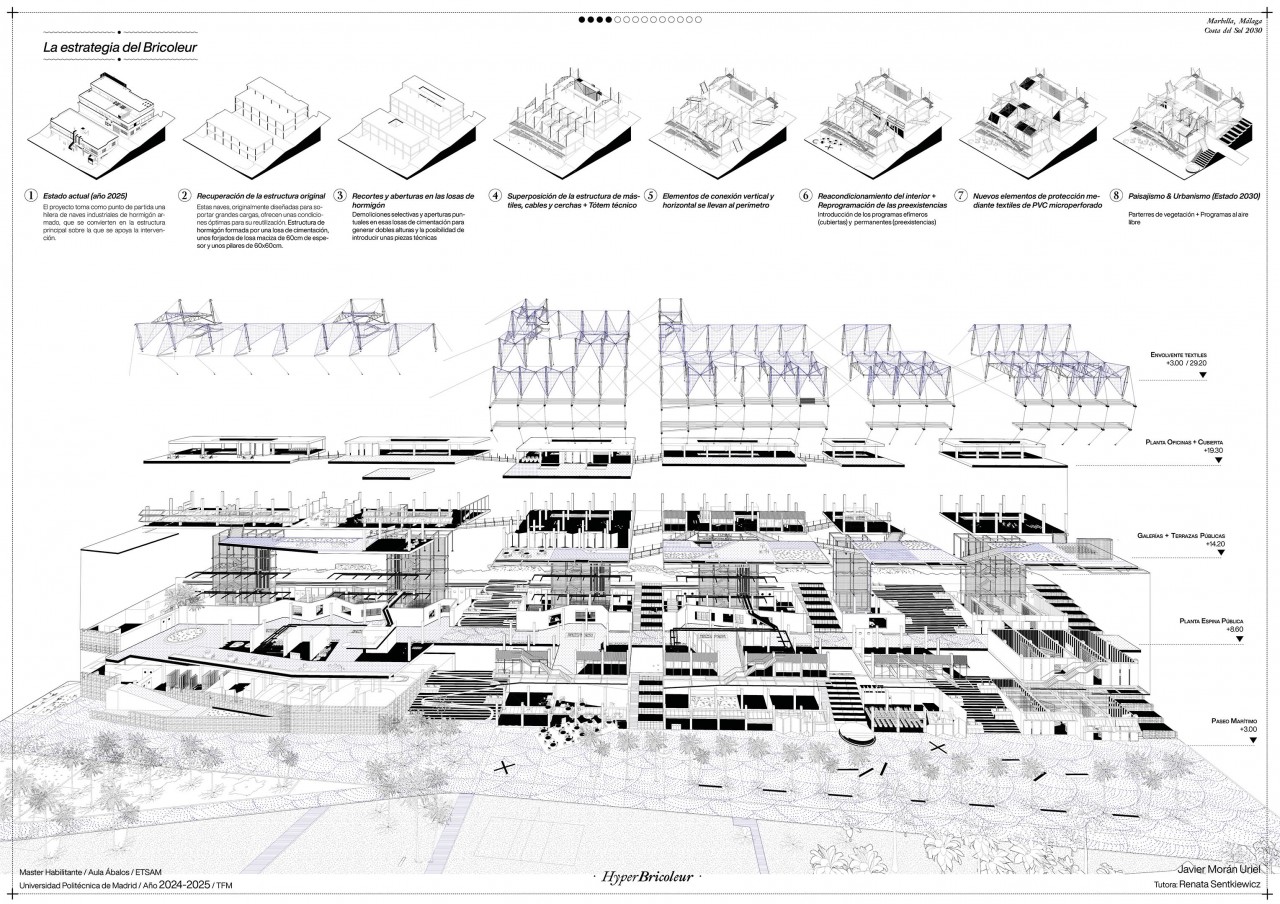
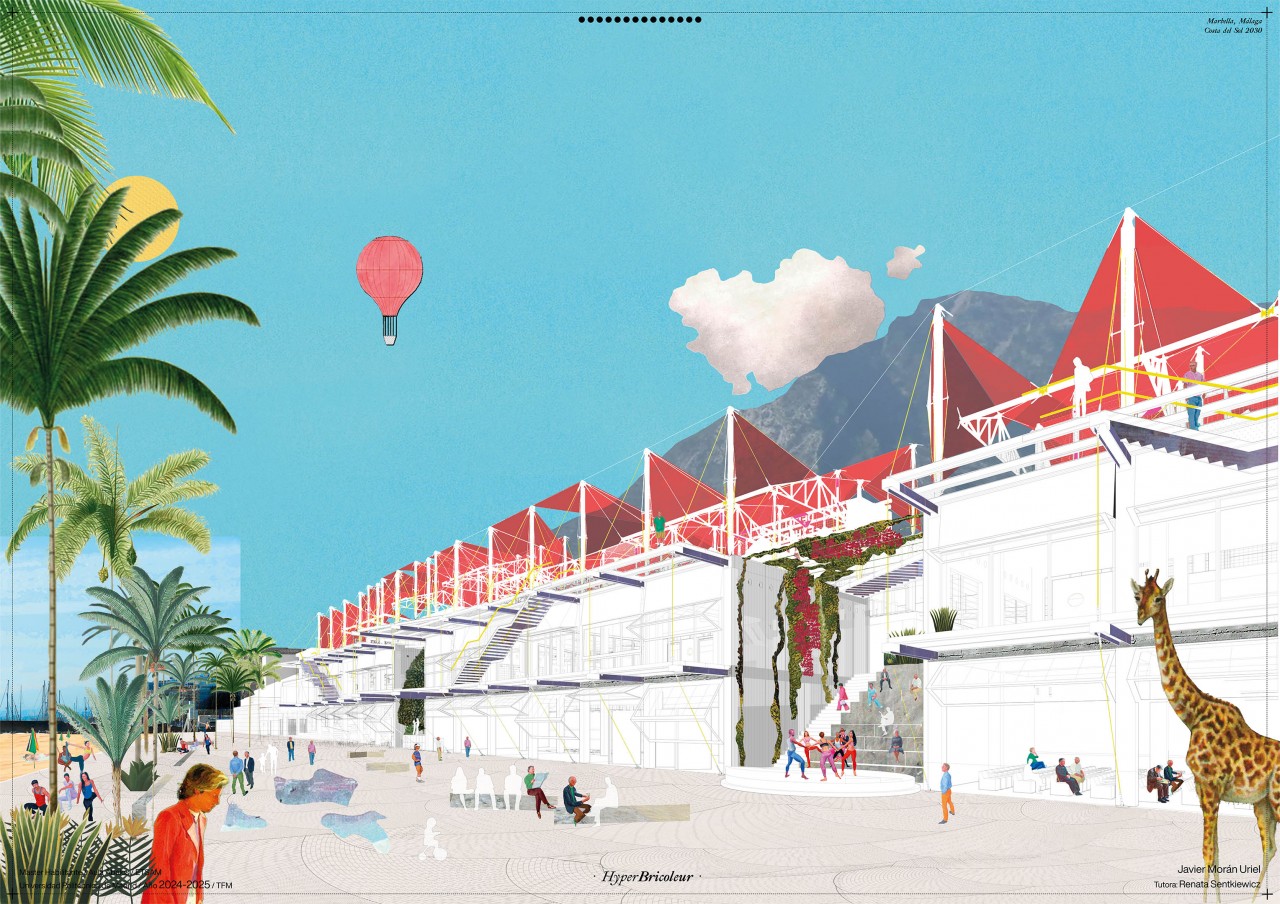
Inspired by Claude Lévi-Strauss’s figure of the Bricoleur, the project embraces improvisation and reuse. It does not start from scratch, but from the debris, materials, and fragments already present. The existing industrial structures are preserved and adapted, punctured to introduce new vertical circulation and technical cores while maintaining their load-bearing capacity. These new totems serve functional and symbolic roles—channeling utilities, guiding movement, and displaying content to the city.
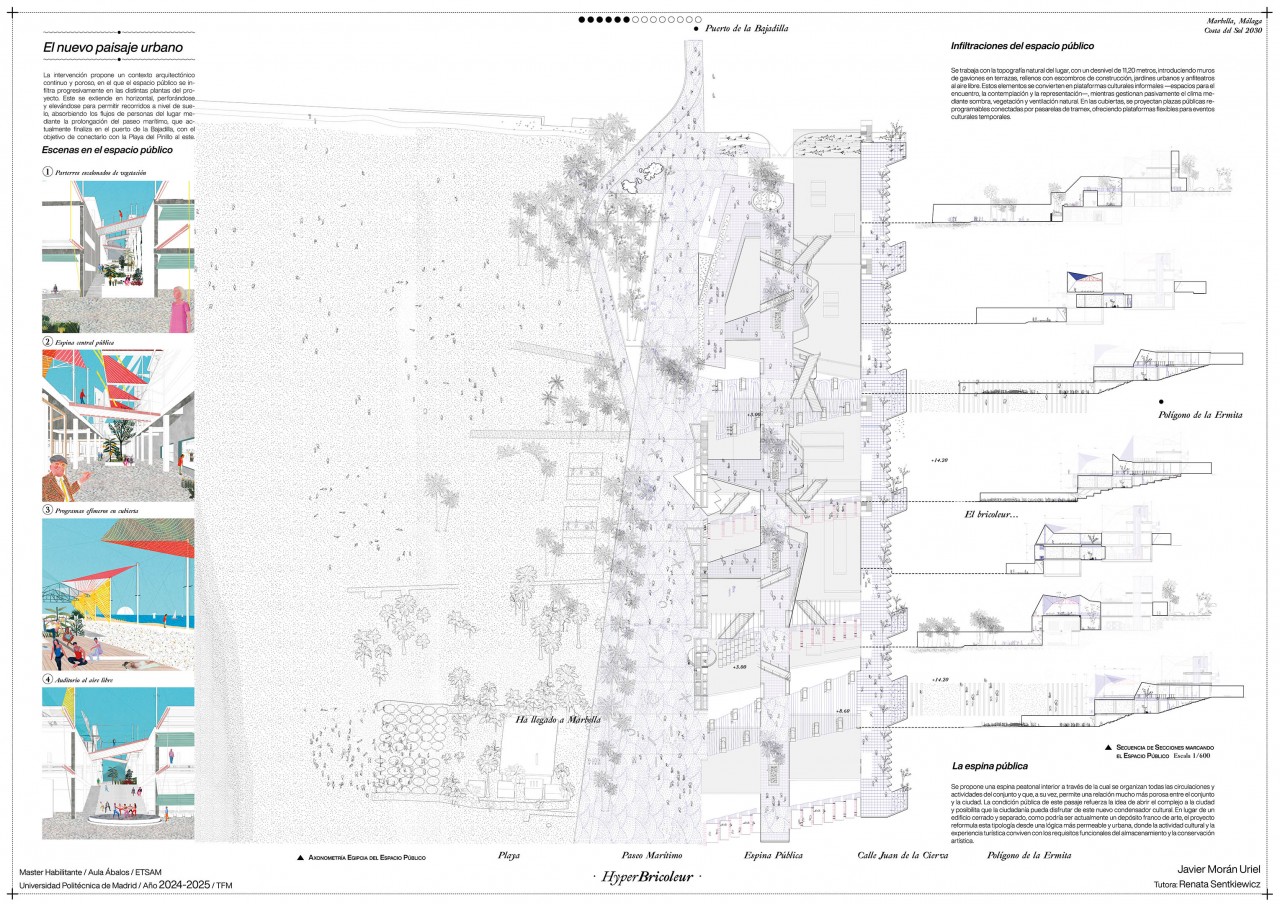
To complement this, a lightweight tensile structure made from reused elements—steel cables, masts, and scaffolding—spans above, supported on the original column grid. It creates shaded, open-air areas without central supports, thanks to flexible trusses and tension-only systems. Circulations and public accesses are redistributed to the periphery, integrating walkways and terraces. Public space gradually infiltrates the building, culminating in rooftop plazas that dissolve the boundaries between inside and outside.
Programmatically, the project introduces a reinterpretation of the art freeport—typically a hidden, exclusive space for high-value storage—by layering cultural and leisure functions on top of its secure infrastructure. Maintaining its fiscal and security protocols, this hybrid typology becomes a cultural engine: a place where the flows of art and people can coexist, where logistical precision meets urban vitality.
Rather than a singular intervention, HyperBricoleur acts as a catalyst within a broader urban strategy. Through local material cycles and urban mining, it aims to progressively activate the Ermita district, transforming it into a cultural and social node. Its architectural language leverages the potential of the existing warehouses, adapting their robust frames to new uses while minimizing environmental impact through passive thermal strategies and the use of thermal mass.
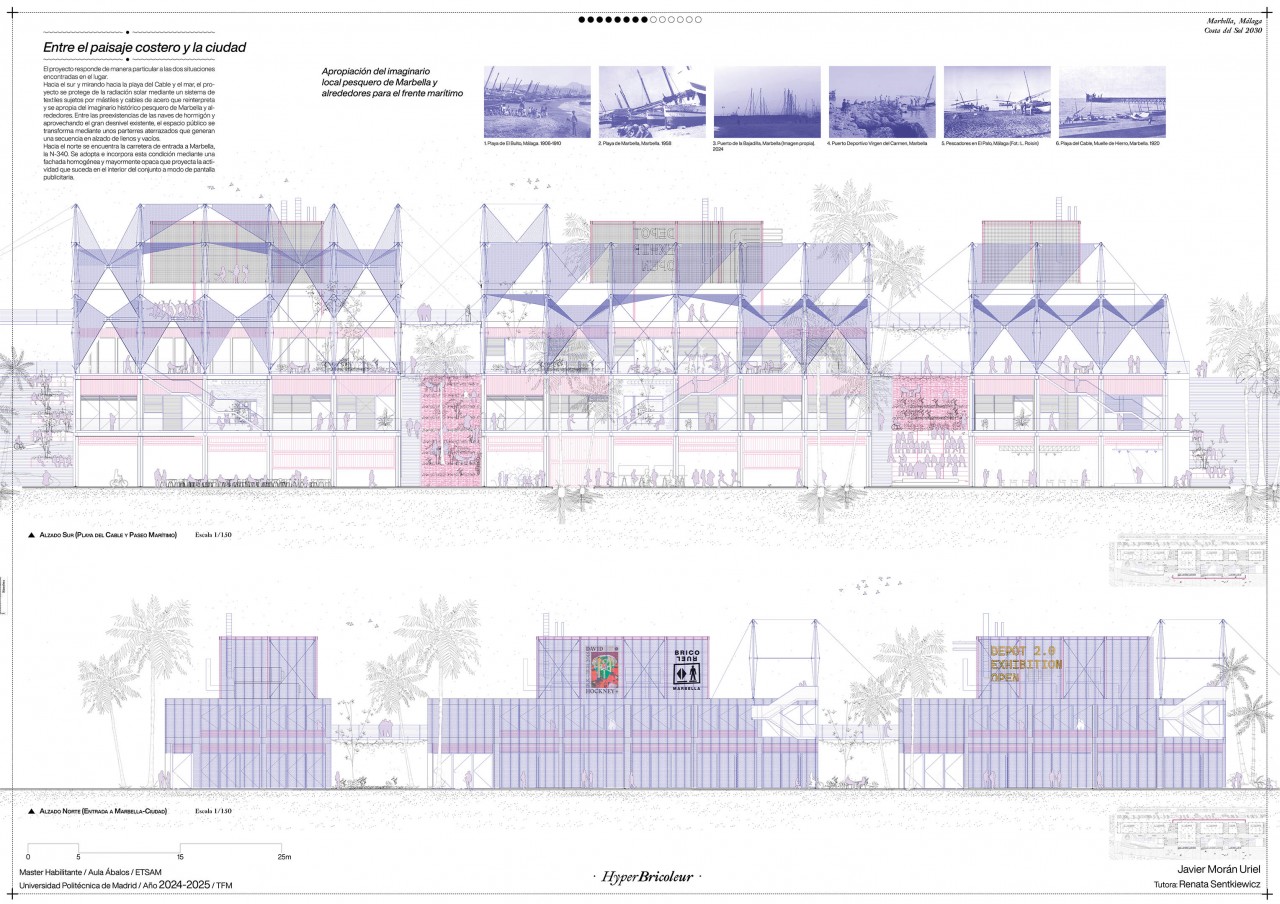
The building presents two distinct faces: an open, fragmented side that embraces the sea and local fishing heritage, and a closed, bold façade facing the main road, communicating its internal activity. This duality reflects the project's essence—a thermal machine that transitions from public to protected, from lightweight to massive, optimizing comfort and energy efficiency.
Through lightweight, reversible strategies that are mindful of the existing material landscape, the Bricoleur creates a dialogue with the surroundings—not nostalgic but deeply rooted in the site’s identity. It is in this layering—constructive, cultural, historical—that the architectural project takes shape.This is not a conservation project, nor entirely new architecture. Two conditions that are usually kept apart are here brought into a state of continuous interaction. The original structure is retained as a trace and support, while new lightweight elements activate it, change its function, and rewrite its character.
In this dialogue between what remains and what is superimposed, the project redefines Marbella’s waterfront and proposes a new way of inhabiting the coast.
The role of the architect has evolved... the Bricoleur emerges.
The chosen site—between the Ermita industrial estate and the Bajadilla port—perfectly encapsulates these contradictions. A degraded beachfront lined with obsolete warehouses and tourist beach bars is fragmented by physical and natural barriers, yet its location by Cable Beach offers strong regenerative potential. Previous large-scale redevelopment projects proposed total demolition and the imposition of generic models, but were later overturned by the courts. In contrast, this proposal takes a different approach: instead of erasing what exists, it seeks to work with it, reinterpreting and reprogramming the pre-existing material and spatial conditions.
Inspired by Claude Lévi-Strauss’s figure of the Bricoleur, the project embraces improvisation and reuse. It does not start from scratch, but from the debris, materials, and fragments already present. The existing industrial structures are preserved and adapted, punctured to introduce new vertical circulation and technical cores while maintaining their load-bearing capacity. These new totems serve functional and symbolic roles—channeling utilities, guiding movement, and displaying content to the city.
To complement this, a lightweight tensile structure made from reused elements—steel cables, masts, and scaffolding—spans above, supported on the original column grid. It creates shaded, open-air areas without central supports, thanks to flexible trusses and tension-only systems. Circulations and public accesses are redistributed to the periphery, integrating walkways and terraces. Public space gradually infiltrates the building, culminating in rooftop plazas that dissolve the boundaries between inside and outside.
Programmatically, the project introduces a reinterpretation of the art freeport—typically a hidden, exclusive space for high-value storage—by layering cultural and leisure functions on top of its secure infrastructure. Maintaining its fiscal and security protocols, this hybrid typology becomes a cultural engine: a place where the flows of art and people can coexist, where logistical precision meets urban vitality.
Rather than a singular intervention, HyperBricoleur acts as a catalyst within a broader urban strategy. Through local material cycles and urban mining, it aims to progressively activate the Ermita district, transforming it into a cultural and social node. Its architectural language leverages the potential of the existing warehouses, adapting their robust frames to new uses while minimizing environmental impact through passive thermal strategies and the use of thermal mass.
The building presents two distinct faces: an open, fragmented side that embraces the sea and local fishing heritage, and a closed, bold façade facing the main road, communicating its internal activity. This duality reflects the project's essence—a thermal machine that transitions from public to protected, from lightweight to massive, optimizing comfort and energy efficiency.
Through lightweight, reversible strategies that are mindful of the existing material landscape, the Bricoleur creates a dialogue with the surroundings—not nostalgic but deeply rooted in the site’s identity. It is in this layering—constructive, cultural, historical—that the architectural project takes shape.This is not a conservation project, nor entirely new architecture. Two conditions that are usually kept apart are here brought into a state of continuous interaction. The original structure is retained as a trace and support, while new lightweight elements activate it, change its function, and rewrite its character.
In this dialogue between what remains and what is superimposed, the project redefines Marbella’s waterfront and proposes a new way of inhabiting the coast.
The role of the architect has evolved... the Bricoleur emerges.





- 00 - Description
- 01 - La
- 02 - figura
- 03 - del
- 04 - arquitecto
- 05 - ha
- 06 - evolucionado
- 07 - .
- 08 - ...
- 09 - .
- 10 - Surge
- 11 - el
- 12 - Bricoleur
- 13 - ¡Y llegó a Marbella!
- 14 - Video