
IN MEMORIAM
The resting place of the dead is the foundation on which the living now depend.
In a world where excessive expansion threatens to erase collective memory, this architectural work stands as a monument to resilience where the past and the future, the earthly and the spiritual, the living and the dead coexist.
We are located in the Philippines, where building density and land occupation have spread in an invasive manner, due to overpopulation and poverty throughout the country. Illegal constructions and settlements have colonized public spaces intended for the enjoyment and activity of citizens. Even cemeteries, places of eternal rest, have become a refuge for the living.
Entire families live among mausoleums and tombs in the Manila cemetery. This community prefers the relative tranquility and safety of this place to the dangerous squatter settlements of the city. They live among makeshift structures and overcrowded graves and face significant problems of space and quality demanding an urgent solution.
In the city of Iloilo, located on the island of Panay, an analogous situation is anticipated in the coming years about the availability of space and the eventual invasion of a community, stemming from the overflowing growth that the territory is experiencing. Faced with this urban metamorphosis, the need arises to address this convergence between the living and the dead.
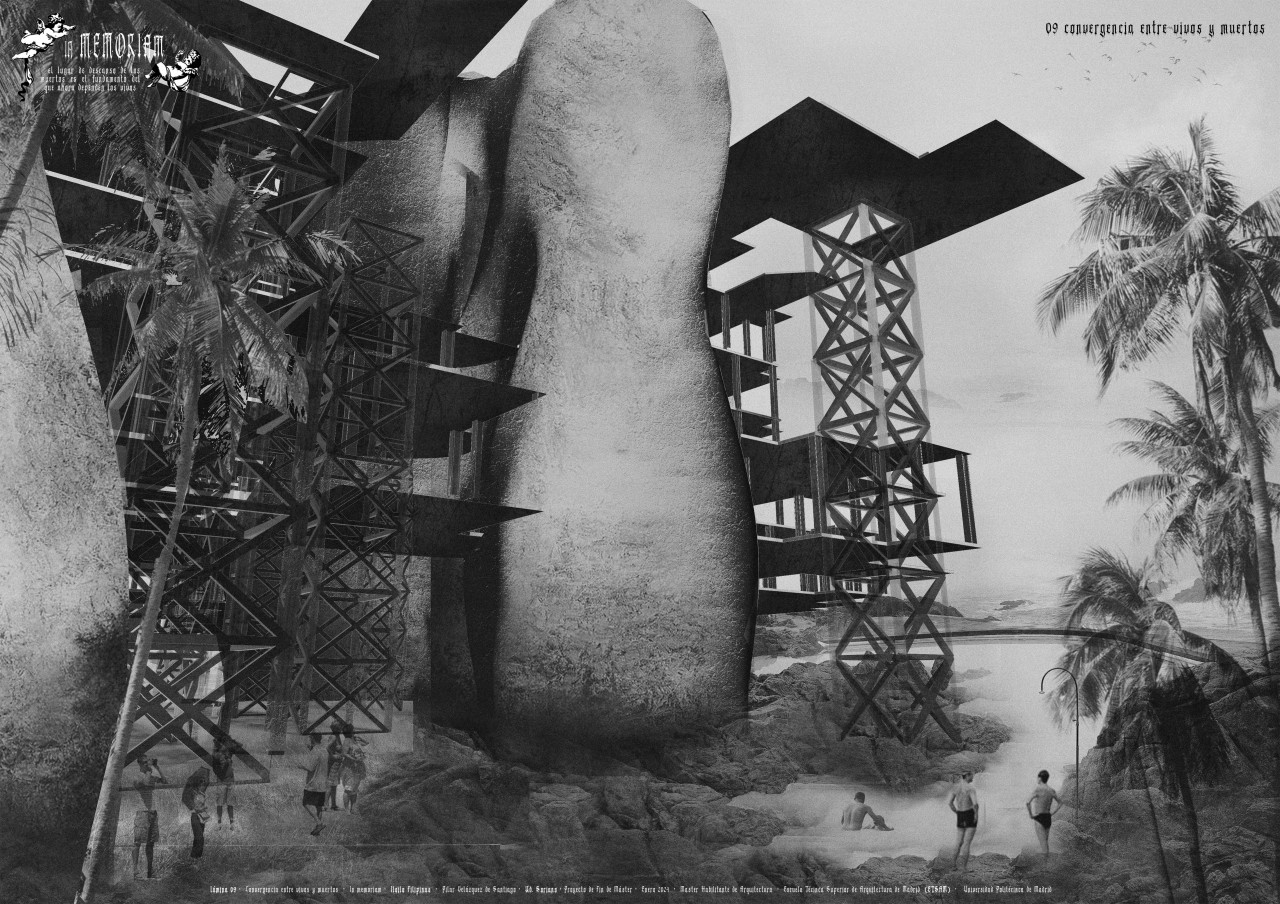
The project consists of the development of a memorial cemetery designed to be inhabited. The habitable infrastructure embraces the spaces of worship, establishing a symbiotic relationship between both worlds, improving the comfort of the place, and generating a new urban landscape that evokes the history of the city.
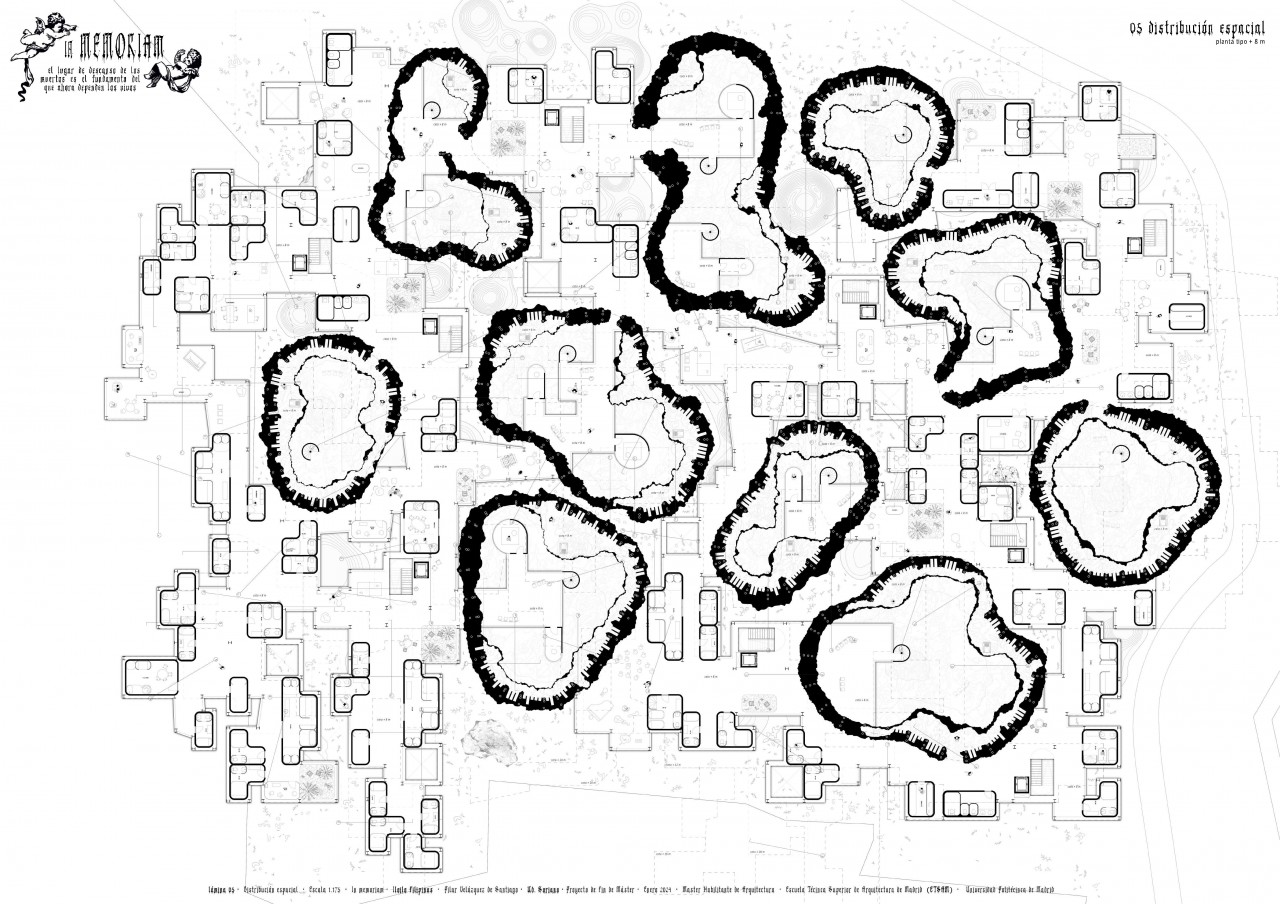
A high-rise neighborhood is generated, with common spaces between the housing units and new streets in which to develop domestic activity. It is made up of 6 levels and has irregular perimeters, which grow due to the spaces left free by the sacred areas. This open and flexible infrastructure diverges from the massiveness of the place of the dead. The place of worship is intended to be a pure, clean, and silent space, a space in which one comes into contact with the beyond, open to the outside, spacious, and monumental. On the other hand, the walls of this place generate a series of circular galleries that run through the entire complex, where the ossuaries and columbaria are housed. Unlike the first space, this one is narrow, cavernous, and humid, prepared for burials.
In this corner of the Philippines, the architectural work achieves a unique fusion of past and present, becoming an architectural link that connects what was and what is to come.
This inhabited mausoleum, marked by the remnants of war and the hope of the Filipino community, shapes a new urban situation. It is not only a physical construction, but a reminder of the human capacity to preserve and build a future rooted in the historical and cultural richness that defines society.
In a world where excessive expansion threatens to erase collective memory, this architectural work stands as a monument to resilience where the past and the future, the earthly and the spiritual, the living and the dead coexist.
We are located in the Philippines, where building density and land occupation have spread in an invasive manner, due to overpopulation and poverty throughout the country. Illegal constructions and settlements have colonized public spaces intended for the enjoyment and activity of citizens. Even cemeteries, places of eternal rest, have become a refuge for the living.
Entire families live among mausoleums and tombs in the Manila cemetery. This community prefers the relative tranquility and safety of this place to the dangerous squatter settlements of the city. They live among makeshift structures and overcrowded graves and face significant problems of space and quality demanding an urgent solution.
In the city of Iloilo, located on the island of Panay, an analogous situation is anticipated in the coming years about the availability of space and the eventual invasion of a community, stemming from the overflowing growth that the territory is experiencing. Faced with this urban metamorphosis, the need arises to address this convergence between the living and the dead.
The project consists of the development of a memorial cemetery designed to be inhabited. The habitable infrastructure embraces the spaces of worship, establishing a symbiotic relationship between both worlds, improving the comfort of the place, and generating a new urban landscape that evokes the history of the city.
A high-rise neighborhood is generated, with common spaces between the housing units and new streets in which to develop domestic activity. It is made up of 6 levels and has irregular perimeters, which grow due to the spaces left free by the sacred areas. This open and flexible infrastructure diverges from the massiveness of the place of the dead. The place of worship is intended to be a pure, clean, and silent space, a space in which one comes into contact with the beyond, open to the outside, spacious, and monumental. On the other hand, the walls of this place generate a series of circular galleries that run through the entire complex, where the ossuaries and columbaria are housed. Unlike the first space, this one is narrow, cavernous, and humid, prepared for burials.
In this corner of the Philippines, the architectural work achieves a unique fusion of past and present, becoming an architectural link that connects what was and what is to come.
This inhabited mausoleum, marked by the remnants of war and the hope of the Filipino community, shapes a new urban situation. It is not only a physical construction, but a reminder of the human capacity to preserve and build a future rooted in the historical and cultural richness that defines society.







- 00 - Description
- 01 - Silent domesticity
- 02 - Spatial diagnosis
- 03 - Living cementery
- 04 - System organigram
- 05 - Spatial distribution
- 06 - Development
- 07 - Deployment
- 08 - Constructive
- 09 - Convergence
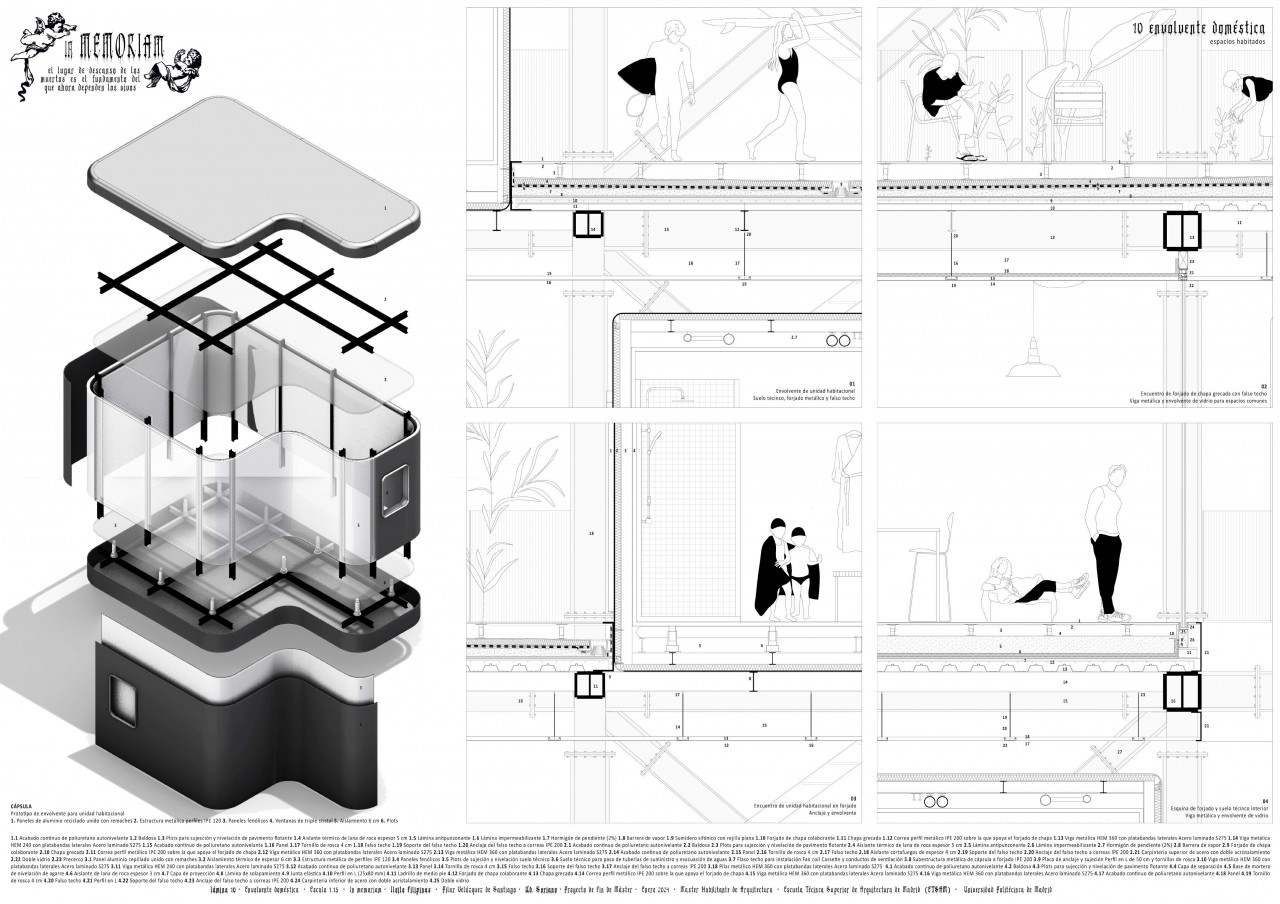
- 10 - Domestic shell
- 11 - Between tombs
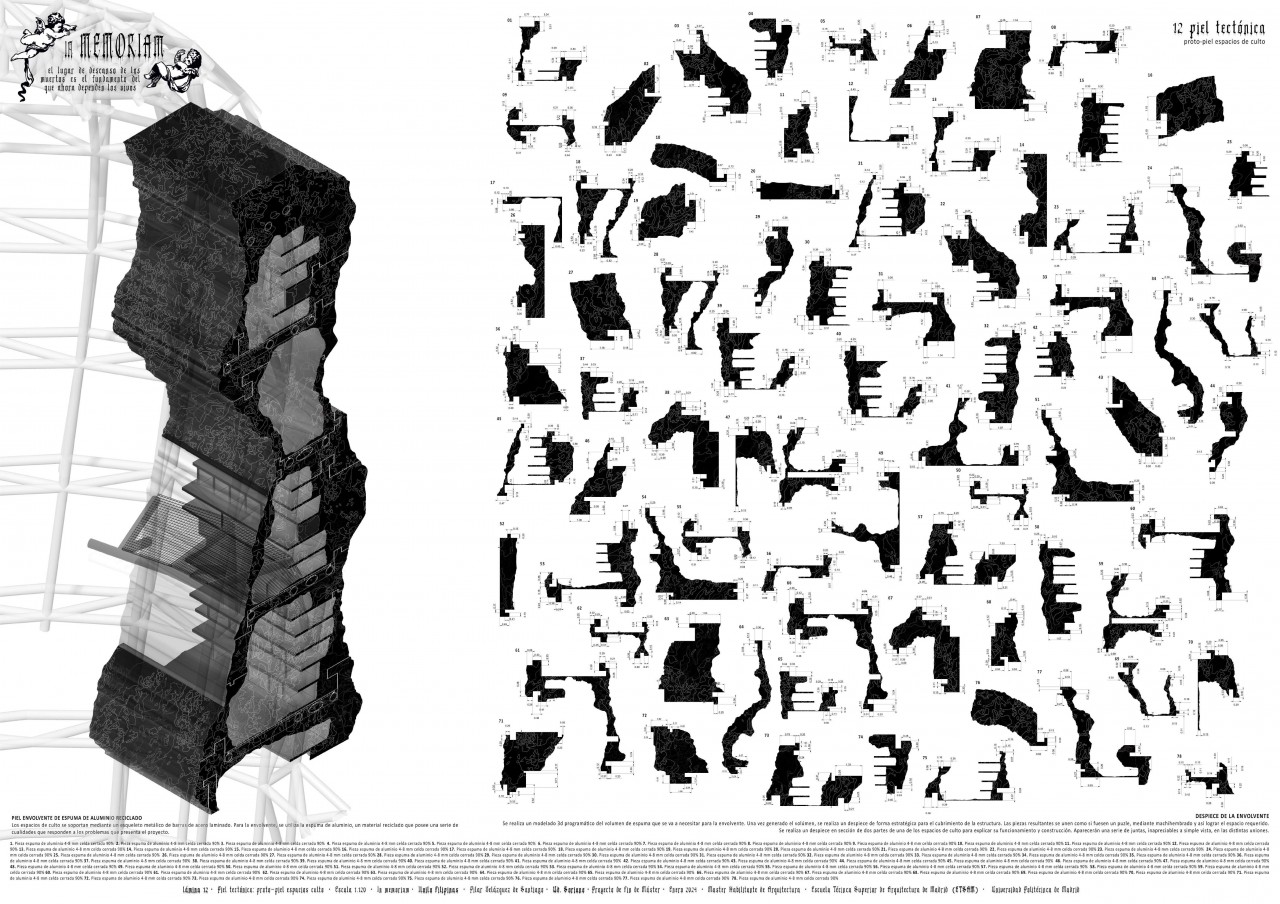
- 12 - Tectonic skin
- 13 - Structural framework
- 14 - Setting pattern
- 15 - Video