
||| indermis ||| Parte I
https://issuu.com/albamsans/docs/bitacora_alba_morcillo_sans_compressed
The new day care center in Las Águilas is the product of the superposition and interdependence of three alternative systems on the intrinsic characteristics of the site and of the building as an active organism.
Understanding it as a symbiosis with the environment, we propose air conditioning executed according to the very nature of external conditions, thus being an active agent within the user's comfort cycle.
The housing vulnerability of the neighborhood due to the energy poverty index forces us to project the building as a response to well-being: integrating the façade as a succession of strips in the form of a sieve which is in charge of the most sensorial solutions.
The hydraulic stress of large cities like Madrid contributes greatly to desertification.
High urban pollution and high temperatures, participate indirectly in the excessive use of water.
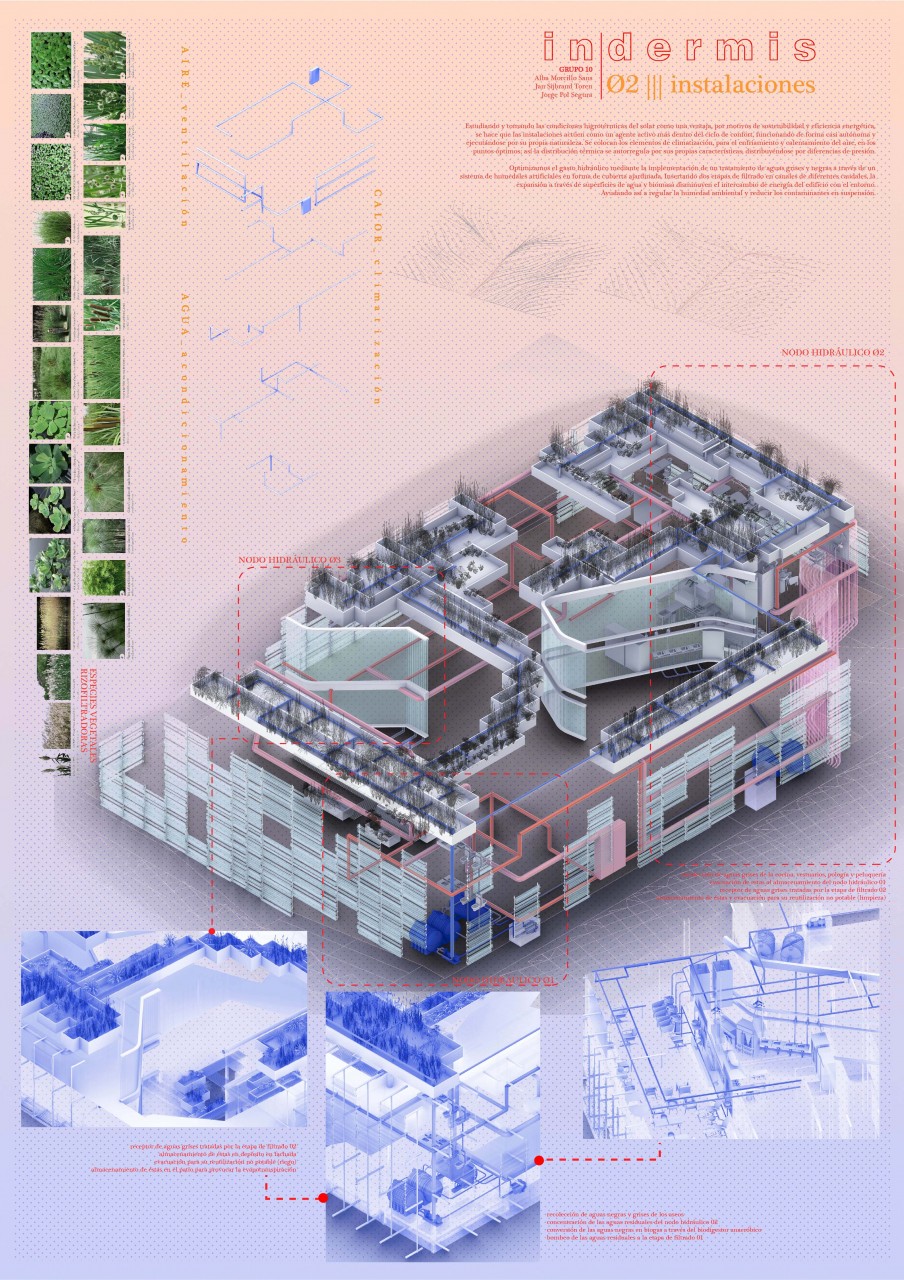
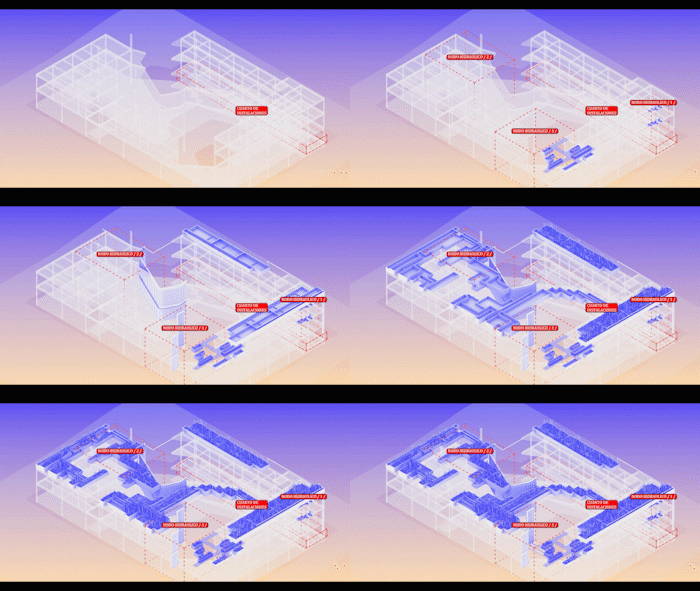
In this way, the problem is faced by rethinking a wastewater reuse system, thus optimizing energy and economic expenditure. The building is defined as a closed water circuit considering four successive phases:
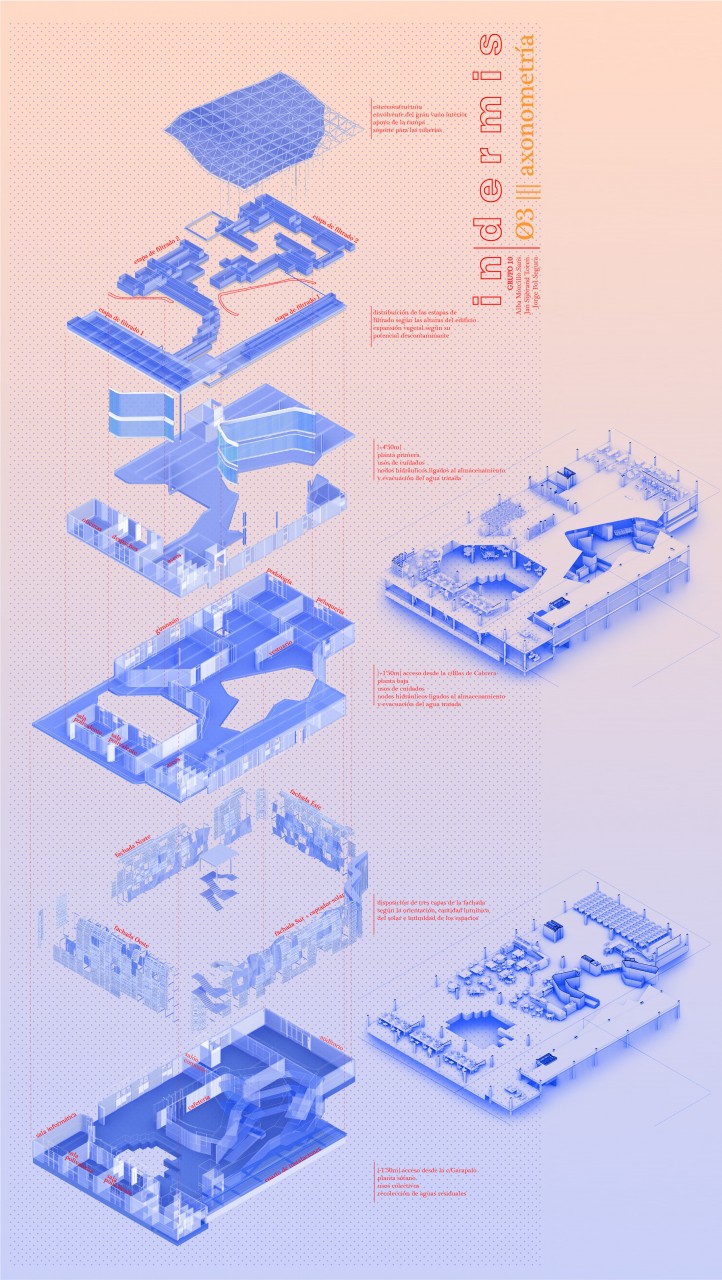
(I) Taking advantage of the unevenness of the plot, we located to the south (below street level), a longitudinal band that contains the room of the facilities dedicated to the storage and management of sewage.
(II) The plumbing meets in three vertical supply cores, around which the program is strategically hierarchized according to its required hydraulic need.
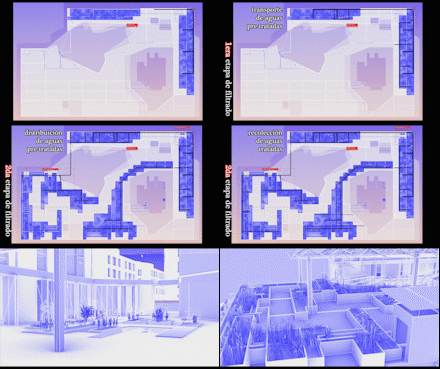
(III) These nodes pump the water to the roof, where the treatment system is carried out using artificial wetlands. Taking advantage of the difference in height of the building's volumes, two filtering stages are distributed along the roof:
1-The first one at a higher height, is in charge of receiving a daily intermittent flow which will be treated with the plant species with the highest purifying capacity.
2-The second one, it is subdivided into several sections along the surface of the roof, taking it as a formal strategy. Through channels of different depths and with more ornamental plants, gardens are generated on a smaller scale.
(IV) Finally, the treated water is stored in both interior façade’s tanks or in the patio, which supply it to adjacent uses as well as blend in with the spatial transparencies of the complex.
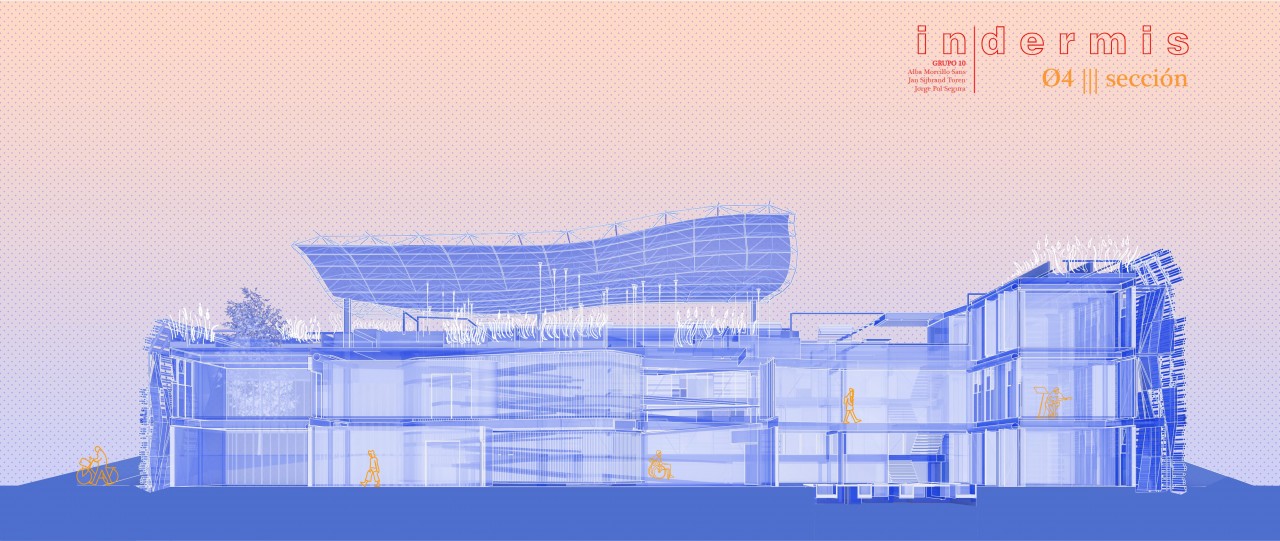
The distribution of the alternative installations is possible thanks to its articulation around the stereostructure of the roof. This in turn, allows the spatial opening of a central span around in which the main vertical connection is organized: the ramp. It not only does connect and organize the 5 floors of the building but also provides the accessibility component required by users of the day care center.
Expansion through water and biomass surfaces reduces the building's energy losses and therefore the demand for its air conditioning. Increasing ambient humidity reduces the effect of the heat island along with suspended contaminants. Both solutions will converge making this system a choice towards sustainability within the urban core.
https://miro.com/app/board/o9J_ksTxz3U=/
<< These documents are part of a largar proyect called |||Indermis||| >>
The new day care center in Las Águilas is the product of the superposition and interdependence of three alternative systems on the intrinsic characteristics of the site and of the building as an active organism.
Understanding it as a symbiosis with the environment, we propose air conditioning executed according to the very nature of external conditions, thus being an active agent within the user's comfort cycle.
The housing vulnerability of the neighborhood due to the energy poverty index forces us to project the building as a response to well-being: integrating the façade as a succession of strips in the form of a sieve which is in charge of the most sensorial solutions.
The hydraulic stress of large cities like Madrid contributes greatly to desertification.
High urban pollution and high temperatures, participate indirectly in the excessive use of water.
In this way, the problem is faced by rethinking a wastewater reuse system, thus optimizing energy and economic expenditure. The building is defined as a closed water circuit considering four successive phases:
(I) Taking advantage of the unevenness of the plot, we located to the south (below street level), a longitudinal band that contains the room of the facilities dedicated to the storage and management of sewage.
(II) The plumbing meets in three vertical supply cores, around which the program is strategically hierarchized according to its required hydraulic need.
(III) These nodes pump the water to the roof, where the treatment system is carried out using artificial wetlands. Taking advantage of the difference in height of the building's volumes, two filtering stages are distributed along the roof:
1-The first one at a higher height, is in charge of receiving a daily intermittent flow which will be treated with the plant species with the highest purifying capacity.
2-The second one, it is subdivided into several sections along the surface of the roof, taking it as a formal strategy. Through channels of different depths and with more ornamental plants, gardens are generated on a smaller scale.
(IV) Finally, the treated water is stored in both interior façade’s tanks or in the patio, which supply it to adjacent uses as well as blend in with the spatial transparencies of the complex.
The distribution of the alternative installations is possible thanks to its articulation around the stereostructure of the roof. This in turn, allows the spatial opening of a central span around in which the main vertical connection is organized: the ramp. It not only does connect and organize the 5 floors of the building but also provides the accessibility component required by users of the day care center.
Expansion through water and biomass surfaces reduces the building's energy losses and therefore the demand for its air conditioning. Increasing ambient humidity reduces the effect of the heat island along with suspended contaminants. Both solutions will converge making this system a choice towards sustainability within the urban core.
https://miro.com/app/board/o9J_ksTxz3U=/
<< These documents are part of a largar proyect called |||Indermis||| >>


- 00 - Description
- 01 - developed axonometry
- 02 - accesibility-ramp
- 03 - cross section
- 04 - clipping plane
- 05 - h2o installation
- 06 - placement estrategy
- 07 - operation system
- 08 - wetland garden
- 09 - Video