
LH1236
A brick shelter for a not very large group of people, located in the Baztán Valley, Navarra.
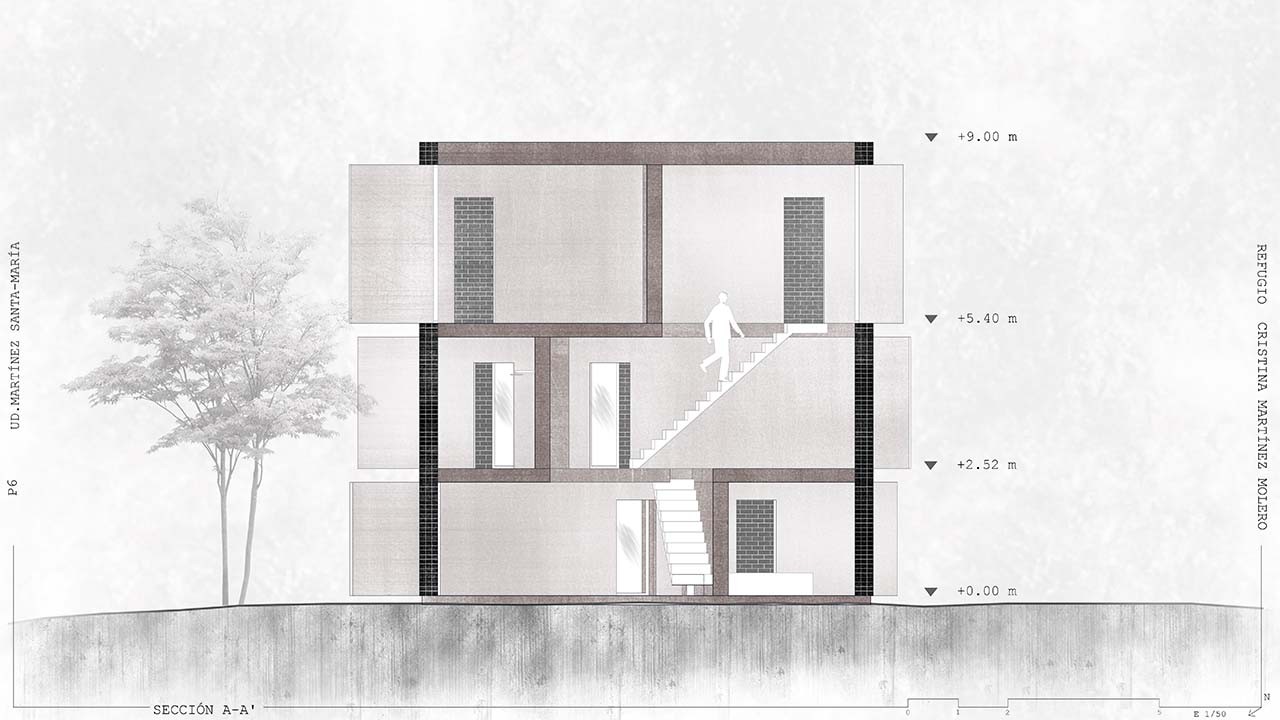
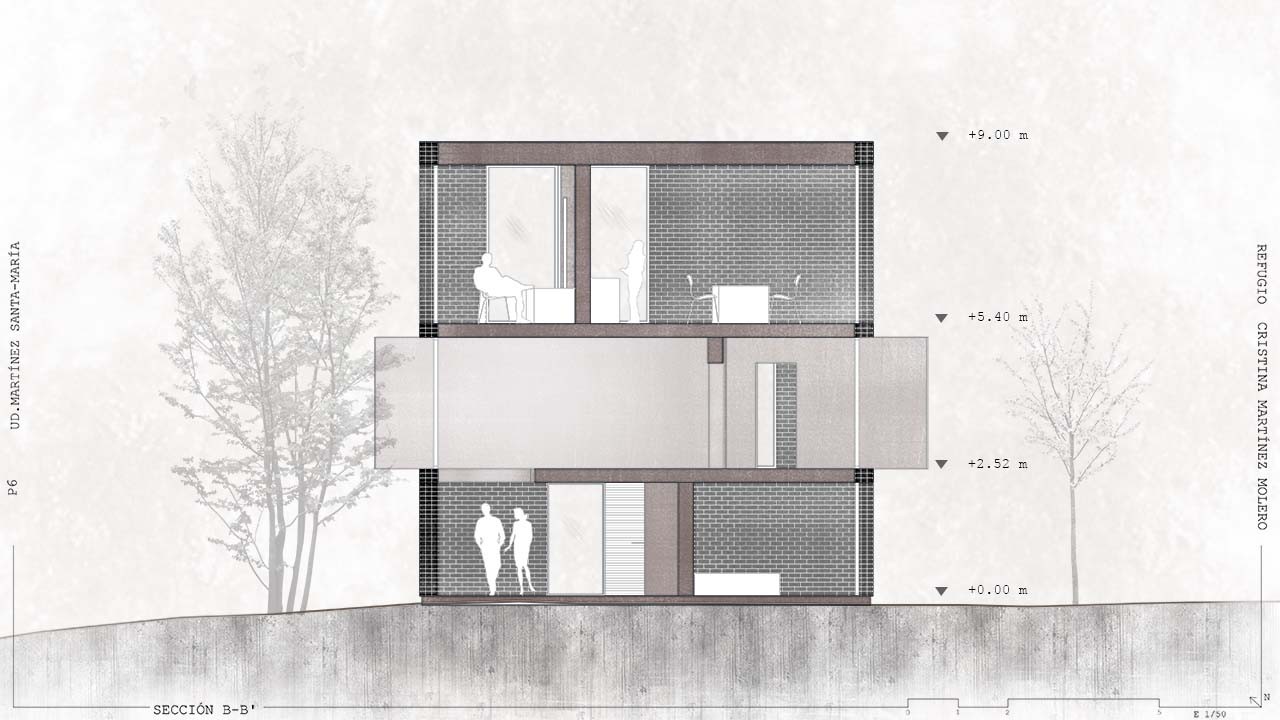
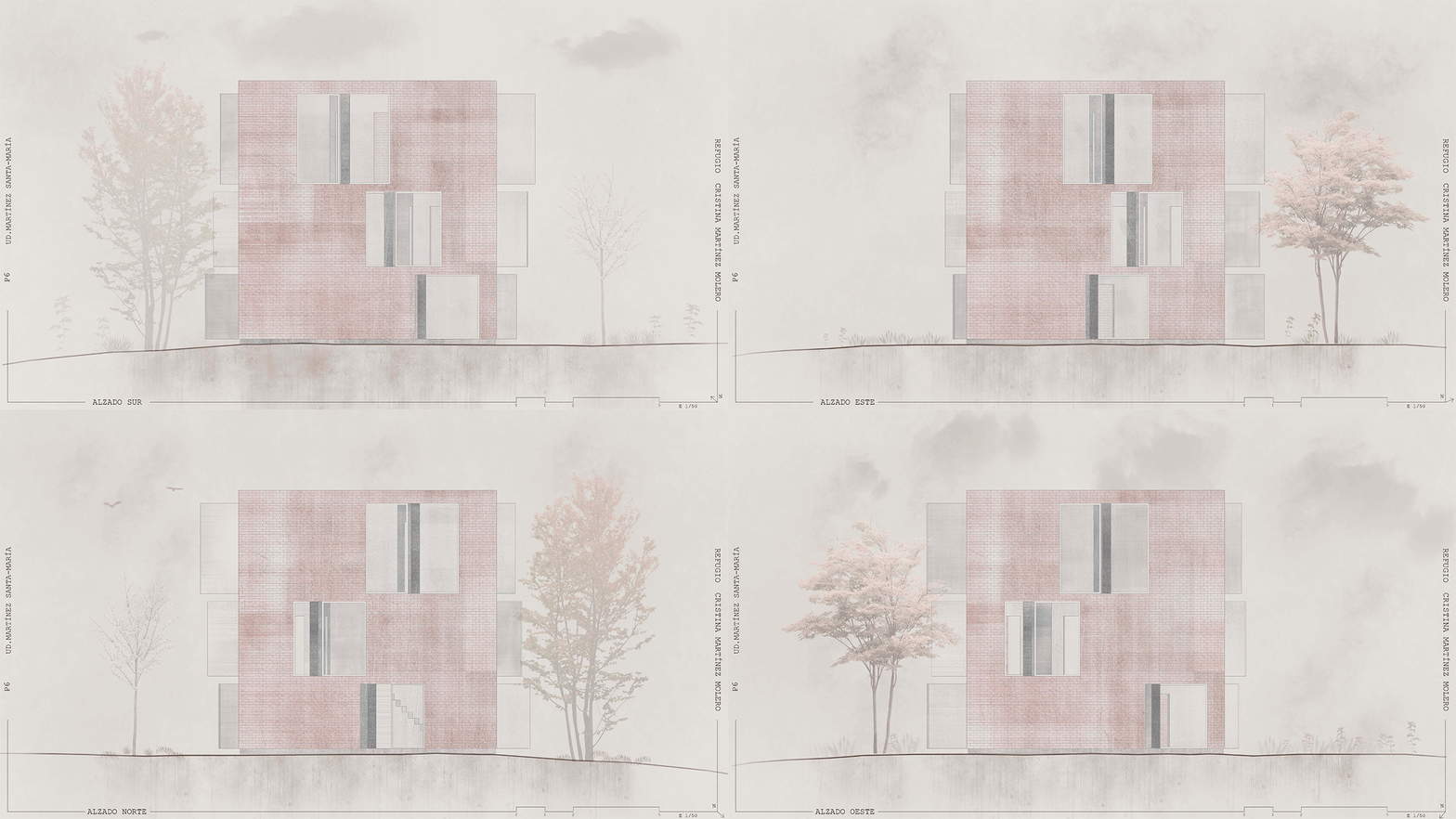
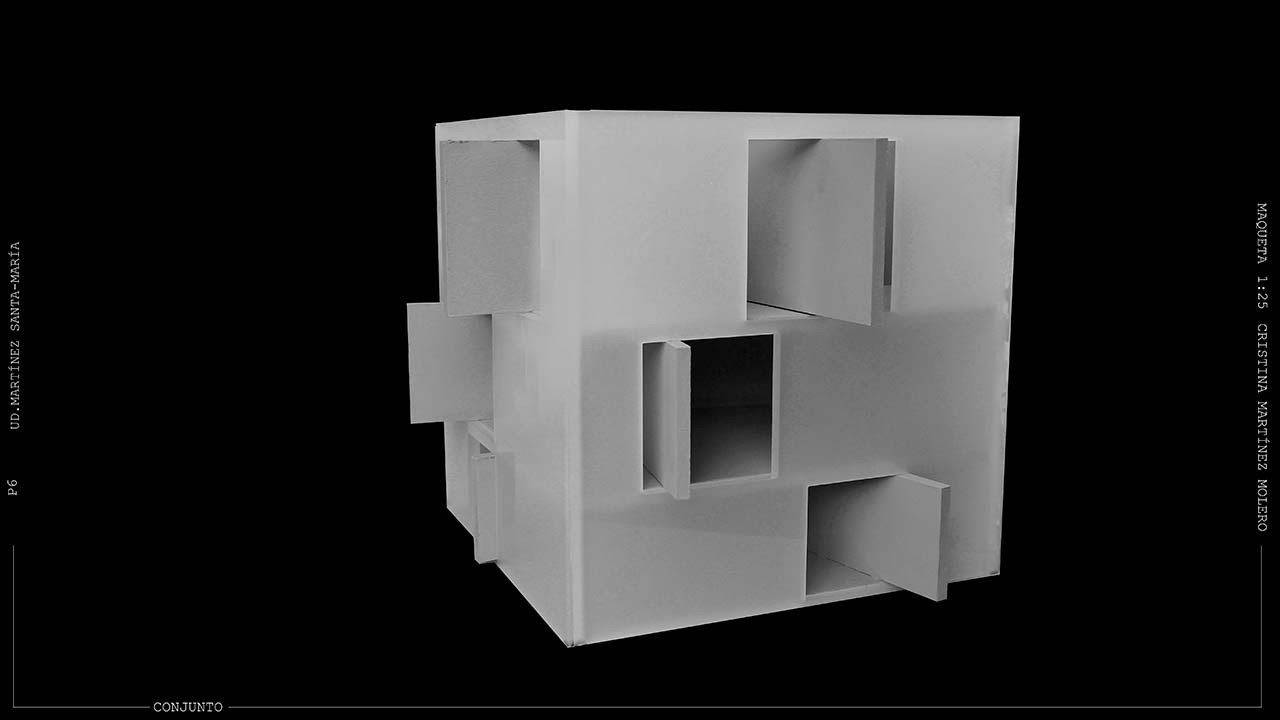
It is a 9x9x9 meter cube that is crossed by a series of concrete walls that divide the rooms. The coexistence of these two materials together can be well understood in this way, or also with the concrete walls as the load-bearing structure, and the brick as an envelope. In any case, the greatest expression is given in the elevations, where the contrast of the two materials, the depth of the interior and the play of heights can be seen.
On all floors, two walls intersect perpendicularly, so that there are three openings on the four facades. On the first floor the free height is 2 and a half meters, limiting its use to sleeping, on the second floor the height increases because there is a greater space with double height, and on the third it increases a little more because there are common spaces and also looking for good views.
There is a gradation in height that makes up the elevation, along with the concrete walls that extend into the landscape in harmony with the brick.
Everything is focused on the Hispalyt contest that is delivered this month. The statement may seem common, since we have been seeing parallelepipeds for centuries but why couldn´t be possible to innovate and that they continue to be interesting architectures? The theme of the Contest for this academic year 2021-2022 is proposed to investigate one of the most interesting characteristics of the architecture made with brick: it is a global construction system. It is used to build buildings in rich and poor countries, in any corner of the world planet. It adapts to all weather conditions with slight adjustments, but always meeting some basic rules (respect for gravity
and for the reasons imposed by the factory rigging). This project is proposed to solve a shelter prototype. A small construction of about 730 m3; not necessarily a 9x9x9 cube but with that capable volume. The brick can coexist with other materials, but its participation will be main due to appearance and constructive role. The cover must not be necessarily flat, taking into account the construction of roof solutions with ceramic materials. The particularity of this prototype is that it must respond to three locations with different climatic or environmental conditions, which must be chosen between 6 proposals. The building may have adjustments from one location to another, but it must be recognized that it is the same prototype. It's not about making three different buildings, if not to analyze what invariants are maintained from one location to another and what parts of the project must be adjusted for the specific conditions of each location.
This exercise of adapting the shelter to places with different climates helped me a lot to realize things that didn't quite work in the project. In this course I have discovered the constructive, aesthetic and expressive capabilities of working with concrete and brick. And I have also confirmed how architecture always, with no exception, answers to the place where it sits and the people living it.
It is a 9x9x9 meter cube that is crossed by a series of concrete walls that divide the rooms. The coexistence of these two materials together can be well understood in this way, or also with the concrete walls as the load-bearing structure, and the brick as an envelope. In any case, the greatest expression is given in the elevations, where the contrast of the two materials, the depth of the interior and the play of heights can be seen.
On all floors, two walls intersect perpendicularly, so that there are three openings on the four facades. On the first floor the free height is 2 and a half meters, limiting its use to sleeping, on the second floor the height increases because there is a greater space with double height, and on the third it increases a little more because there are common spaces and also looking for good views.
There is a gradation in height that makes up the elevation, along with the concrete walls that extend into the landscape in harmony with the brick.
Everything is focused on the Hispalyt contest that is delivered this month. The statement may seem common, since we have been seeing parallelepipeds for centuries but why couldn´t be possible to innovate and that they continue to be interesting architectures? The theme of the Contest for this academic year 2021-2022 is proposed to investigate one of the most interesting characteristics of the architecture made with brick: it is a global construction system. It is used to build buildings in rich and poor countries, in any corner of the world planet. It adapts to all weather conditions with slight adjustments, but always meeting some basic rules (respect for gravity
and for the reasons imposed by the factory rigging). This project is proposed to solve a shelter prototype. A small construction of about 730 m3; not necessarily a 9x9x9 cube but with that capable volume. The brick can coexist with other materials, but its participation will be main due to appearance and constructive role. The cover must not be necessarily flat, taking into account the construction of roof solutions with ceramic materials. The particularity of this prototype is that it must respond to three locations with different climatic or environmental conditions, which must be chosen between 6 proposals. The building may have adjustments from one location to another, but it must be recognized that it is the same prototype. It's not about making three different buildings, if not to analyze what invariants are maintained from one location to another and what parts of the project must be adjusted for the specific conditions of each location.
This exercise of adapting the shelter to places with different climates helped me a lot to realize things that didn't quite work in the project. In this course I have discovered the constructive, aesthetic and expressive capabilities of working with concrete and brick. And I have also confirmed how architecture always, with no exception, answers to the place where it sits and the people living it.




- 00 - Description
- 01 - Plans
- 02 - Sections
- 03 - Sections
- 04 - Elevations
- 05 - Images
- 06 - Interior models
- 07 - Exterior model
- 08 - Climate adaptation
- 09 - Video