
Mushroom's trail
The massive and accelerated growth of cities nowadays demand new spaces, new urban typologies and architectures where the uses are hybridized. This course poses to mix urban typologies and productive landscapes in order to create new architectures that can solve the problems of our current society where the cities are highly densified and in a process of continuous expansion.
“Mushroom’s trail” is a project originated after the investigation of three programmatic lines belonging to three large groups. In the first place, a productive landscape in transition from the rural to the urban areas: mushrooms farming. Second, a medium-sized urban activity (M): multi-restaurants. Last, a large-scale urban activity (L): athletic stadium.
The research line followed was the productive landscape in transition from the rural to the urban, which in this case was mushroom farming. Mushroom farming has traditionally taken place in rural areas, practiced in caves and in places with high humidity, keeping the mycelium in pottery jars. With industrialization, these practices have been carried further in China, where the cultivation of the species "Volvariella volvacea" is widespread and is carried out in massive industrial buildings throughout the year thanks to the control of humidity and temperature through technology in these large infrastructures.
At the same time that these large structures are created that replicate the mushrooms growth conditions in nature, in cities abandoned after the industry delocalization in the United States, large infrastructures of the industrial era, such as old underground tunnels or quarries, are used for mushrooms farming, since they meet the optimal hygrothermal conditions for this activity.
Based on this research, this project is located on the Huangpu River shore in the area near Pudong, the financial center of Shanghai. Taking advantage of the operations that are taking place in the last few years to reactivate the river by building a series of parks and walks along it, this building is considered as a crossroads between runners and athletes who train in these previously mentioned rides, the worker of the financial zone that looks for a place where to eat and be entertained at the same time, and the mushrooms lover that goes to a place where this mushrooms transform the atmosphere and the spatiality of the building.
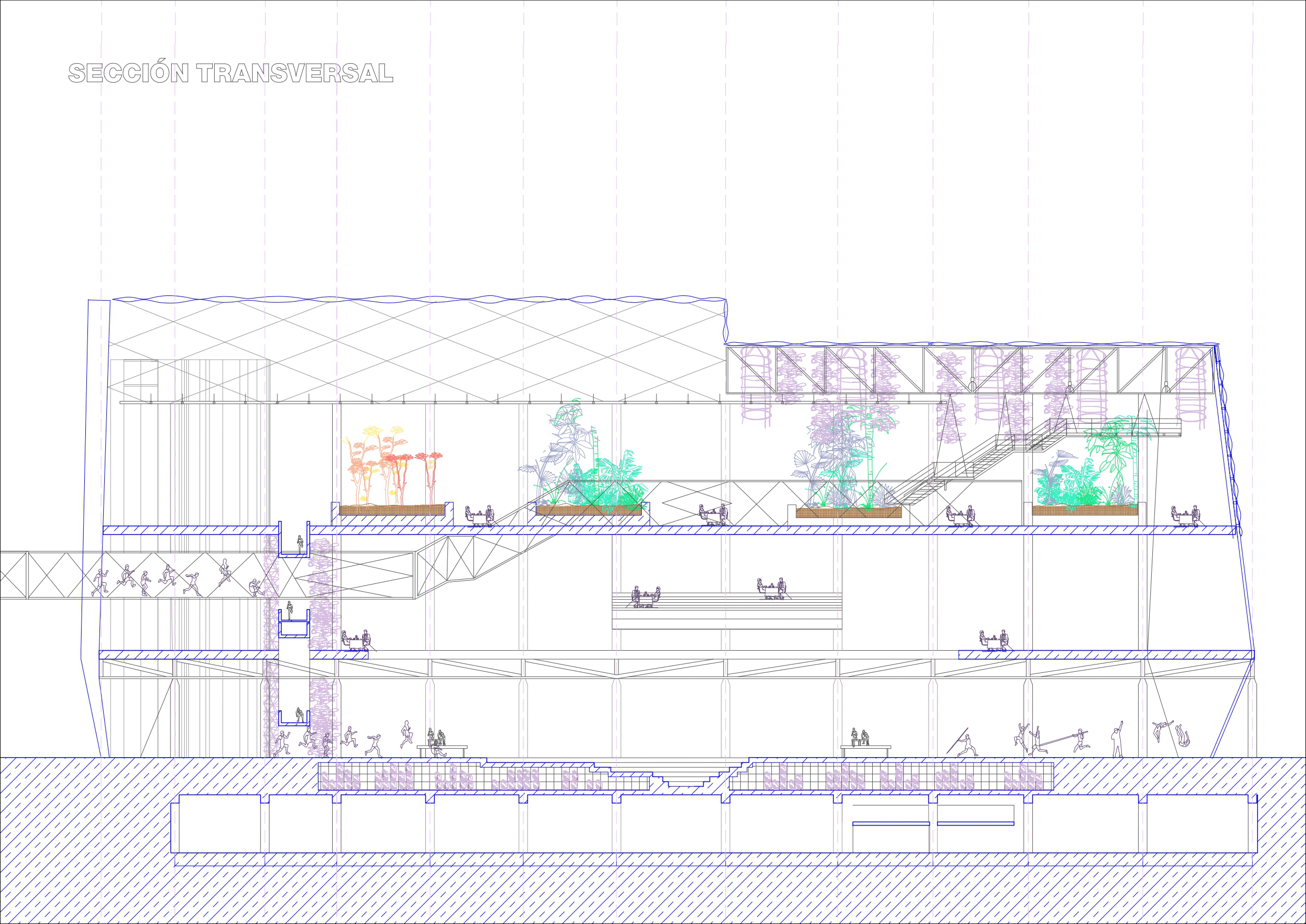
These three programs coexist in a single space, where the person is the dinner guest and spectator at the same time. In addition, the athlete and the person who crosses the building through the system of ramps that articulates the communications is also spectator and athlete at the same time, all this action takes place in a space where the mushroom is the protagonist, since it invades the walls and the areas of facilities taking advantage of the humidity and the light in the different phases of growth.
“Mushroom’s trail” is a project originated after the investigation of three programmatic lines belonging to three large groups. In the first place, a productive landscape in transition from the rural to the urban areas: mushrooms farming. Second, a medium-sized urban activity (M): multi-restaurants. Last, a large-scale urban activity (L): athletic stadium.
The research line followed was the productive landscape in transition from the rural to the urban, which in this case was mushroom farming. Mushroom farming has traditionally taken place in rural areas, practiced in caves and in places with high humidity, keeping the mycelium in pottery jars. With industrialization, these practices have been carried further in China, where the cultivation of the species "Volvariella volvacea" is widespread and is carried out in massive industrial buildings throughout the year thanks to the control of humidity and temperature through technology in these large infrastructures.
At the same time that these large structures are created that replicate the mushrooms growth conditions in nature, in cities abandoned after the industry delocalization in the United States, large infrastructures of the industrial era, such as old underground tunnels or quarries, are used for mushrooms farming, since they meet the optimal hygrothermal conditions for this activity.
Based on this research, this project is located on the Huangpu River shore in the area near Pudong, the financial center of Shanghai. Taking advantage of the operations that are taking place in the last few years to reactivate the river by building a series of parks and walks along it, this building is considered as a crossroads between runners and athletes who train in these previously mentioned rides, the worker of the financial zone that looks for a place where to eat and be entertained at the same time, and the mushrooms lover that goes to a place where this mushrooms transform the atmosphere and the spatiality of the building.
These three programs coexist in a single space, where the person is the dinner guest and spectator at the same time. In addition, the athlete and the person who crosses the building through the system of ramps that articulates the communications is also spectator and athlete at the same time, all this action takes place in a space where the mushroom is the protagonist, since it invades the walls and the areas of facilities taking advantage of the humidity and the light in the different phases of growth.




- 00 - Description
- 01 - 01_investigation
- 02 - 02_groupsection
- 03 - 03_locationplan
- 04 - 04_longitudinalsec
- 05 - 05_transversalsec
- 06 - 06_accessfloor
- 07 - 07_garagefloor
- 08 - 08_greenhousefloor
- 09 - 09_atmosphere
- 10 - 10_axonometricview