
Nuevo Banús 2067
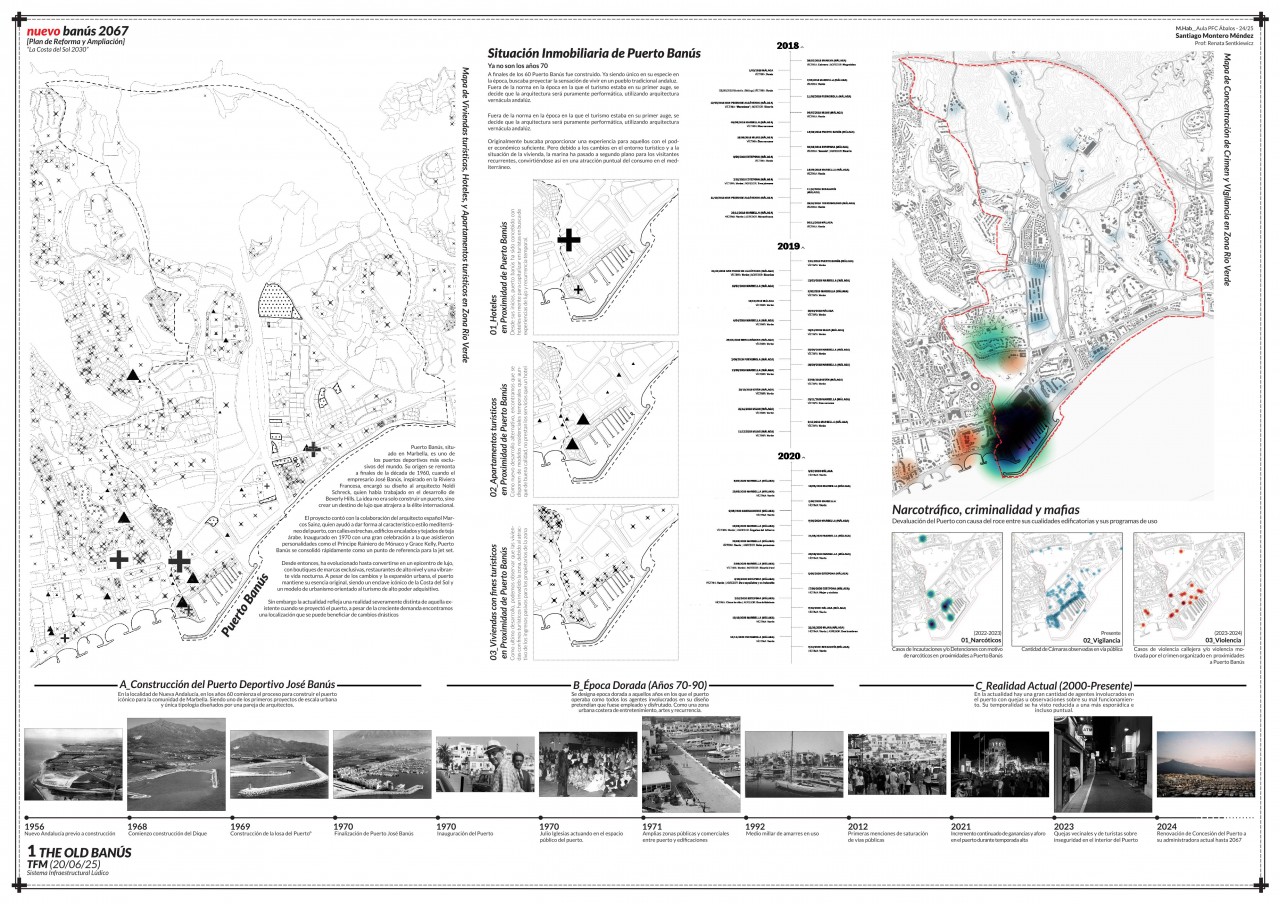
The brief for this project focused on an approach to the issue of tourism in Marbella toward the year 2030. Interest in international tourism marked a turning point in the 1960s on the Costa del Sol, prompting developers to build tourist hubs in areas that had previously relied on the fishing industry.
One such developer was José Banús, who chose to create a port that imitated Andalusian vernacular architecture in order to generate a unique experience aimed at an international audience.
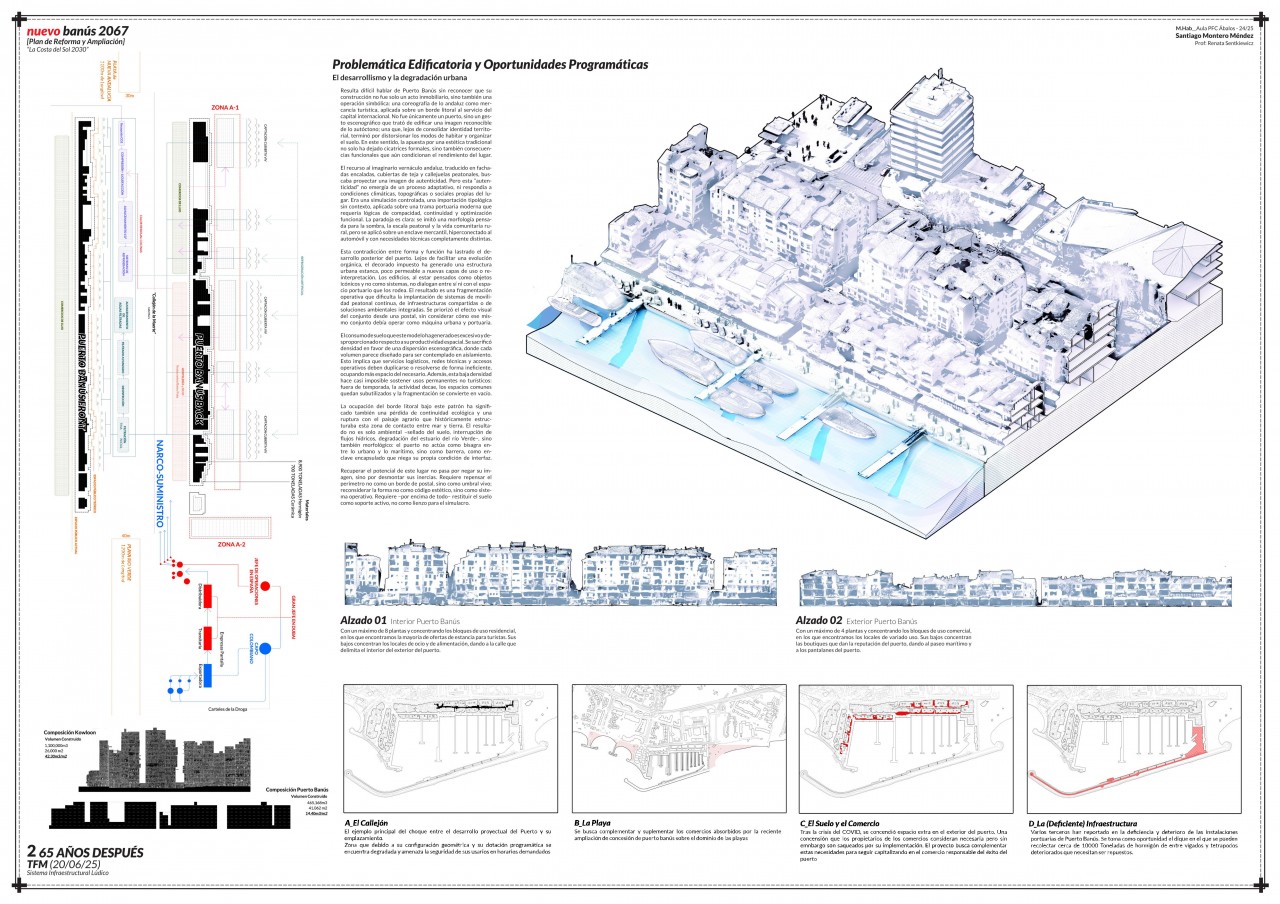
What was, in its golden age, a luxury destination with recurring visitors and property ownership within the port, finds itself fifty years later in a completely different position. This shift is the result of changes in tourism seasonality, with shorter stays and the decline of the notion of a frequent summer retreat, transforming instead into a one-off attraction along the coast.
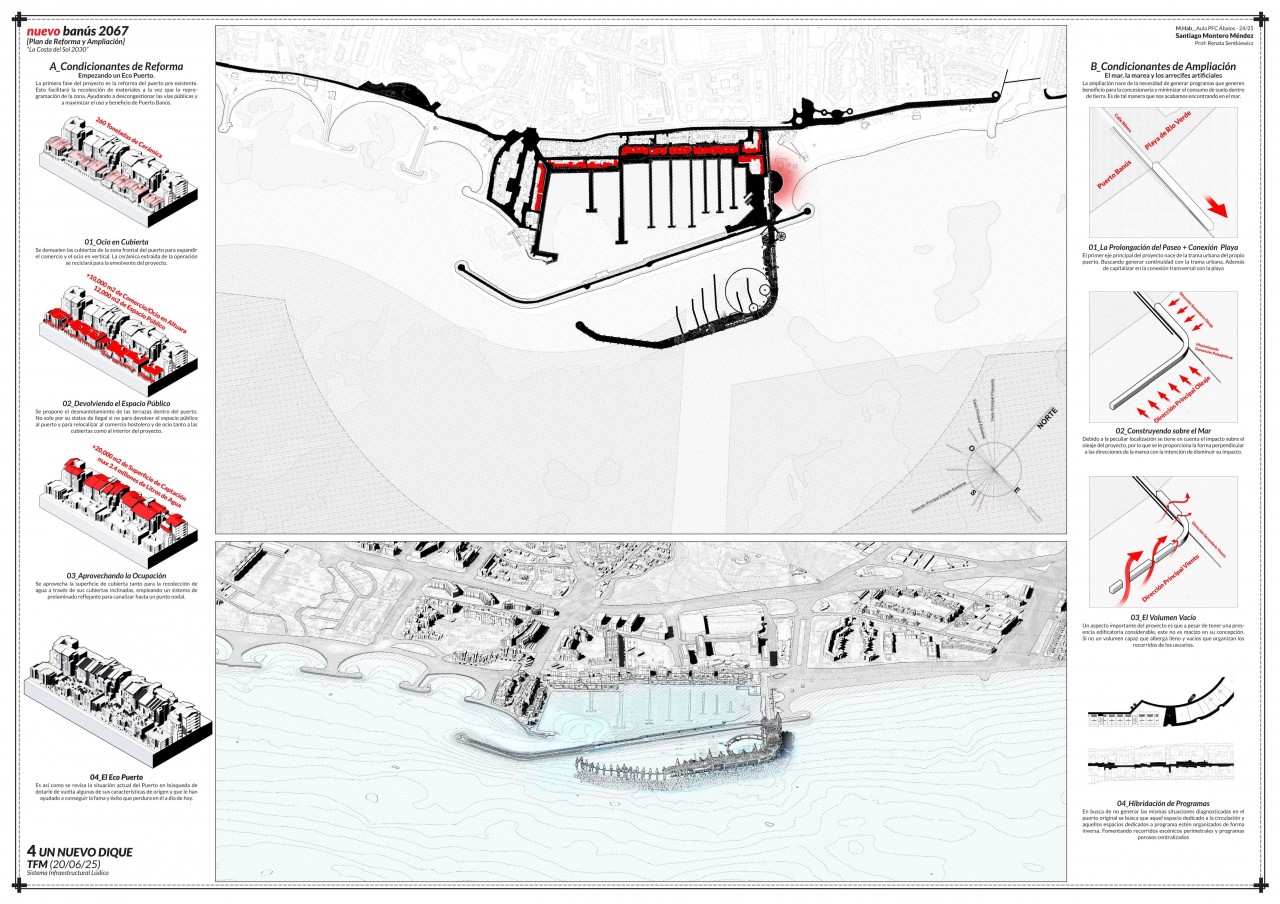
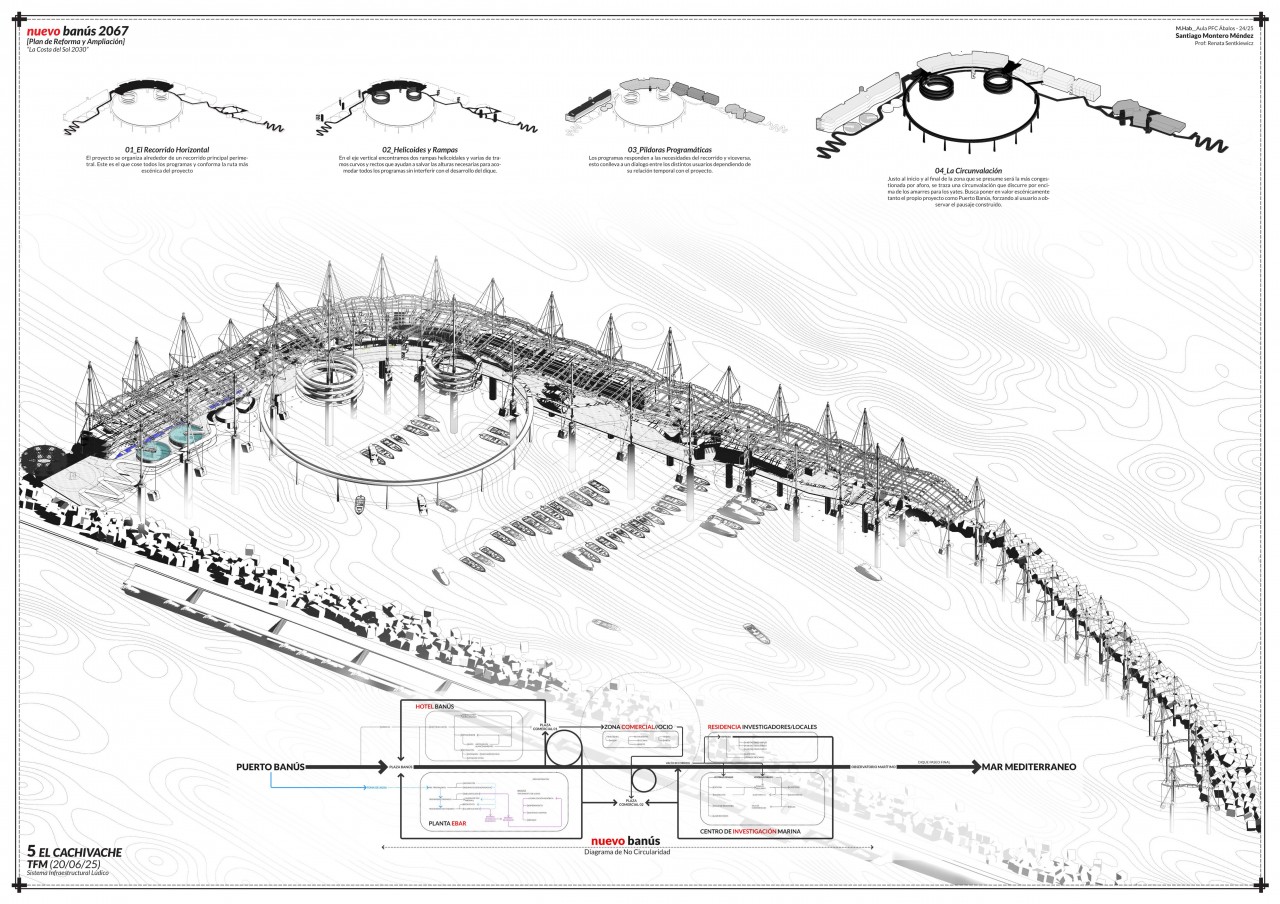
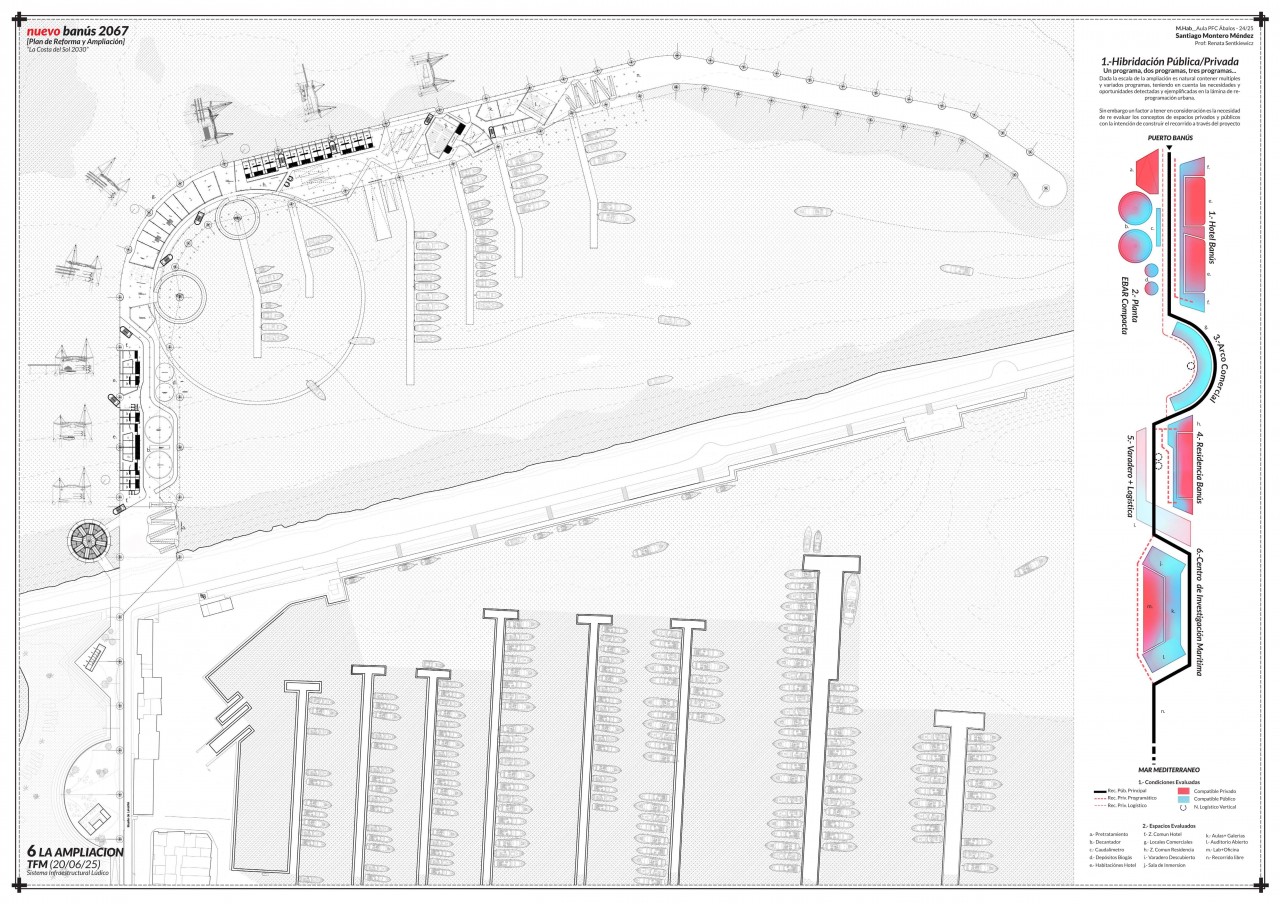
The extension emerges as the prolongation of Ribera del Puerto street, an axis that is deformed to counteract the effects of the tide, while generating openings to withstand wind pressure, which in turn become interstitial public spaces. This main axis is what enables dialogue with the beach through support structures for beach bars and restroom areas.
The project revolves around the notion of pathways, distributing the program according to the user’s promenade.
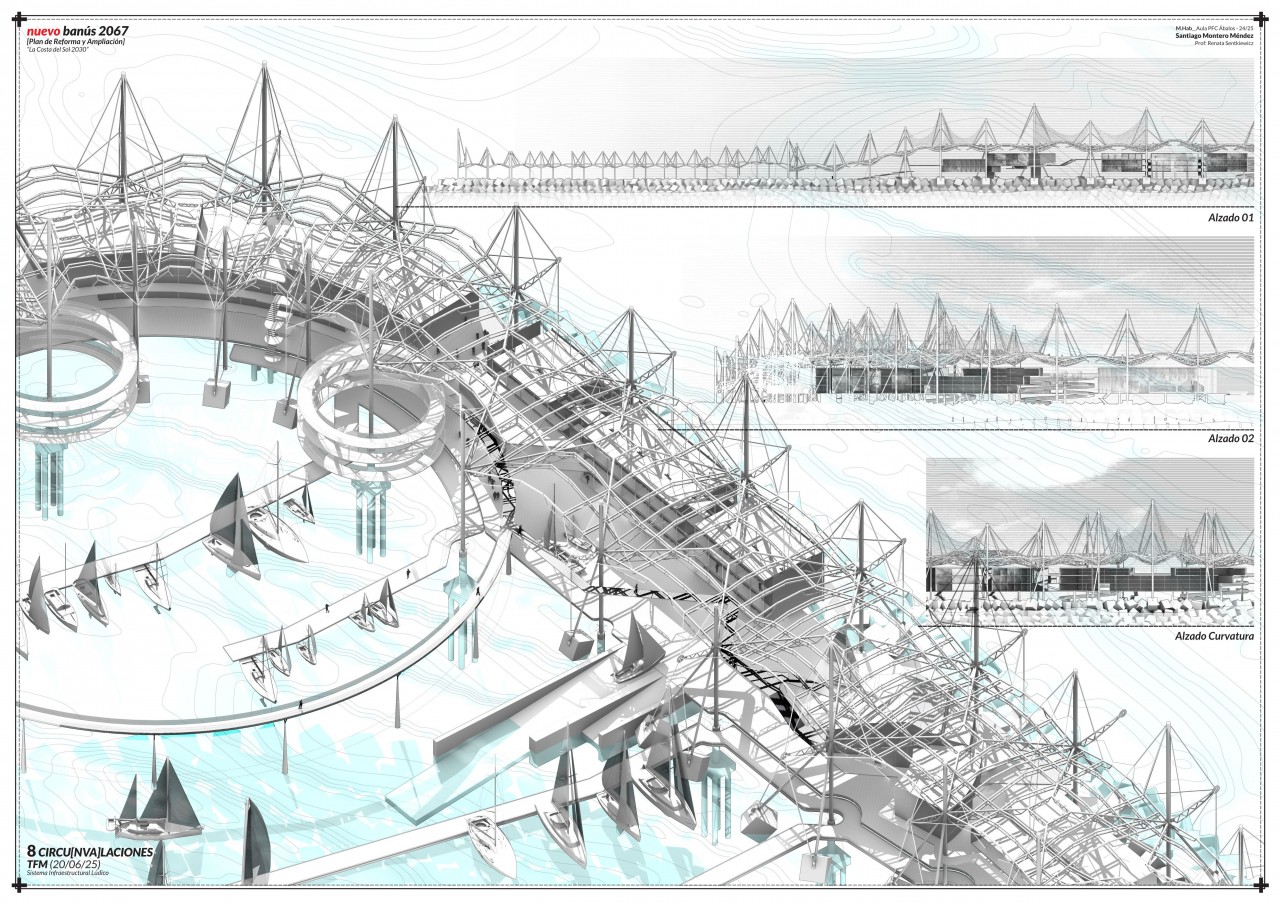
These routes manifest as an elevated, sinuous line along the inner side of the project, compelling observation of both the intervention itself and Puerto Banús. This results in programmatic capsules conceived as independent volumes, stitched together by the pathways and vertically connected through ramps and staircases, always located near the structural masts to facilitate dialogue between users and the project.
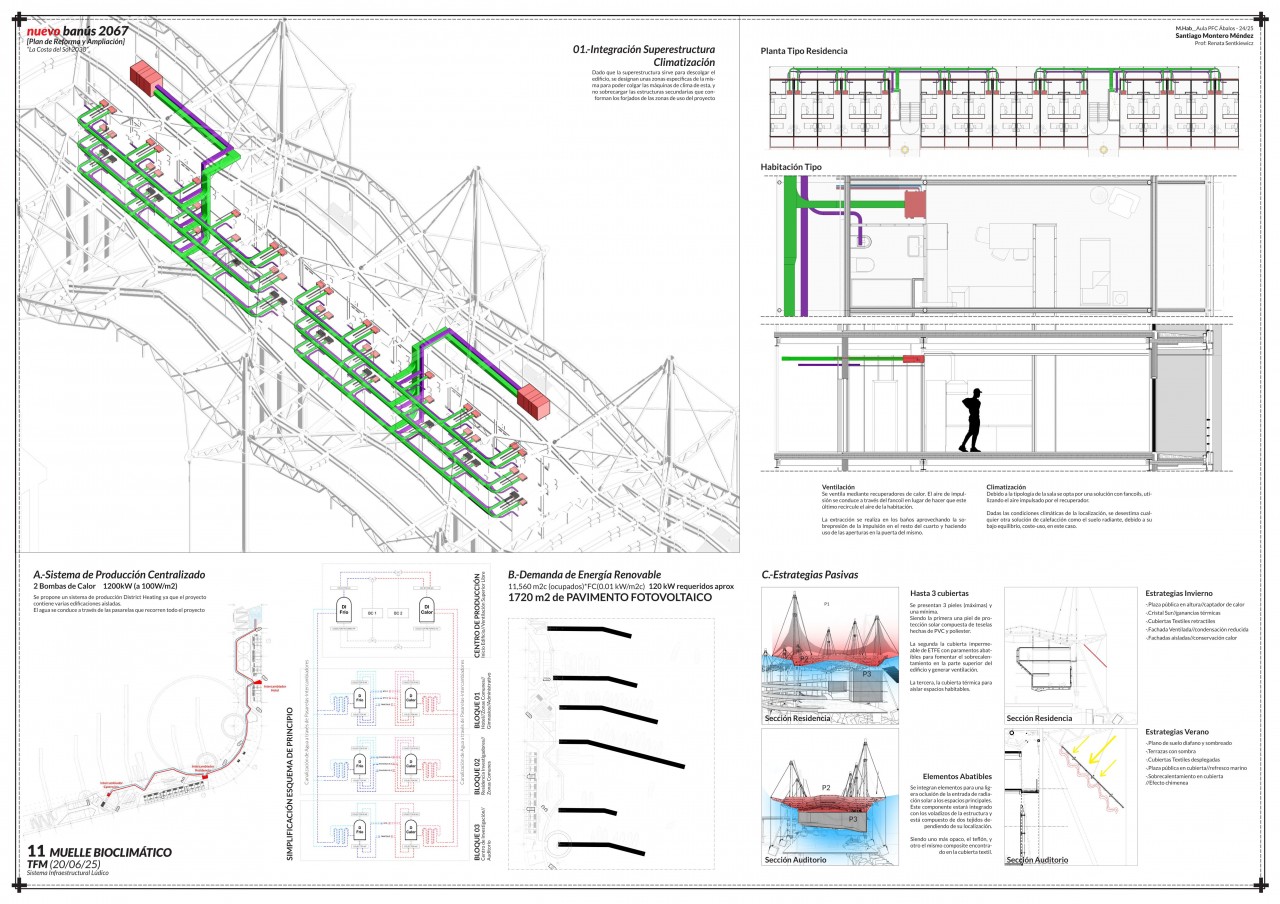
Thus, the program is condensed into programmatic capsules, whose spaces are also reevaluated to ensure their compatibility with the public circulation—not in a purely literal sense, but rather seeking to reveal the systems that enable the project’s passive performance.
Another reason for approaching the concept of empty volume lies in the fact that, given the project’s scale, the structure itself becomes a landscape gesture.
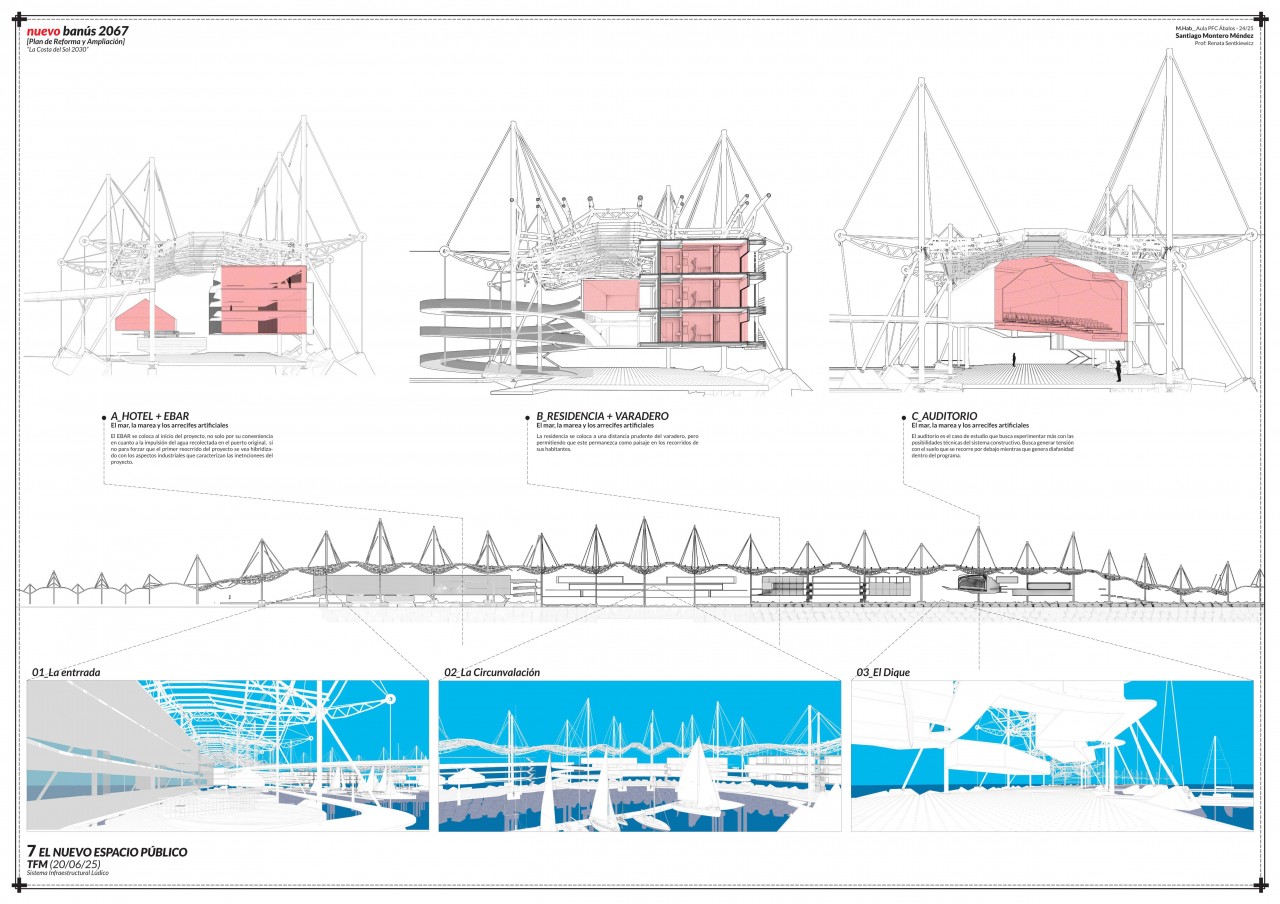
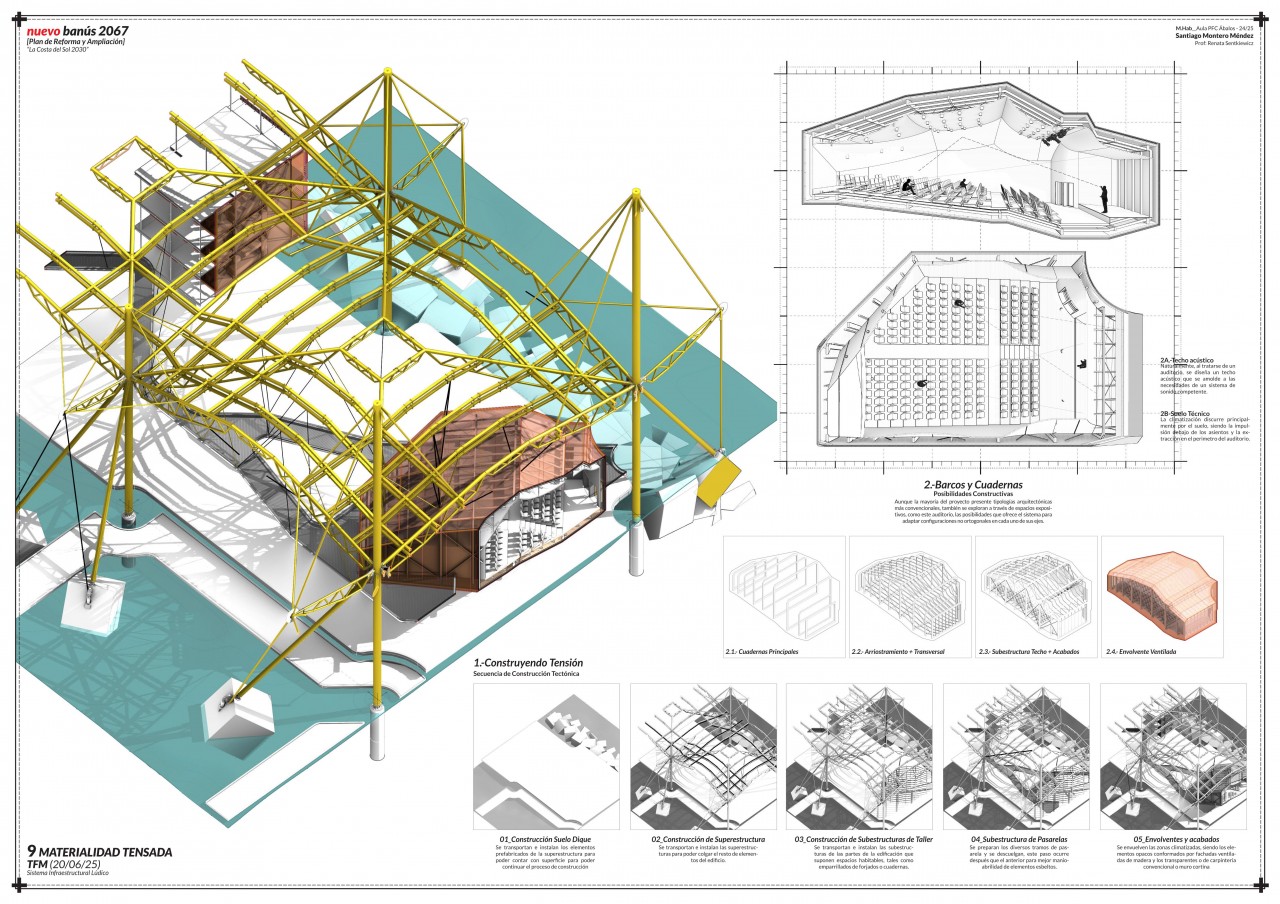
The priority is to leave the entire ground floor—the seafront promenade—completely open, opting instead to suspend the building, with CLT slabs maximizing lightness.
It is a flexible, semi-modular system designed to externalize the amount of program at each point, breaking the monotony of scale. A system that allows diversification in how the suspended spaces are projected, exemplified in the interior auditorium, which is built in the same way as a ship.
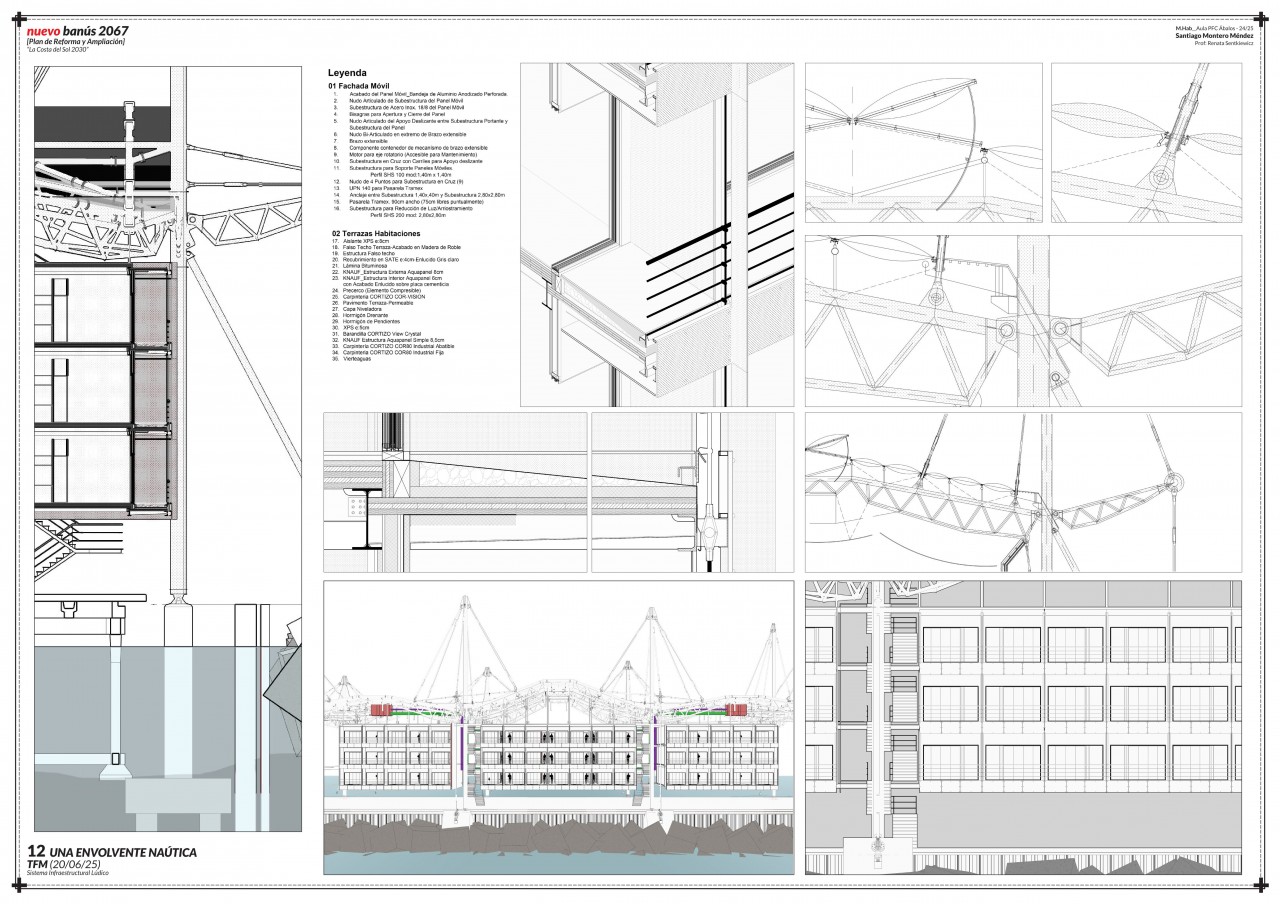
The envelope consists of a ventilated wooden façade with ribs, preventing condensation and overheating issues. Textile canopies maximize transparency and ensure ventilation through the stack effect of overheating; these do not cover the entire complex at all times, but rather selectively, in the project’s public areas.
One such developer was José Banús, who chose to create a port that imitated Andalusian vernacular architecture in order to generate a unique experience aimed at an international audience.
What was, in its golden age, a luxury destination with recurring visitors and property ownership within the port, finds itself fifty years later in a completely different position. This shift is the result of changes in tourism seasonality, with shorter stays and the decline of the notion of a frequent summer retreat, transforming instead into a one-off attraction along the coast.
The extension emerges as the prolongation of Ribera del Puerto street, an axis that is deformed to counteract the effects of the tide, while generating openings to withstand wind pressure, which in turn become interstitial public spaces. This main axis is what enables dialogue with the beach through support structures for beach bars and restroom areas.
The project revolves around the notion of pathways, distributing the program according to the user’s promenade.
These routes manifest as an elevated, sinuous line along the inner side of the project, compelling observation of both the intervention itself and Puerto Banús. This results in programmatic capsules conceived as independent volumes, stitched together by the pathways and vertically connected through ramps and staircases, always located near the structural masts to facilitate dialogue between users and the project.
Thus, the program is condensed into programmatic capsules, whose spaces are also reevaluated to ensure their compatibility with the public circulation—not in a purely literal sense, but rather seeking to reveal the systems that enable the project’s passive performance.
Another reason for approaching the concept of empty volume lies in the fact that, given the project’s scale, the structure itself becomes a landscape gesture.
The priority is to leave the entire ground floor—the seafront promenade—completely open, opting instead to suspend the building, with CLT slabs maximizing lightness.
It is a flexible, semi-modular system designed to externalize the amount of program at each point, breaking the monotony of scale. A system that allows diversification in how the suspended spaces are projected, exemplified in the interior auditorium, which is built in the same way as a ship.
The envelope consists of a ventilated wooden façade with ribs, preventing condensation and overheating issues. Textile canopies maximize transparency and ensure ventilation through the stack effect of overheating; these do not cover the entire complex at all times, but rather selectively, in the project’s public areas.
- 00 - Description
- 01 - The Old Banús
- 02 - 65 Years Later
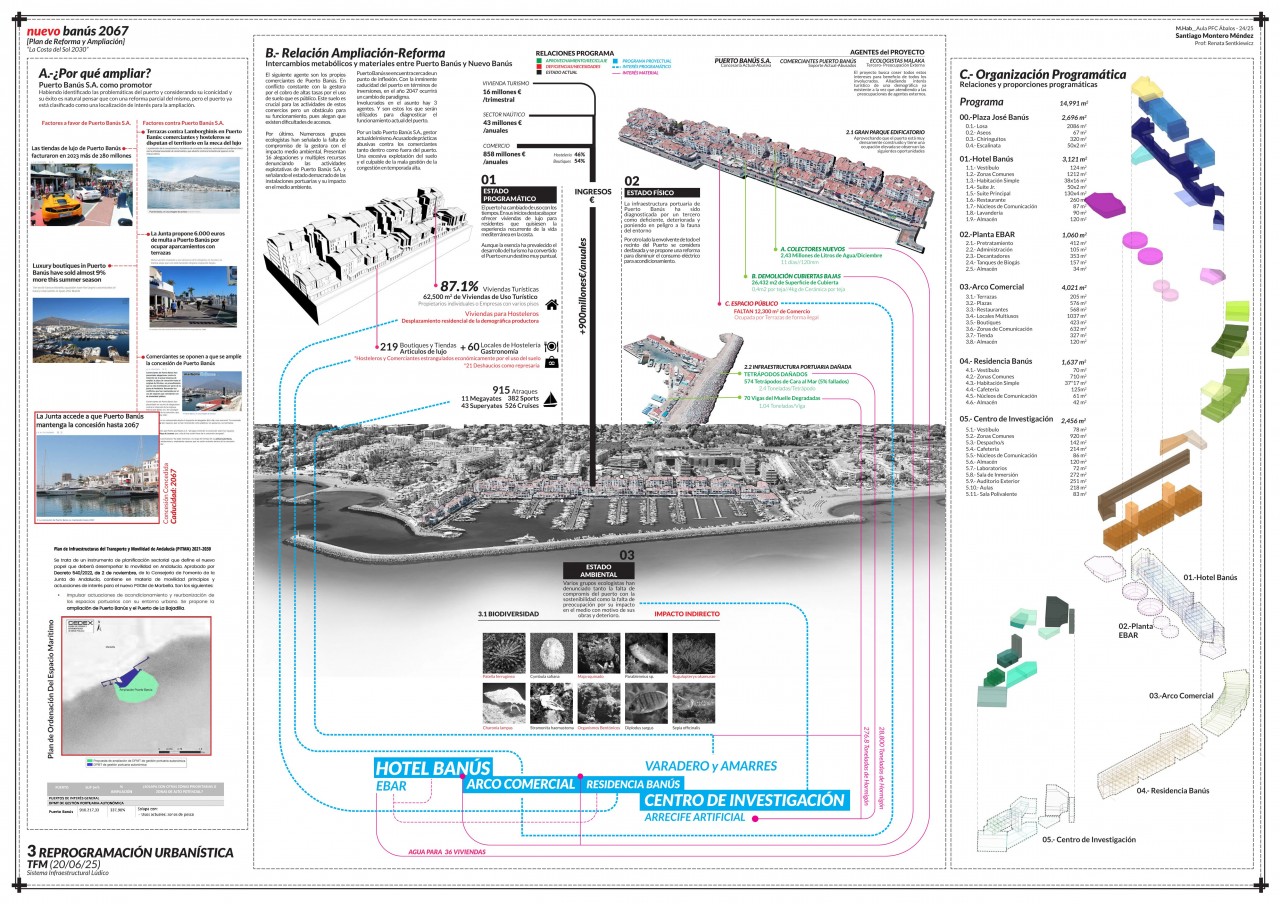
- 03 - Urban Reprograming
- 04 - A New Dock
- 05 - The Line
- 06 - The Expansion
- 07 - A New Public Space
- 08 - Circumvallation
- 09 - Tensile materiality
- 10 - Structural System
- 11 - Bioclimatic Pier
- 12 - Nautical Envelope
- 13 - Video