
Oasis de Silencio
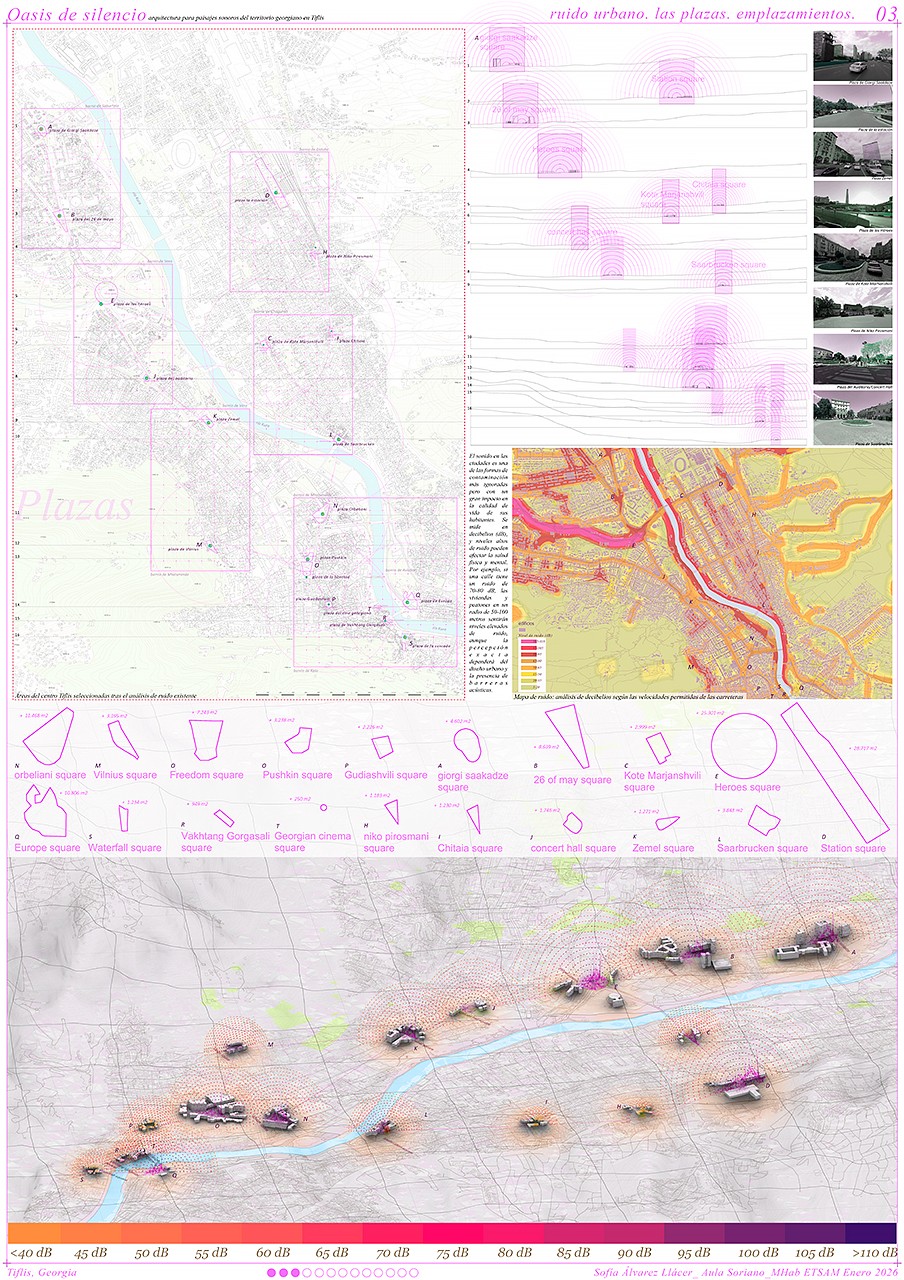
The city of Tbilisi currently experiences high levels of noise pollution, particularly along its main streets and avenues. Road traffic, characterized by strong accelerations, abrupt braking, and relatively high speed limits, generates a constant background noise that invades public spaces and significantly deteriorates the urban environmental quality. This situation not only affects the daily comfort of citizens but also transforms the experience of public space into a hostile environment, where sound ceases to be a neutral element and instead becomes a permanent source of stress.
In response to this issue, the project proposes the creation of a series of urban silence oasis within the city. These are conceived as architectural spaces capable of protecting users from external noise while offering an atmosphere of calm and introspection. These oasis are not intended merely as spaces of acoustic isolation, but rather as active public spaces designed for social interaction, rest, and reconnection with the surrounding environment, where silence becomes a valuable urban resource.
At the same time, the project addresses a second issue of social and territorial nature. Within the current geopolitical context of Georgia, there are communities of people displaced from their places of origin in rural and mountainous regions—territories that have been occupied following conflicts with Russia. Many of these individuals have found refuge in the capital, Tbilisi, and have been forced to abandon not only their homes but also a way of life deeply connected to landscape, nature, and the memory of place.
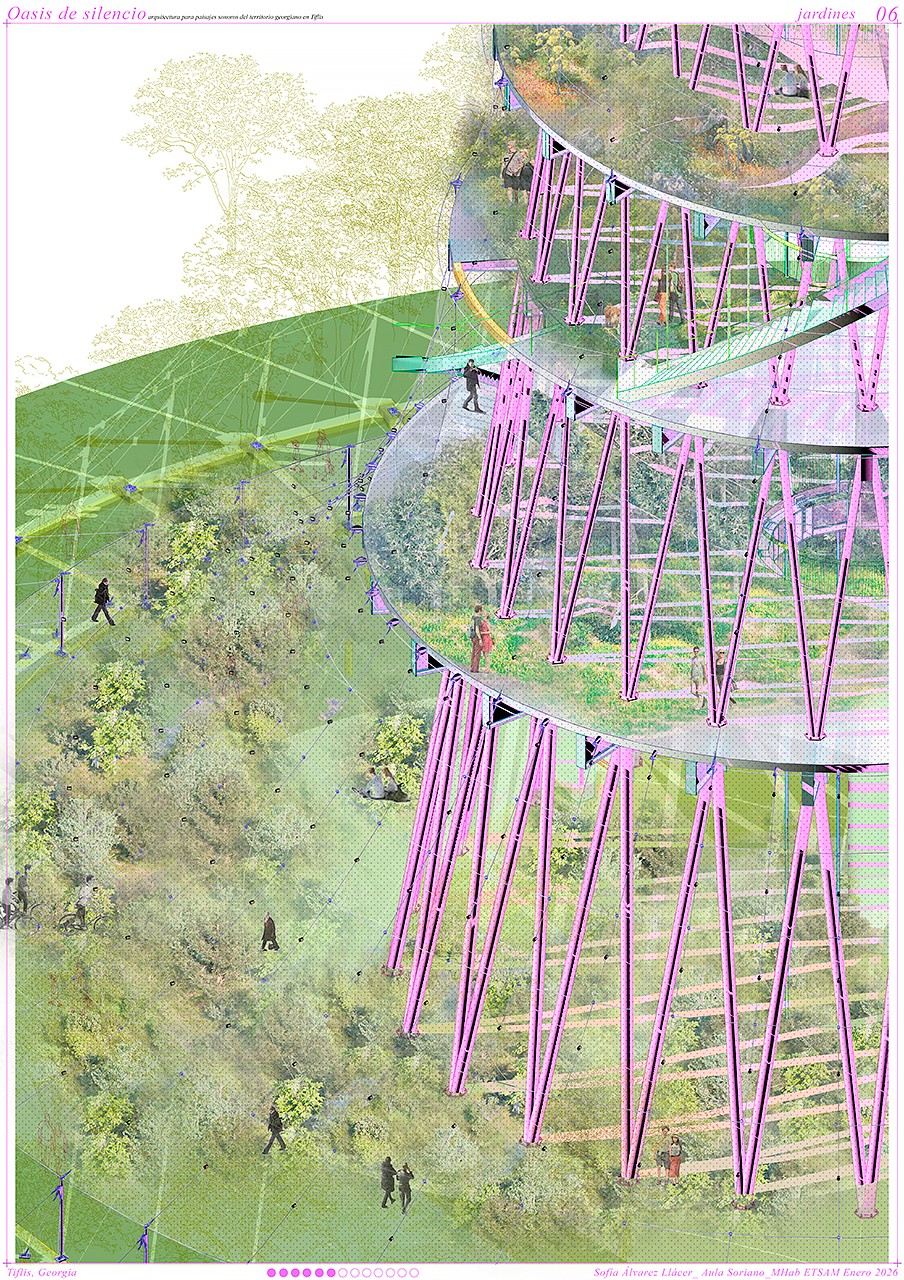
The project therefore understands architecture as a tool capable of rebuilding emotional connections with a lost territory. It proposes the creation of spaces that evoke rural Georgia, incorporating landscape, topography, vegetation, and the silence characteristic of countryside and mountain environments into the urban context. The aim is to bring the landscape into the city—not in a literal sense, but through spatial sensations, atmospheres, and sequences that allow these communities to recognize themselves and feel once again close to their homeland.
From a technological perspective, the project also explores new forms of active noise cancellation applied to architecture. Today, noise cancellation technology is commonly found in everyday devices such as active noise-cancelling headphones, which analyze external sound and generate an inverse wave that neutralizes the perceived noise. At a larger scale, research conducted at universities such as the National University of Singapore has demonstrated the feasibility of sound-cancellation systems integrated into building window frames. These devices are capable of capturing external noise and emitting an opposing wave towards the interior, significantly reducing acoustic transmission without the need for hermetically sealed enclosures.
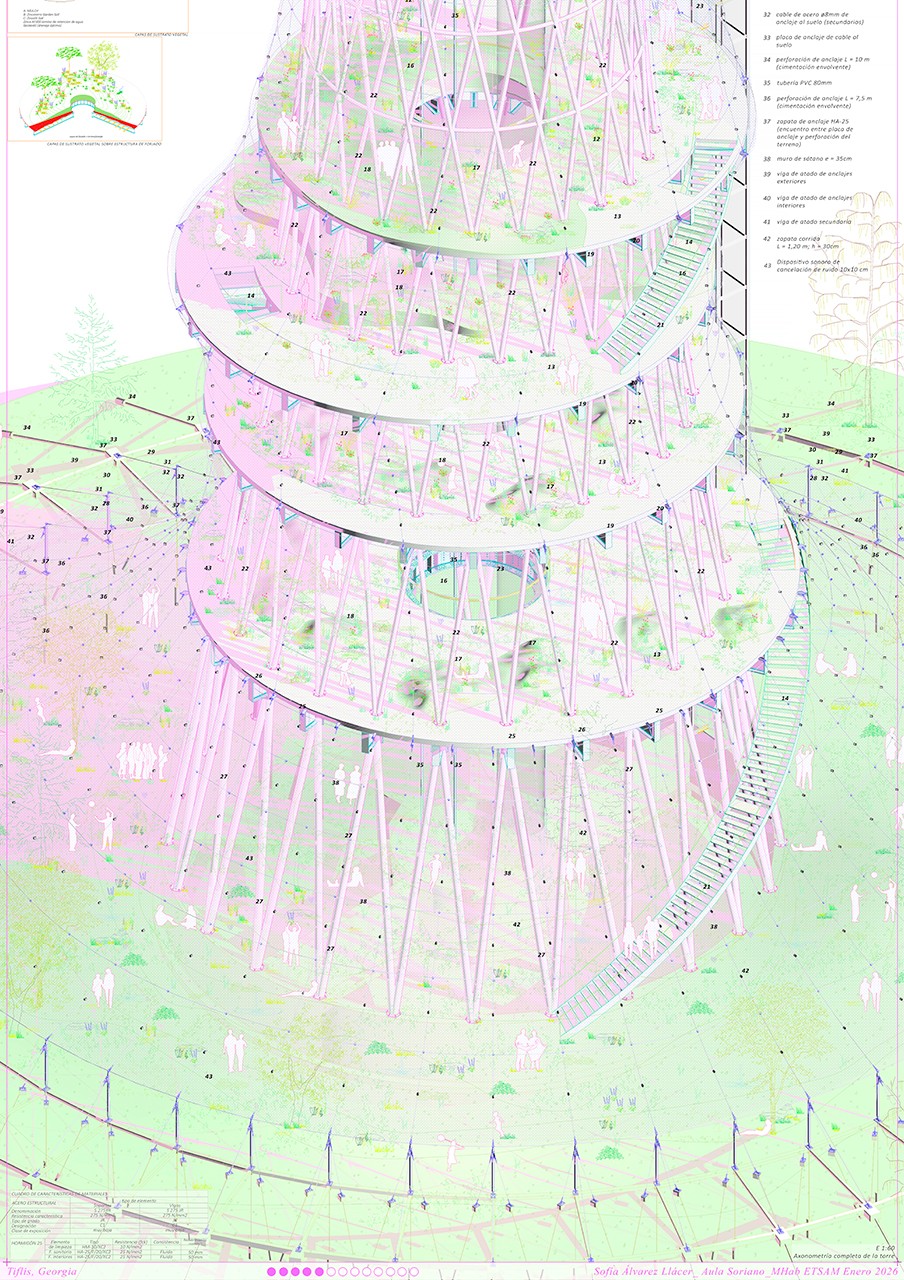
The project translates this principle to an architectural and urban scale by integrating sound detection and emission systems within the building envelope. The façade thus becomes a technological and acoustic skin capable of actively interacting with the surrounding soundscape of the city. Microphones and speakers, embedded within a lightweight and flexible surface, analyze external noise in real time and generate inverse waves that create a protected, quiet, and habitable interior.
In this way, architecture ceases to be a passive element in the face of urban noise and becomes an active device capable of modifying the environmental conditions of a place. The building is conceived as an urban refuge — a hybrid space between technology and landscape, between city and nature — where silence is not simply an absence, but a consciously constructed condition. Ultimately, the project proposes a new relationship between architecture, sound, and the city, in which silence is reclaimed as a collective right and a fundamental element for contemporary urban life.
In response to this issue, the project proposes the creation of a series of urban silence oasis within the city. These are conceived as architectural spaces capable of protecting users from external noise while offering an atmosphere of calm and introspection. These oasis are not intended merely as spaces of acoustic isolation, but rather as active public spaces designed for social interaction, rest, and reconnection with the surrounding environment, where silence becomes a valuable urban resource.
At the same time, the project addresses a second issue of social and territorial nature. Within the current geopolitical context of Georgia, there are communities of people displaced from their places of origin in rural and mountainous regions—territories that have been occupied following conflicts with Russia. Many of these individuals have found refuge in the capital, Tbilisi, and have been forced to abandon not only their homes but also a way of life deeply connected to landscape, nature, and the memory of place.
The project therefore understands architecture as a tool capable of rebuilding emotional connections with a lost territory. It proposes the creation of spaces that evoke rural Georgia, incorporating landscape, topography, vegetation, and the silence characteristic of countryside and mountain environments into the urban context. The aim is to bring the landscape into the city—not in a literal sense, but through spatial sensations, atmospheres, and sequences that allow these communities to recognize themselves and feel once again close to their homeland.
From a technological perspective, the project also explores new forms of active noise cancellation applied to architecture. Today, noise cancellation technology is commonly found in everyday devices such as active noise-cancelling headphones, which analyze external sound and generate an inverse wave that neutralizes the perceived noise. At a larger scale, research conducted at universities such as the National University of Singapore has demonstrated the feasibility of sound-cancellation systems integrated into building window frames. These devices are capable of capturing external noise and emitting an opposing wave towards the interior, significantly reducing acoustic transmission without the need for hermetically sealed enclosures.
The project translates this principle to an architectural and urban scale by integrating sound detection and emission systems within the building envelope. The façade thus becomes a technological and acoustic skin capable of actively interacting with the surrounding soundscape of the city. Microphones and speakers, embedded within a lightweight and flexible surface, analyze external noise in real time and generate inverse waves that create a protected, quiet, and habitable interior.
In this way, architecture ceases to be a passive element in the face of urban noise and becomes an active device capable of modifying the environmental conditions of a place. The building is conceived as an urban refuge — a hybrid space between technology and landscape, between city and nature — where silence is not simply an absence, but a consciously constructed condition. Ultimately, the project proposes a new relationship between architecture, sound, and the city, in which silence is reclaimed as a collective right and a fundamental element for contemporary urban life.






- 00 - Description
- 01 - oasis de silencio
- 02 - silencio en el campo
- 03 - paisajes
- 04 - ruido urbano
- 05 - torre-plaza
- 06 - ecosistema
- 07 - vertical
- 08 - jardines
- 09 - llegada al oasis
- 10 - especies endémicas
- 11 - envolvente sonora
- 12 - de ruido a silencio
- 13 - geometría/patronaje
- 14 - estructura
- 15 - programa vertical
- 16 - Video