
PASAIO BEGIA
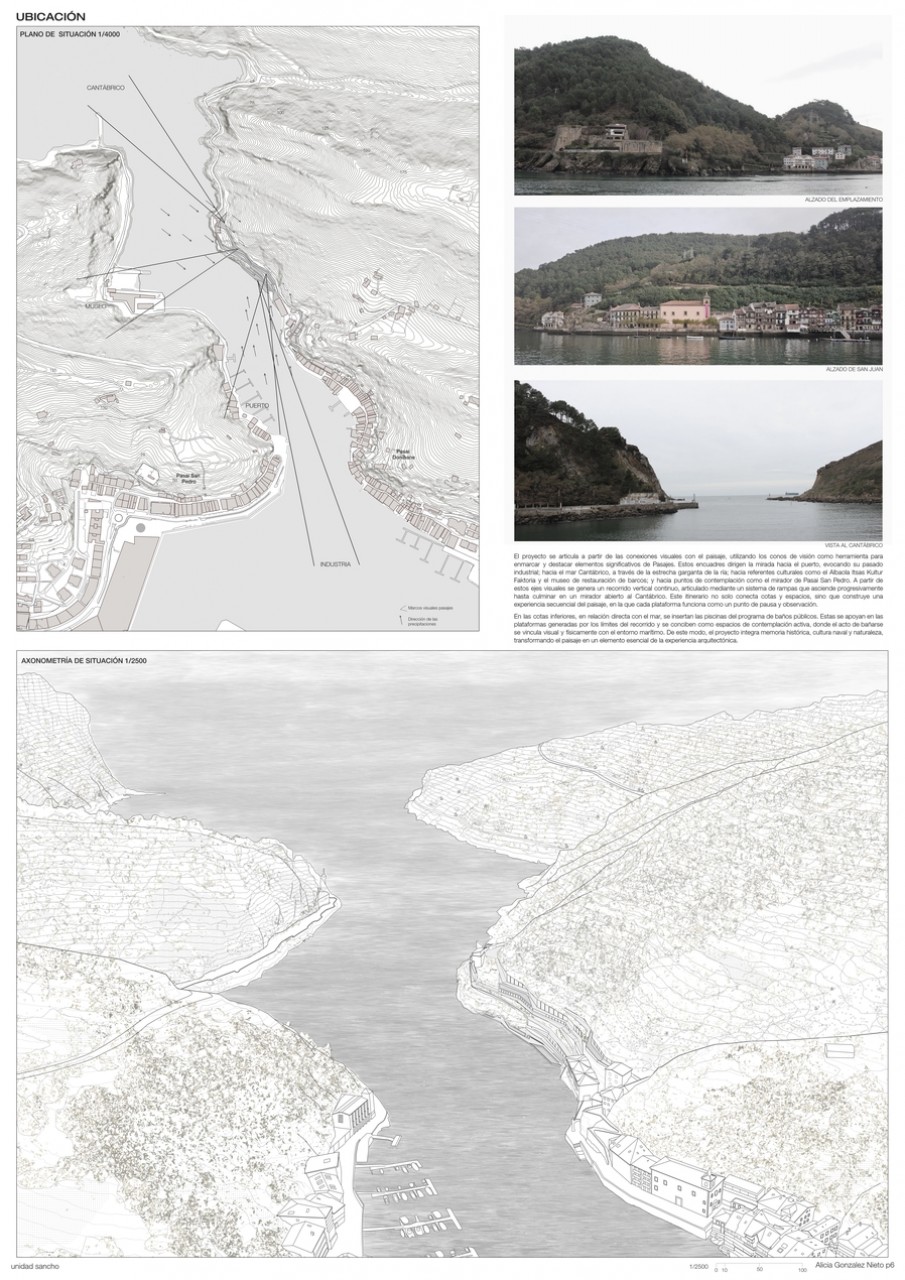
Pasajes is a place deeply shaped by industrialization. A town where productive activity has defined not only the landscape but also its fractures. The project is located precisely in one of them: the mouth of Pasajes, the estuary that connects the port and the historic center with the Cantabrian Sea.
PASAIO BEGIA emerges from the study of the site’s variables, understood as design tools. These include the topography—a steep hillside where the built fabric rises to elevations of approximately 25 meters above sea level; orientation and solar exposure, which make it possible to identify favorable points and define solar control strategies; and maritime traffic, an active corridor currently navigated by vessels up to 40 meters in height, conditioning the form and growth of the coastal edge.
From this reading, the project seeks to establish a new relationship between the city, the port, and the sea, creating a new urban and landscape threshold. It reactivates the waterfront promenade and reconnects two historic elements that are currently disconnected: the Arch of Santa Ana and the Castle of Santa Isabel, former landmarks that once functioned as gateways and are brought together again through the project.
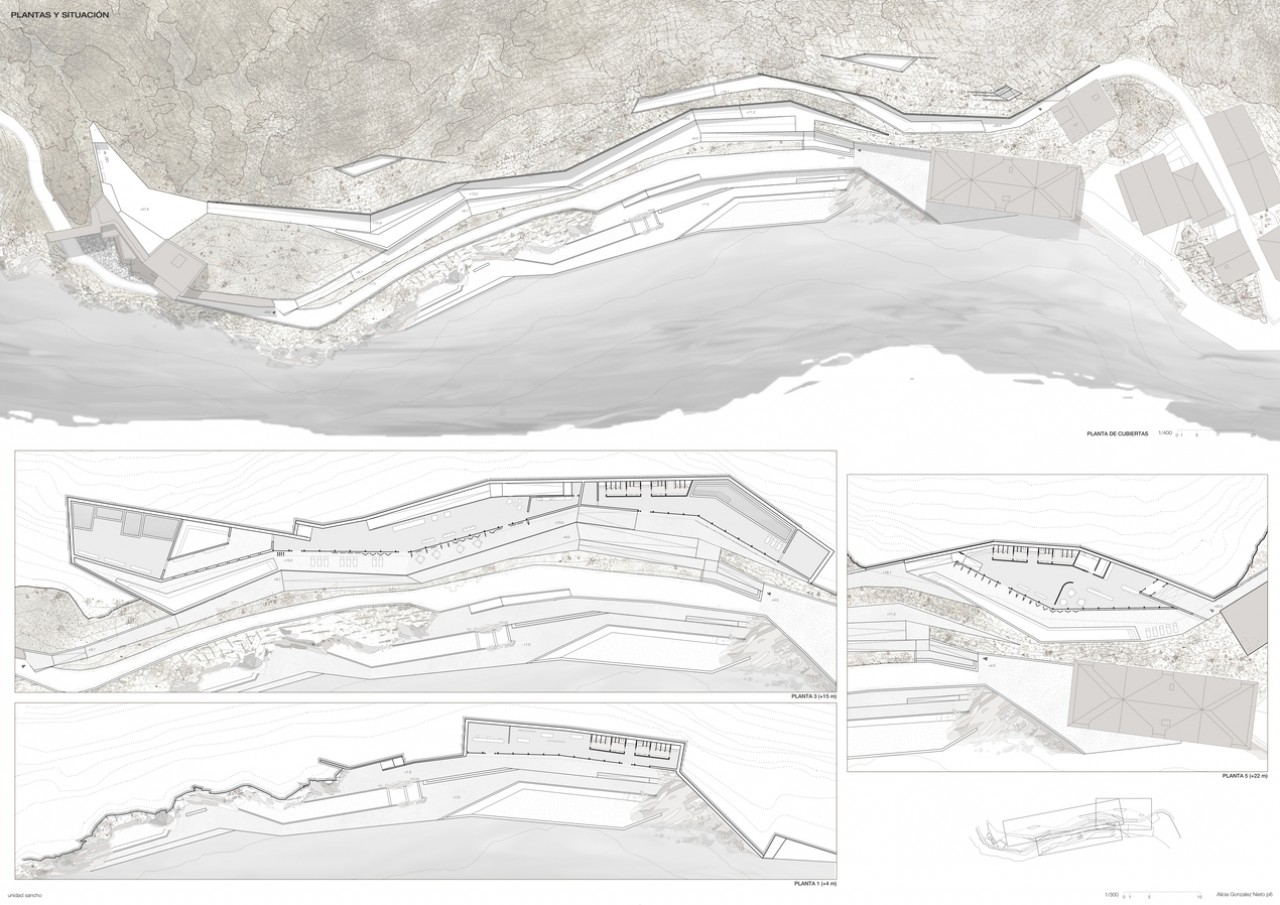
The project is organized into three areas, conceived as a single continuous route and articulated through the existing path.
The first area intervenes in the coastal edge through a system of natural pools that adapts to the existing shoreline, reshaping it and activating the space as a place for public use and direct contact with the water.
The second area develops through an ascending sequence of folded ramps, conceived as a route of observation over Pasajes. Through the work with visual cones and viewpoints, the project is defined through experience, offering four perspectives: toward the industrial past, toward nature, toward the cultural and historical dimension, and toward the sea. This route also incorporates a program of indoor and outdoor pools and thermal baths, reinforcing the idea of pause, observation, and reflection.
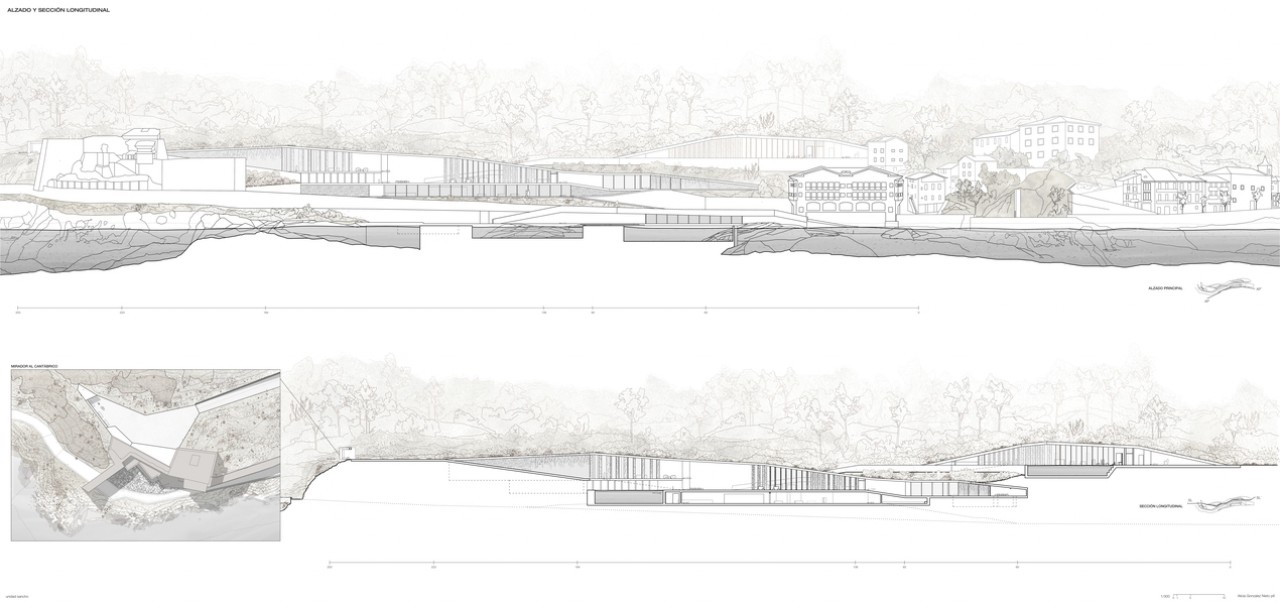
The third area culminates in a lookout over the Cantabrian Sea, reusing the Castle of Santa Isabel, a former gateway to the sea. The intervention transforms it into a symbolic frame where the memory of the place and the landscape converge.
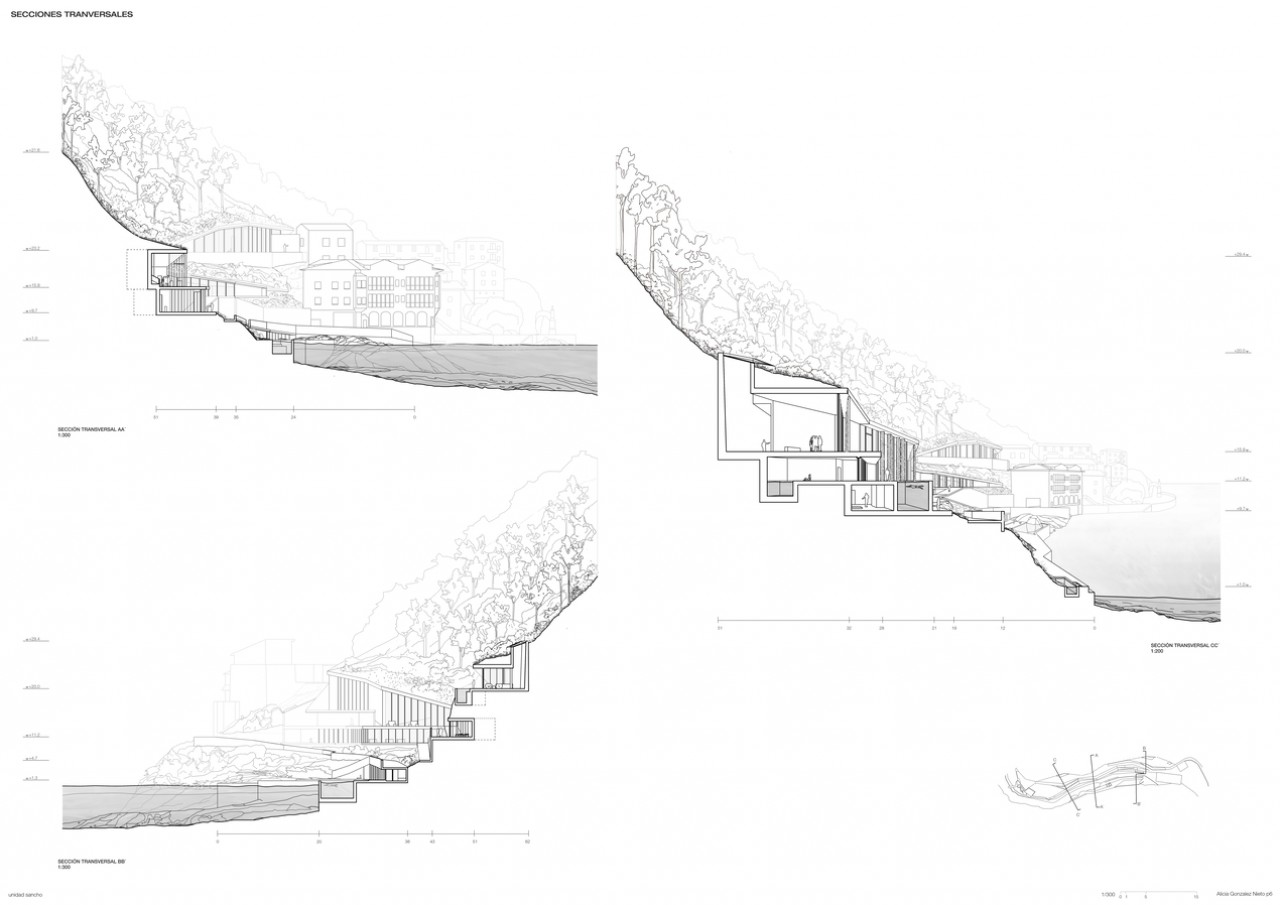
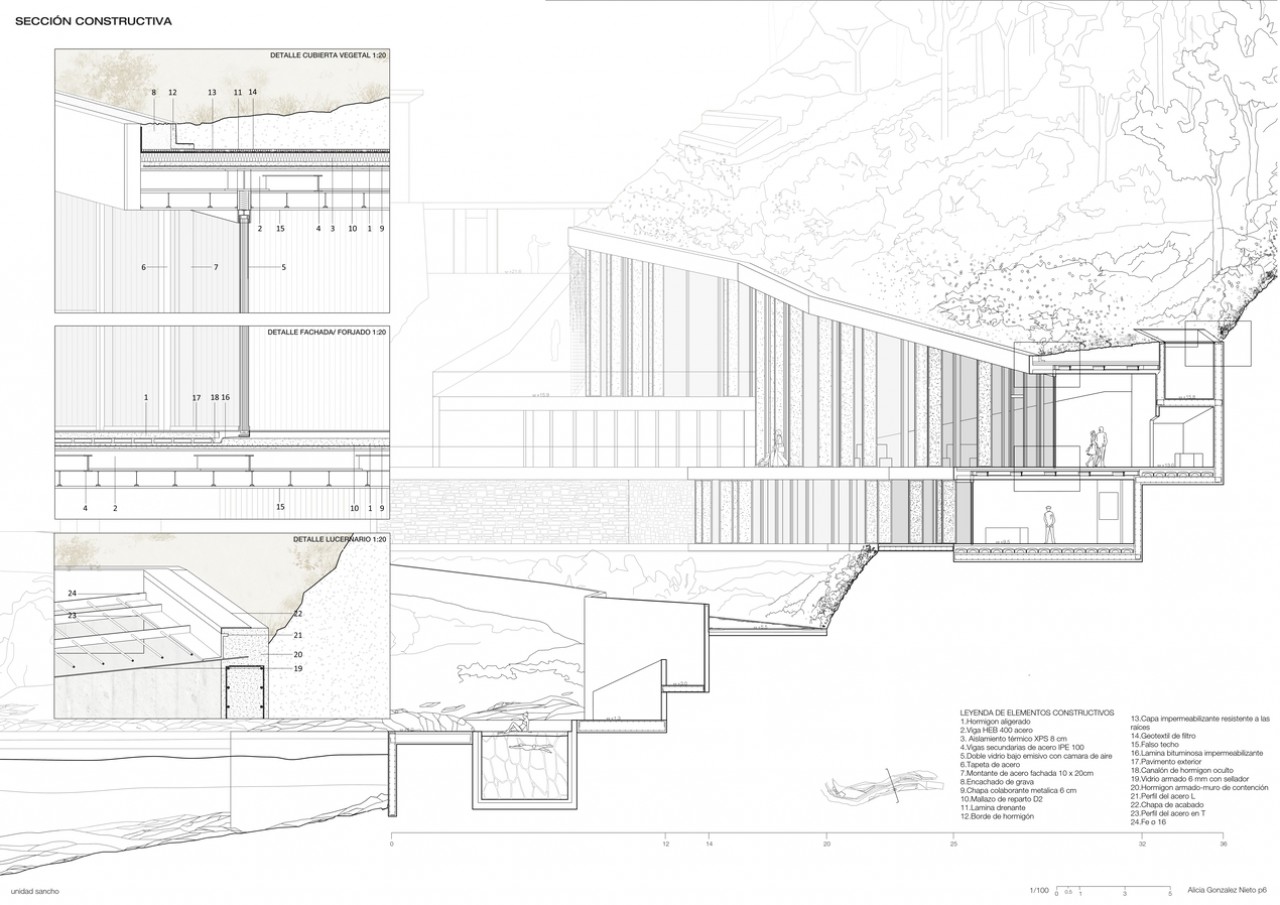
In plan, the project is configured as a system of broken bands that adapt to the topography. The interior spaces along the route are housed beneath a folded concrete slab, generating five levels in height. The structure is resolved through retaining walls, with a façade composed of floor-to-ceiling structural glazing that frees the interior space. In areas requiring greater enclosure, stone panels are used, while in zones with higher solar exposure, double-skin systems are incorporated, either through movable perforated corten steel modules or vegetated façades with hanging plants, filtering light and connecting the building to the landscape. A green roof fully integrates the project into the existing hillside.
PASAIO BEGIA does not seek to impose itself on the territory, but rather to reconnect city, port, and landscape through movement and vision, transforming the territory into a place.
PASAIO BEGIA emerges from the study of the site’s variables, understood as design tools. These include the topography—a steep hillside where the built fabric rises to elevations of approximately 25 meters above sea level; orientation and solar exposure, which make it possible to identify favorable points and define solar control strategies; and maritime traffic, an active corridor currently navigated by vessels up to 40 meters in height, conditioning the form and growth of the coastal edge.
From this reading, the project seeks to establish a new relationship between the city, the port, and the sea, creating a new urban and landscape threshold. It reactivates the waterfront promenade and reconnects two historic elements that are currently disconnected: the Arch of Santa Ana and the Castle of Santa Isabel, former landmarks that once functioned as gateways and are brought together again through the project.
The project is organized into three areas, conceived as a single continuous route and articulated through the existing path.
The first area intervenes in the coastal edge through a system of natural pools that adapts to the existing shoreline, reshaping it and activating the space as a place for public use and direct contact with the water.
The second area develops through an ascending sequence of folded ramps, conceived as a route of observation over Pasajes. Through the work with visual cones and viewpoints, the project is defined through experience, offering four perspectives: toward the industrial past, toward nature, toward the cultural and historical dimension, and toward the sea. This route also incorporates a program of indoor and outdoor pools and thermal baths, reinforcing the idea of pause, observation, and reflection.
The third area culminates in a lookout over the Cantabrian Sea, reusing the Castle of Santa Isabel, a former gateway to the sea. The intervention transforms it into a symbolic frame where the memory of the place and the landscape converge.
In plan, the project is configured as a system of broken bands that adapt to the topography. The interior spaces along the route are housed beneath a folded concrete slab, generating five levels in height. The structure is resolved through retaining walls, with a façade composed of floor-to-ceiling structural glazing that frees the interior space. In areas requiring greater enclosure, stone panels are used, while in zones with higher solar exposure, double-skin systems are incorporated, either through movable perforated corten steel modules or vegetated façades with hanging plants, filtering light and connecting the building to the landscape. A green roof fully integrates the project into the existing hillside.
PASAIO BEGIA does not seek to impose itself on the territory, but rather to reconnect city, port, and landscape through movement and vision, transforming the territory into a place.




- 00 - Description
- 01 - Analysis & program
- 02 - Location & situation
- 03 - Plans
- 04 - Longitudinal section
- 05 - Cross sections
- 06 - Site Axonometry
- 07 - Construction section
- 08 - Constructive Axo
- 09 - Images
- 10 - Images