
PendeVÍA
1 IDEA AND CONTEXT
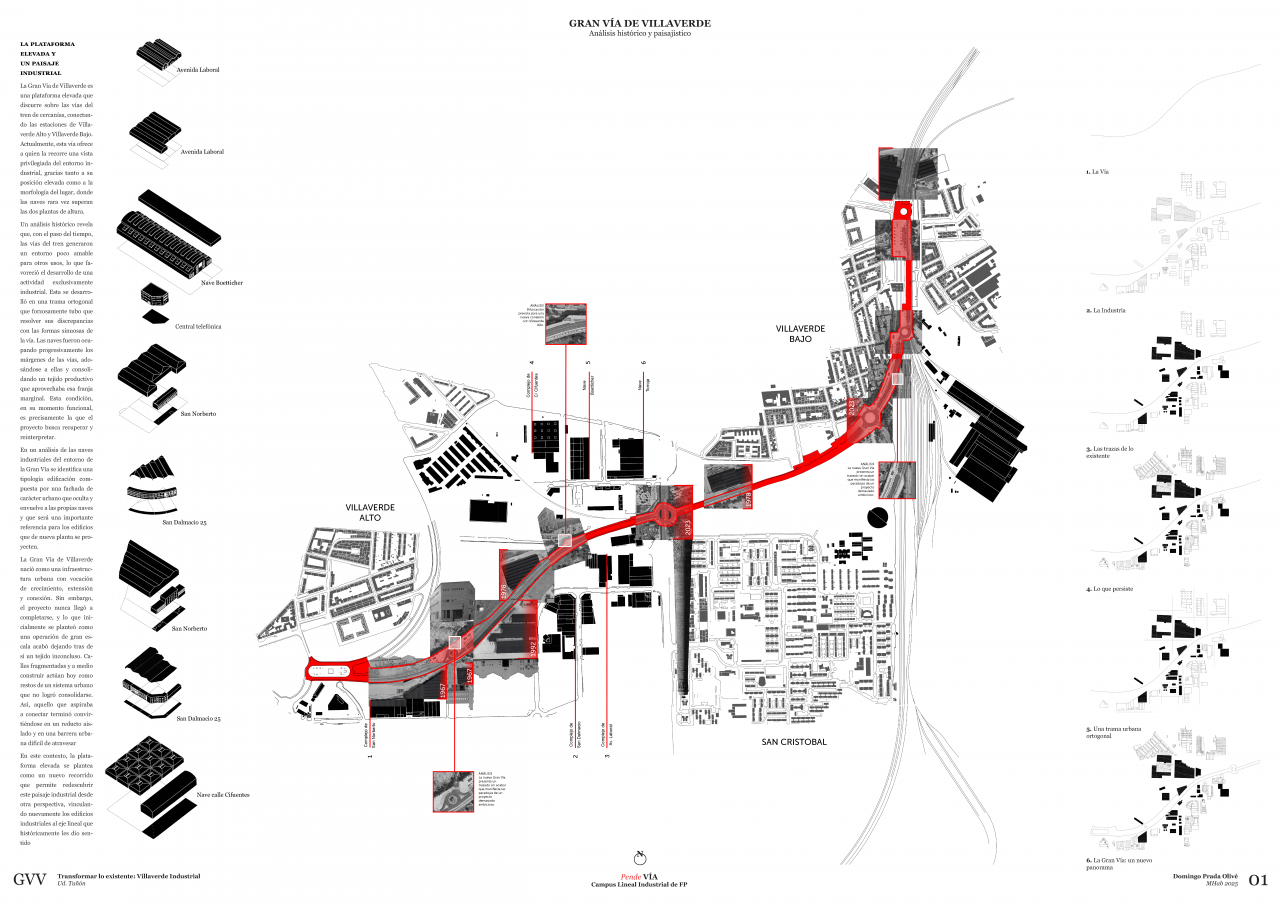
The project is located in the area of Villaverde Industrial, a territory historically linked to railway infrastructure and to Madrid’s productive development. The arrival of the railway in the nineteenth century shaped an industrial landscape whose urban morphology was deeply determined by the alignment of the tracks and the progressive implantation of warehouses and factories along their edges.
With the decline of industrial activity, this system lost its original meaning: the warehouses became obsolete, the urban fabric was fragmented, and the railway infrastructure shifted from being a structuring element to becoming an urban barrier.
In this context, the Gran Vía de Villaverde emerges as an elevated platform conceived as an urban infrastructure capable of stitching the territory together. However, its incomplete development resulted in an unfinished system, characterized by unresolved urban fronts and residual spaces lacking a clear identity.
The project takes this platform as both seed and structural axis for the implantation of a Vocational Training campus, understanding the Gran Vía not merely as infrastructure, but as a new suspended urban layer capable of reactivating, reinterpreting, and extending the existing productive landscape.
2 PROGRAM
The campus is conceived as a productive and educational ecosystem in which classrooms, workshops, laboratories, applied research spaces, exhibition areas, common spaces, a library, a project incubator, and flexible spaces coexist alongside a residential program linked to students and young professionals. This programmatic mix seeks to ensure an almost permanent level of activity and to recover a historical condition of the site, in which life and work coexisted under the same roof.
3 URBAN STRATEGY
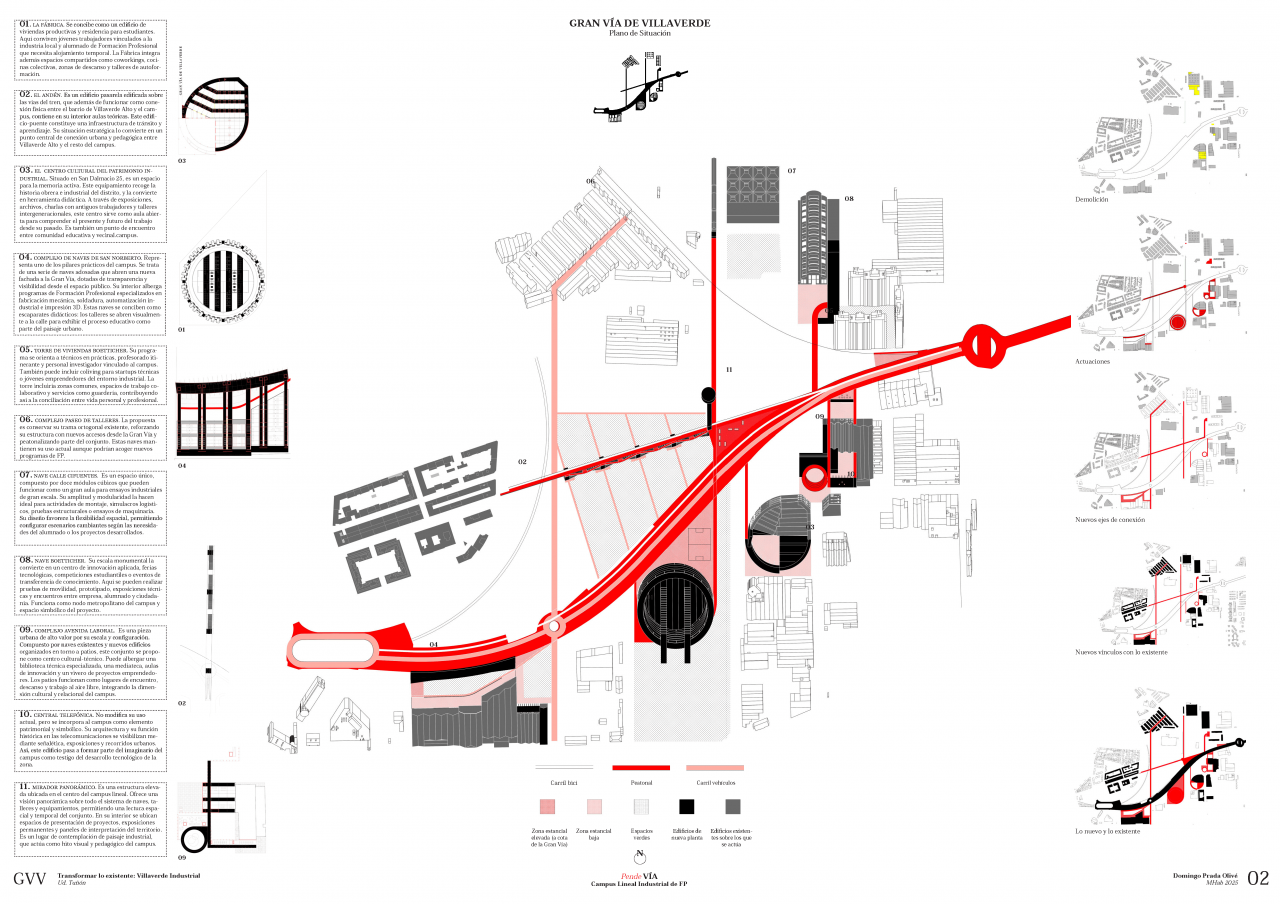
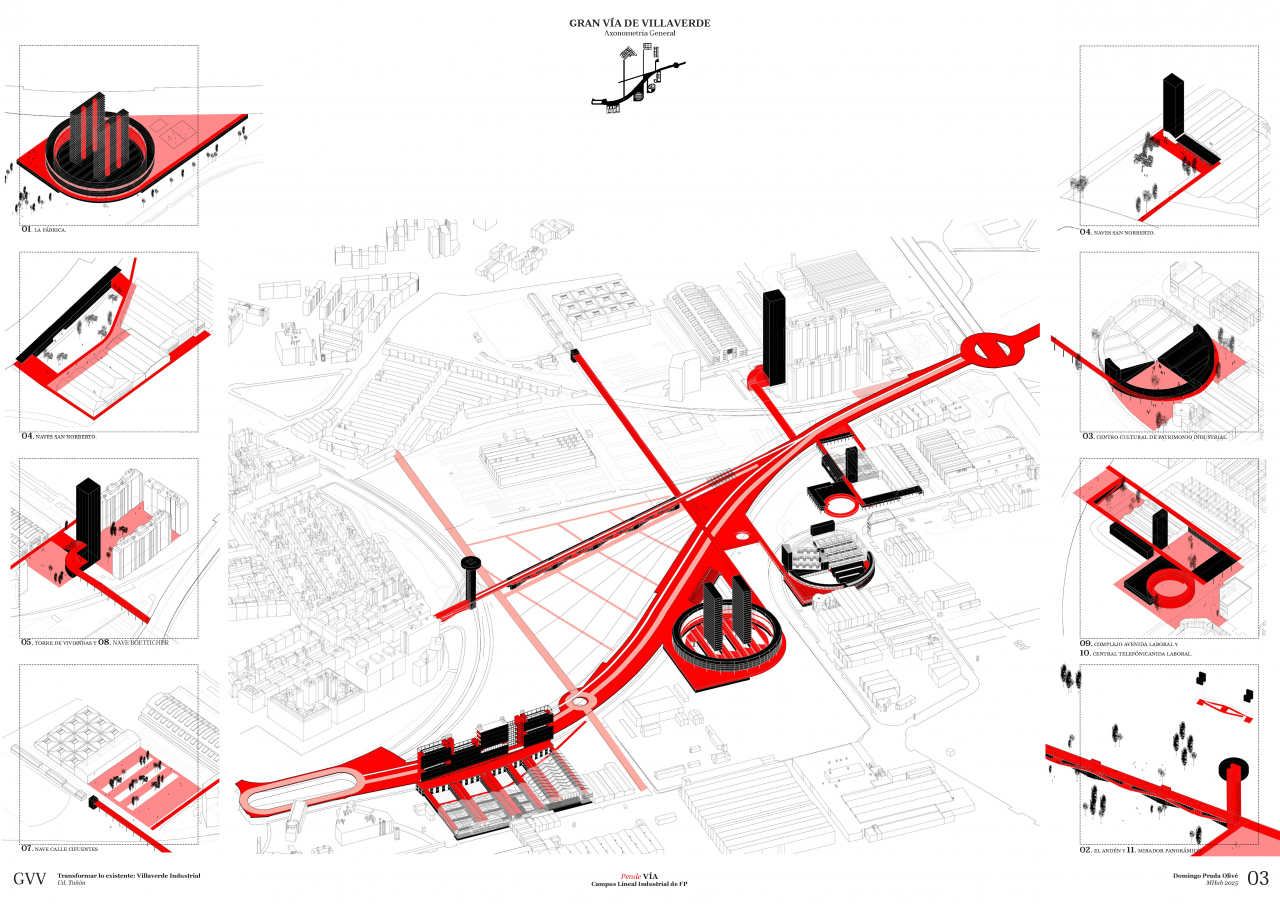
The proposal understands the campus as a linear system of interventions supported by the Gran Vía de Villaverde. Through vertical extensions, ramps, spirals, and walkways, a new artificial topography is constructed that allows the recomposition of the fragmented industrial fabric, the restoration of pedestrian continuity across the railway tracks, and the reconnection of the former warehouses with the elevated urban axis.
These walkways operate as contemporary urban docks, evoking the historical relationship between industry and the railway. They are no longer conceived as infrastructures for the exchange of goods, but as supports for the exchange of knowledge, education, and contemporary productive activity.
The interventions do not replace the existing fabric, but rather complete it, stitch it together, and reprogram it, generating new façades facing the Gran Vía and providing the warehouses with the infrastructures required to accommodate new educational, residential, and productive uses.
4 TYPOLOGY AS PROJECT
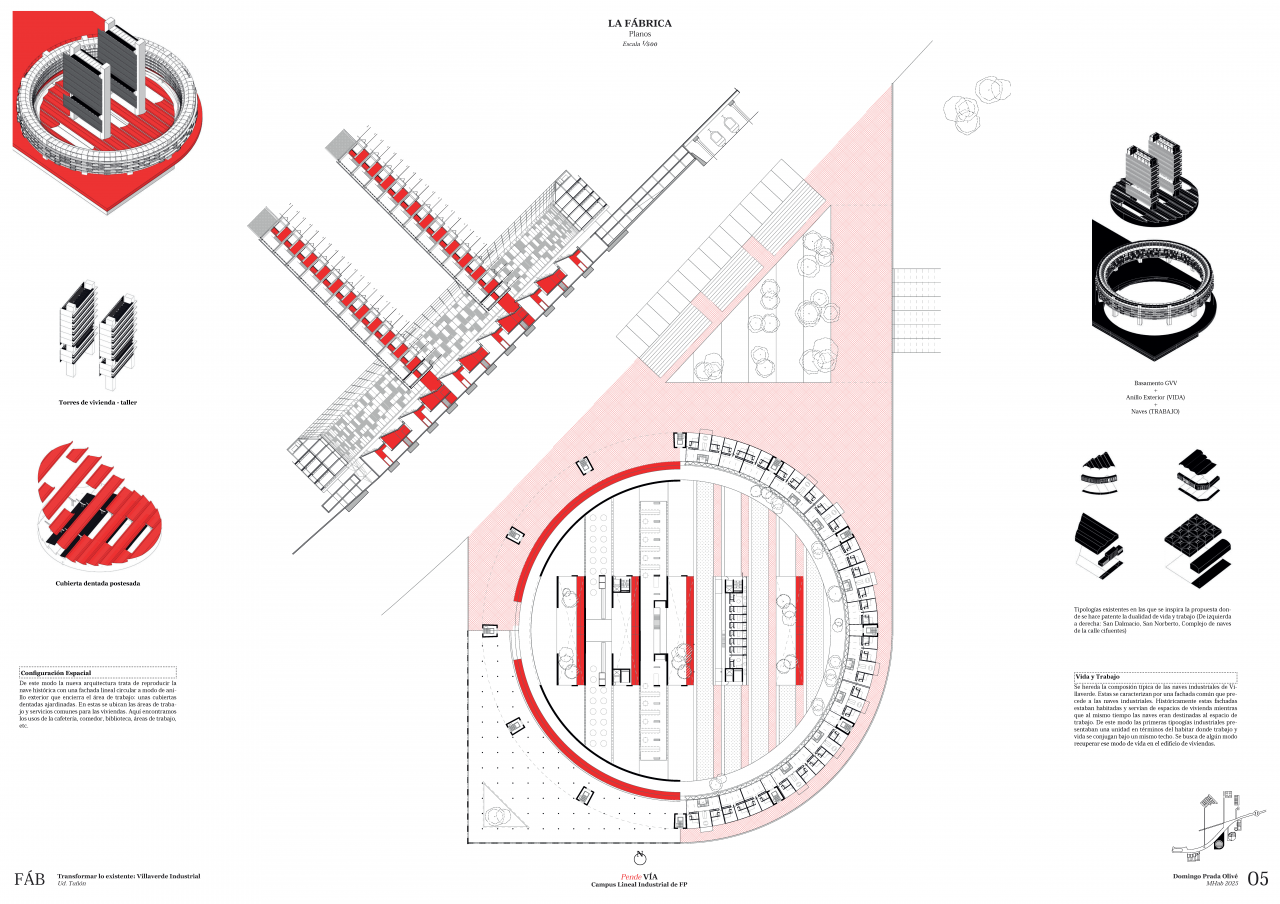
The project is based on the historical typology of Villaverde, structured around the façade–warehouse binomial. The façade is understood as an urban, representative, and inhabited element, while the warehouse is conceived as a flexible and deep productive space. This duality reflected an essential condition of the industrial landscape, in which life and work shared a single architectural support.
The new campus recovers this typological logic and reinterprets it from a contemporary perspective, in which education, production, research, and residence once again coexist within a single architectural system.
5 THE PROJECT COMPONENTS
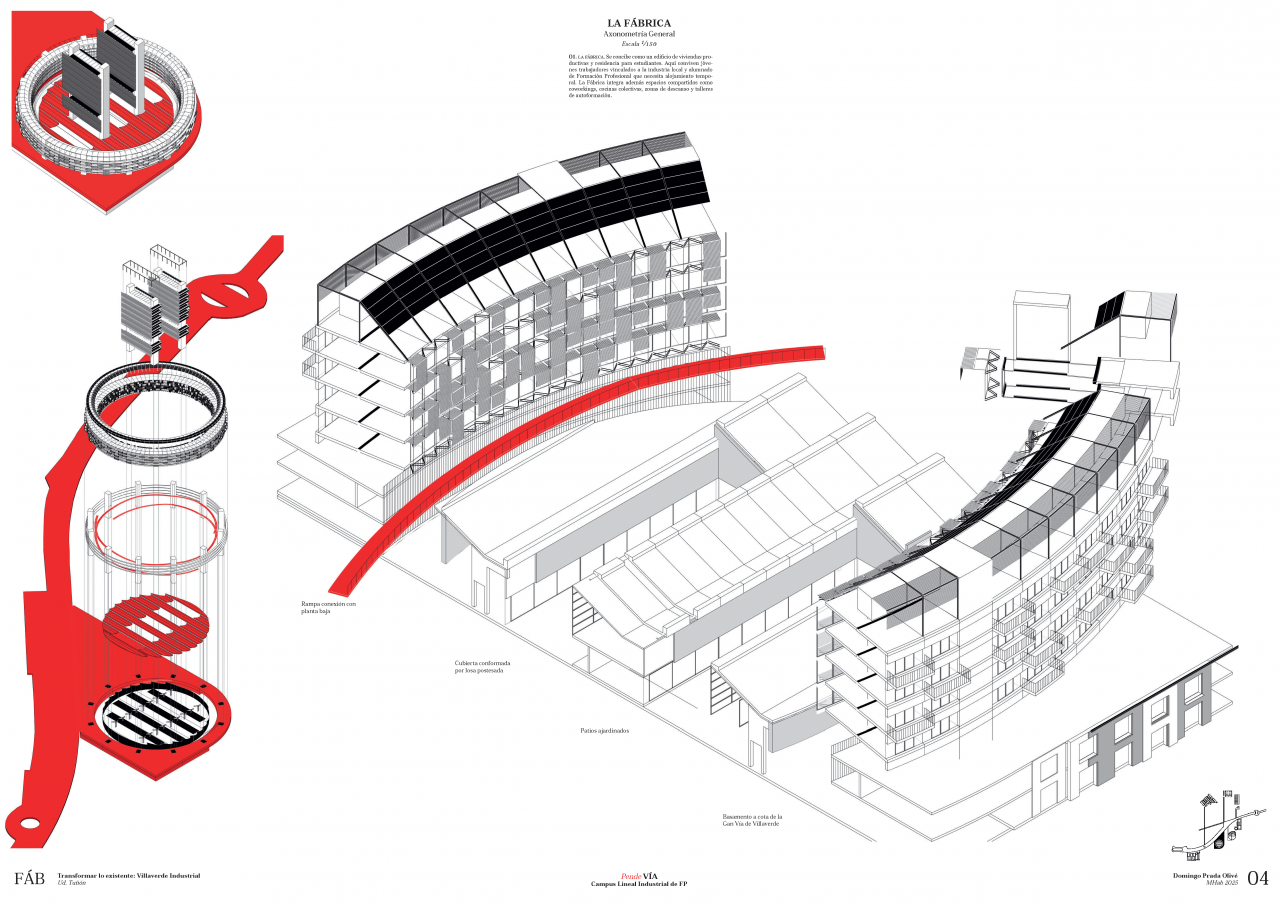
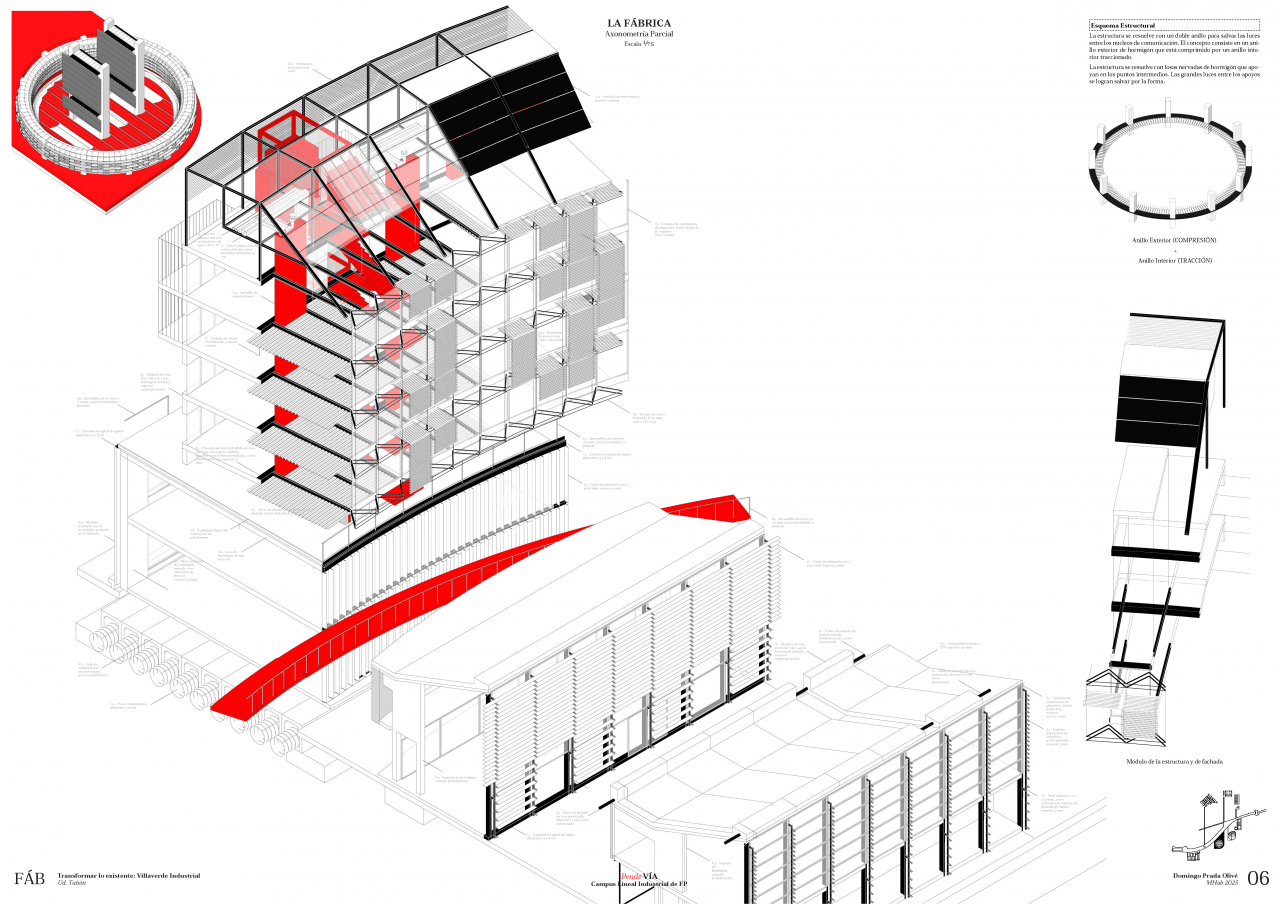
La Fábrica is a new-build structure that acts both as an extension of the Gran Vía and as a landmark within the campus. It accommodates productive housing, student residences, workshops, and shared spaces. Its volumetric and spatial organization reinterprets traditional industrial architecture, establishing a balance between a dense interior and an exterior open to the productive landscape.
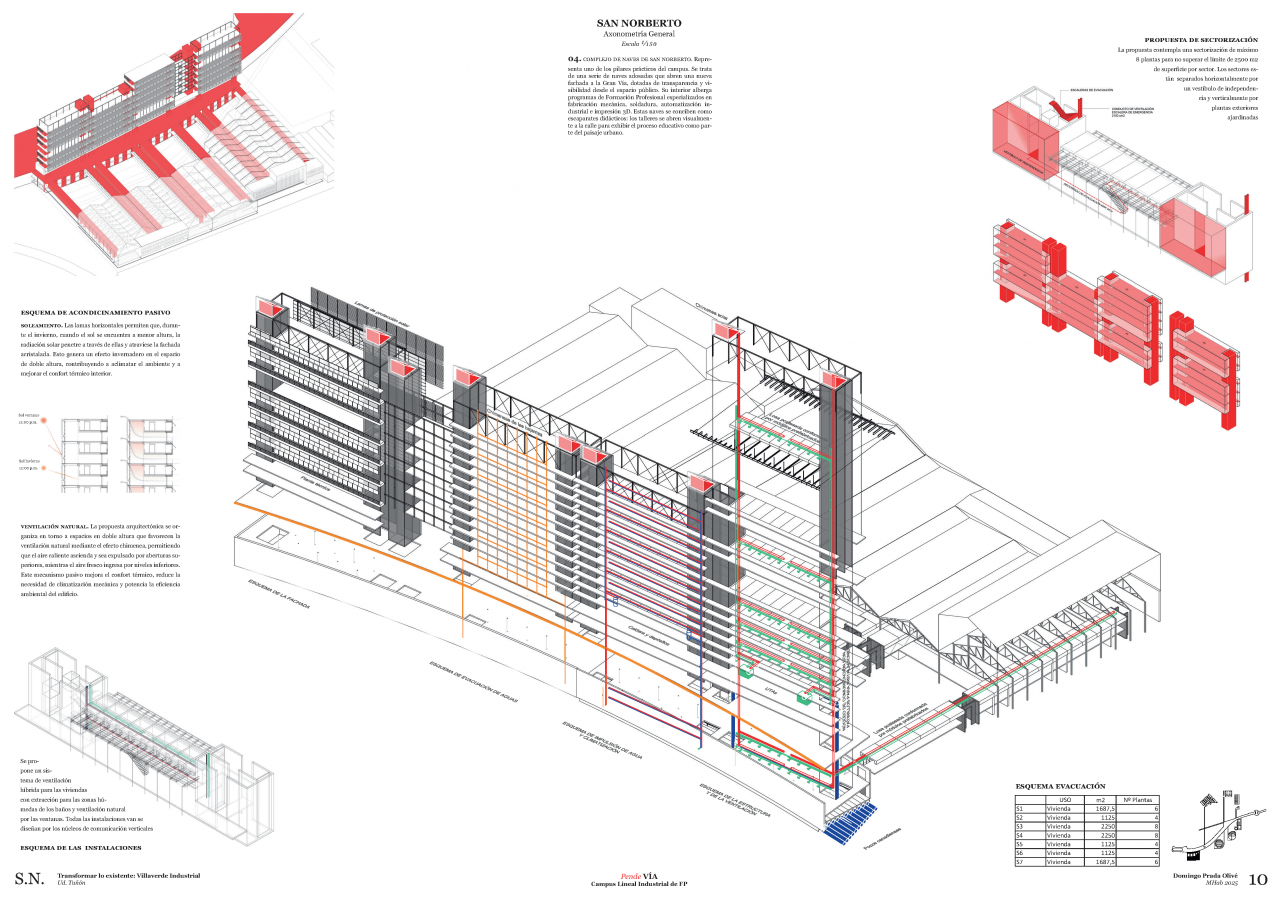
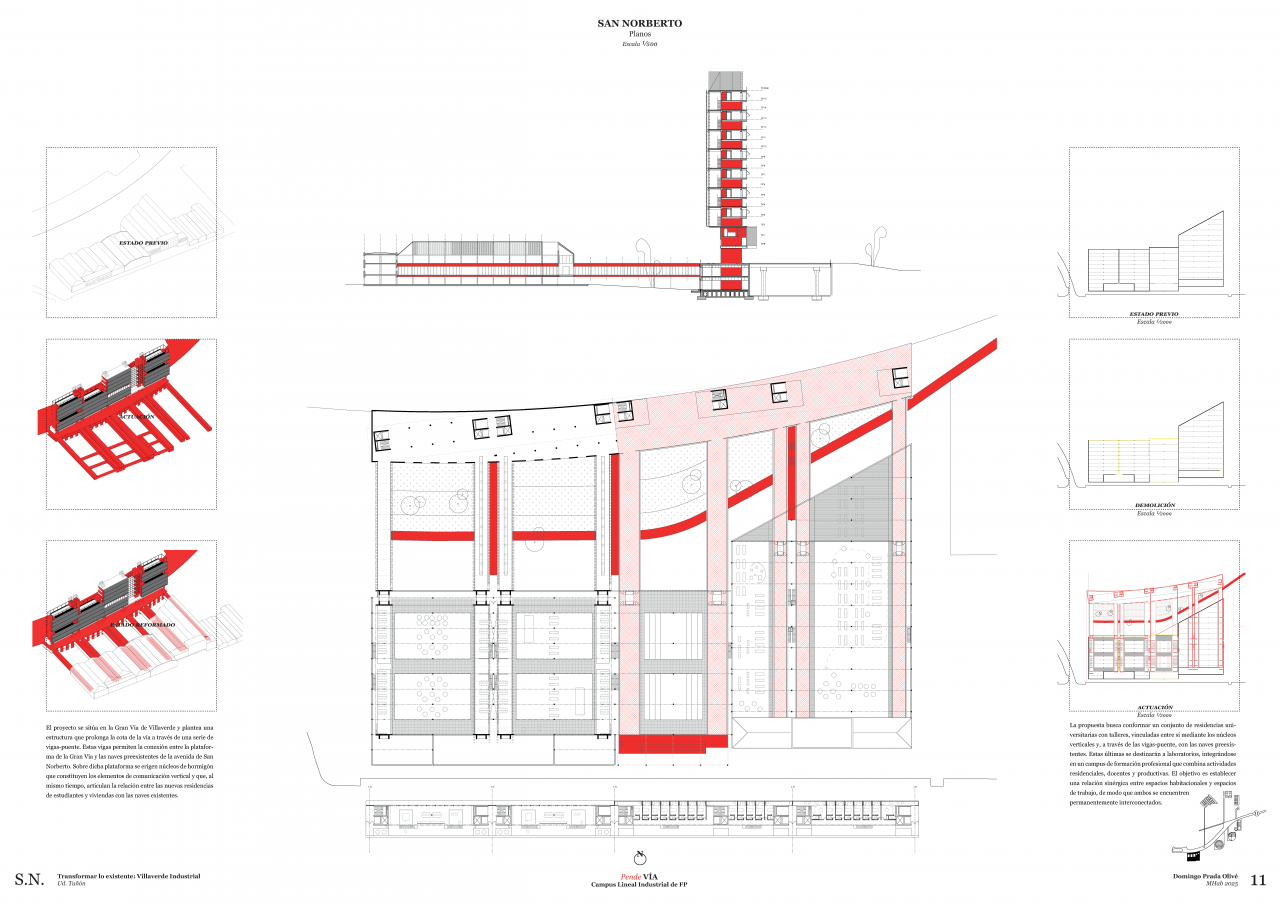
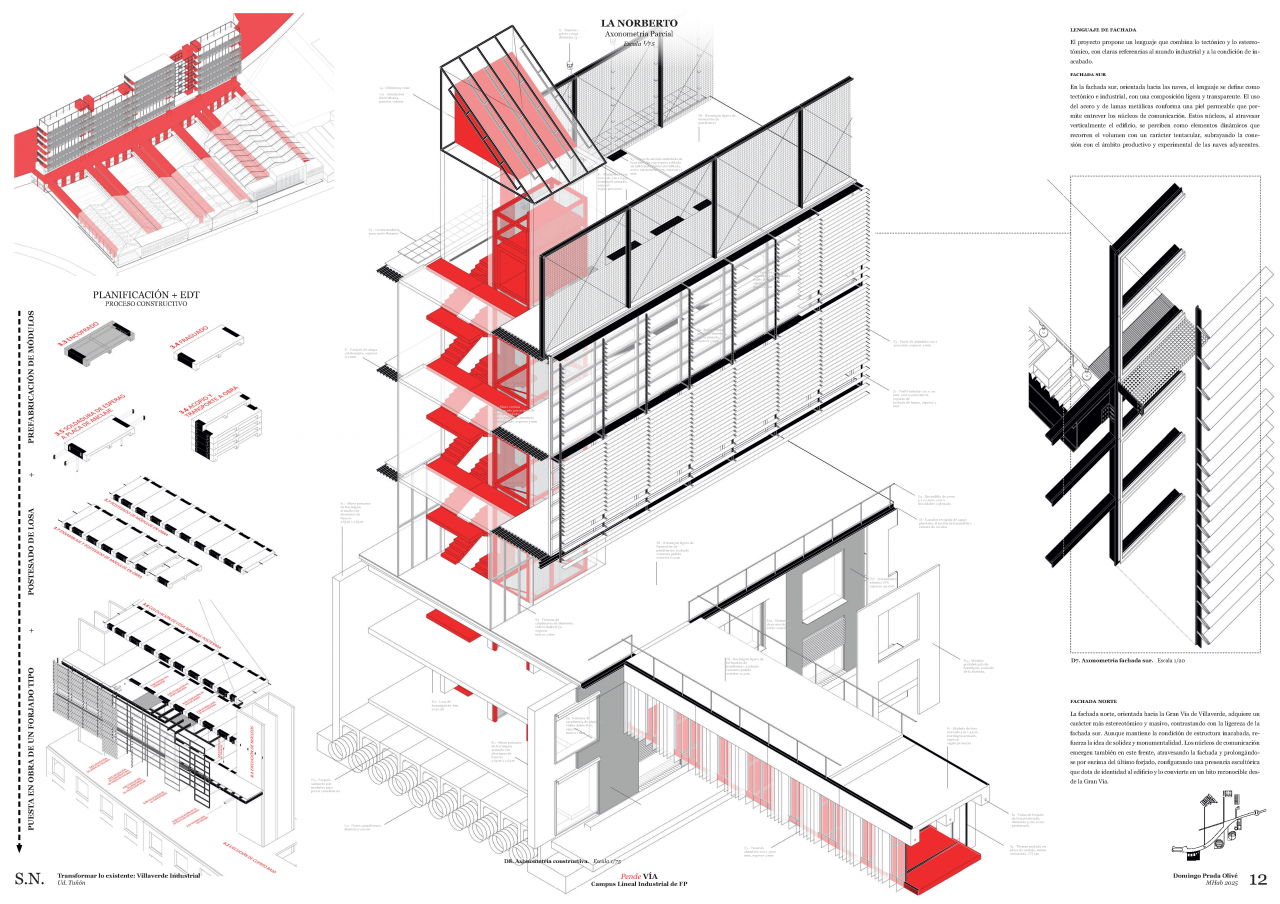
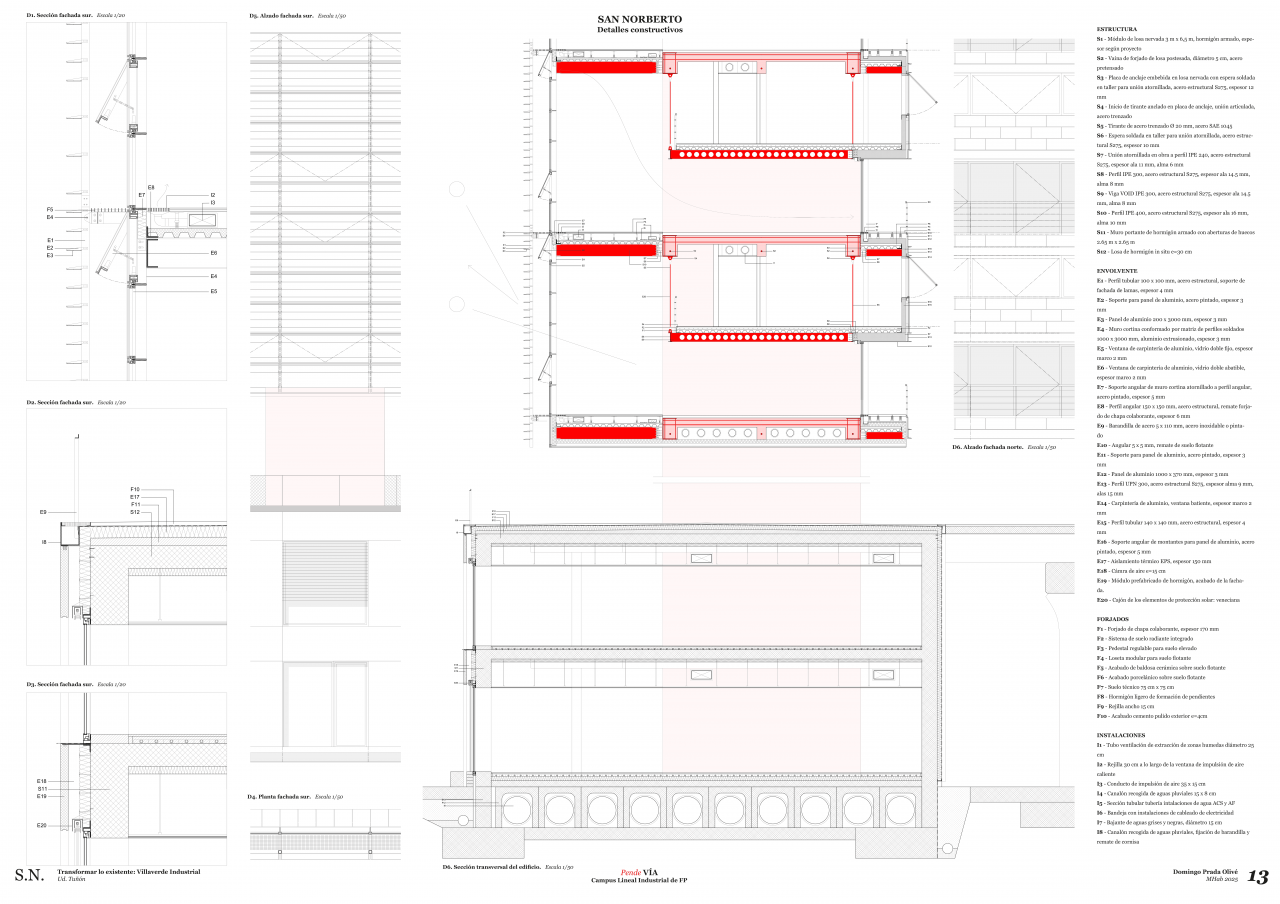
The intervention at San Norberto reconfigures the existing warehouses through a new threshold-façade facing the Gran Vía. An open, lightweight, and extendable structure generates a scaffold-like image that expresses the evolutionary character of the campus. Structural walkways directly connect the warehouses to the elevated platform, materializing the everyday journey between living and working.
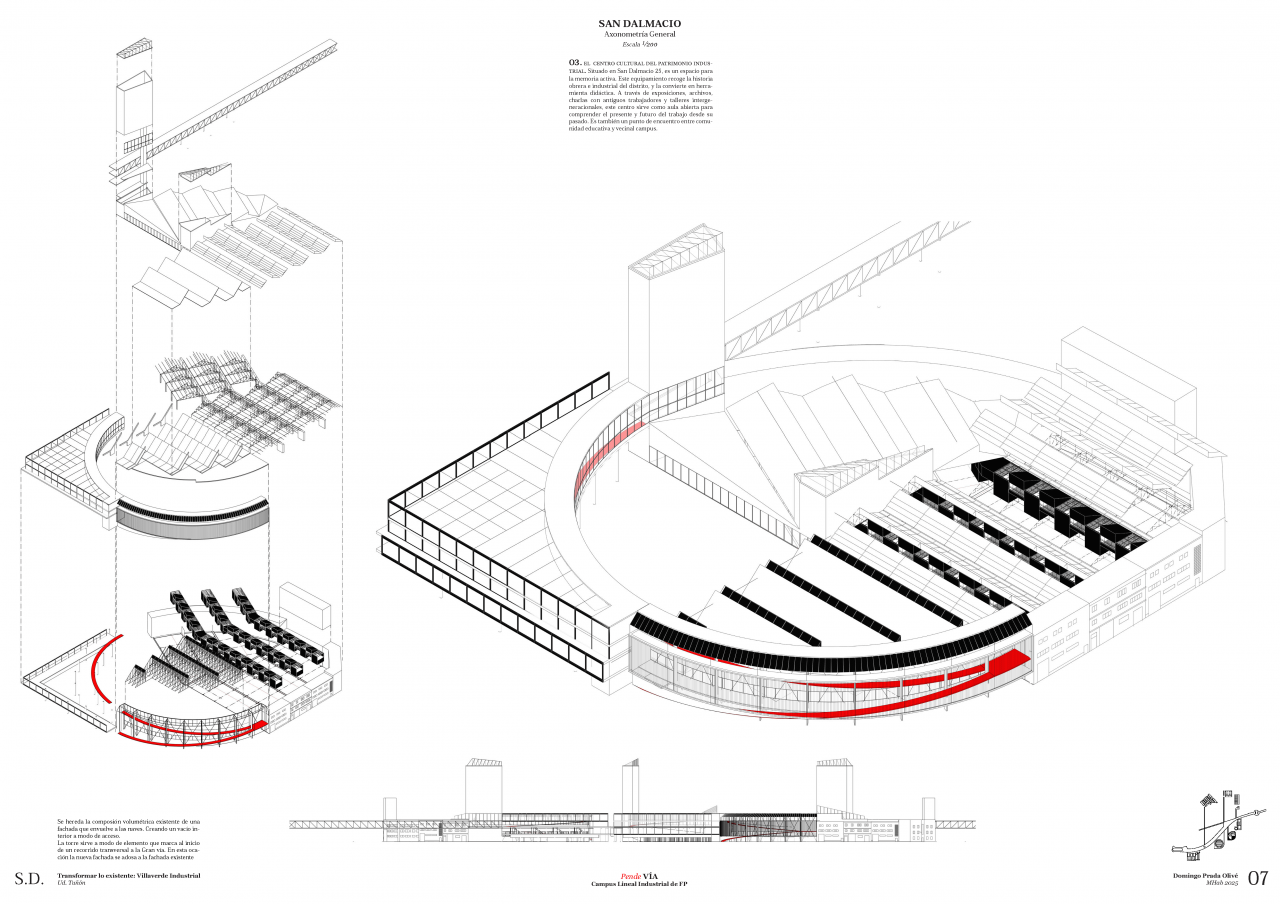
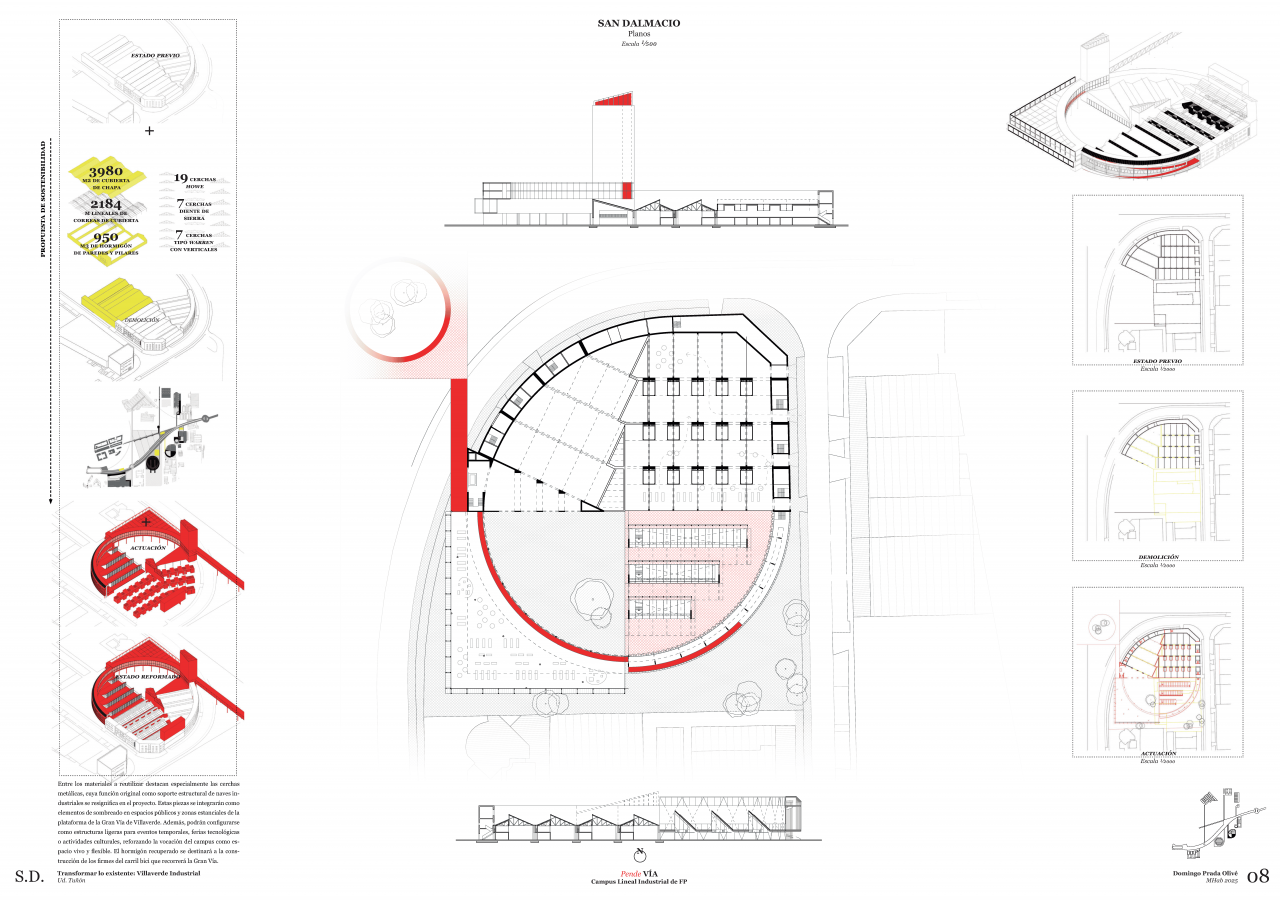
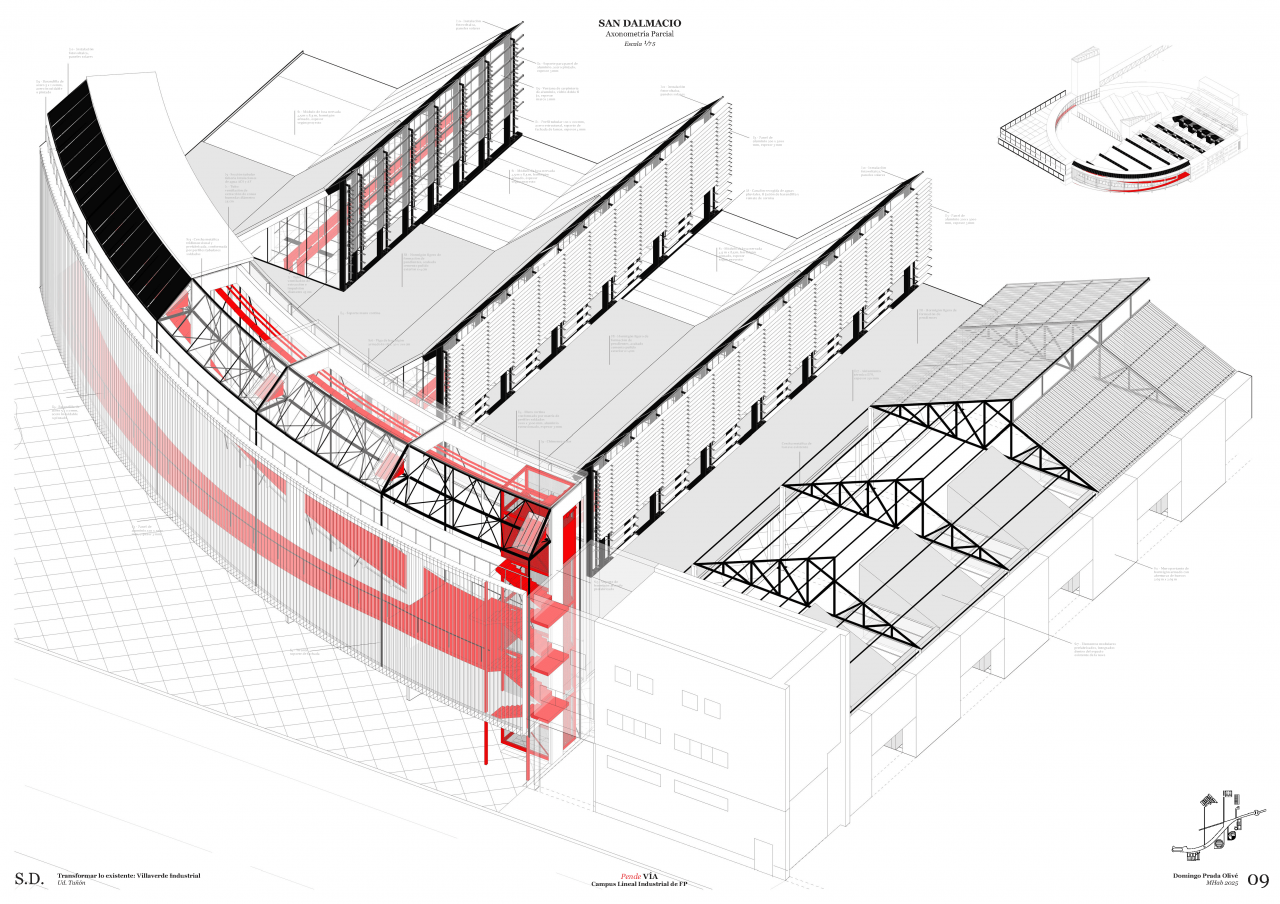
San Dalmacio is conceived as a space of active memory. Part of the existing warehouses is removed, and their structure is reused as shading devices at different points across the campus. The remaining warehouses retain their industrial use, complemented by new attached volumes housing services and innovation laboratories. An external volumetric ring stitches the ensemble together and formalizes its relationship with the surrounding neighborhood.
6 STRUCTURAL AND CONSTRUCTIVE CONCEPT
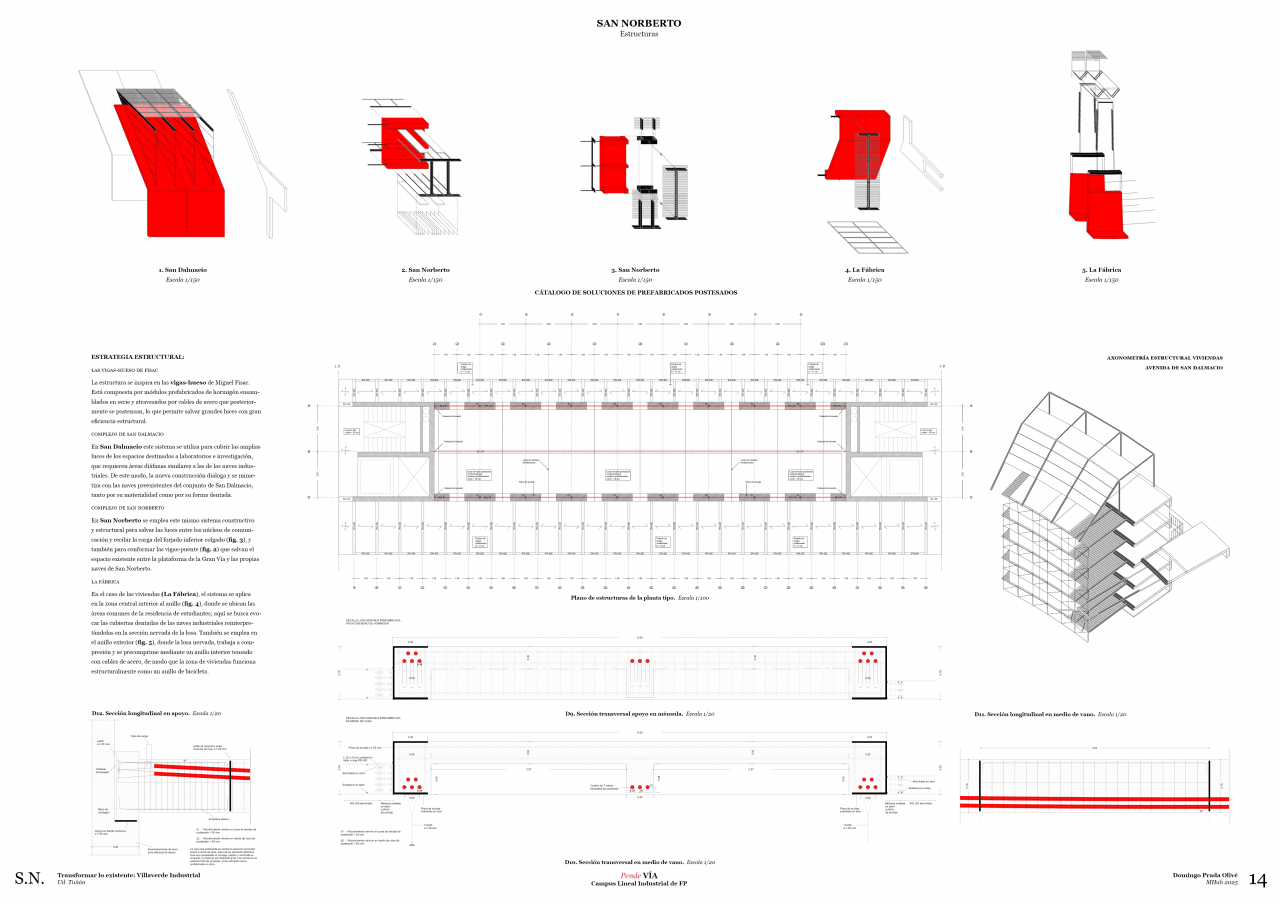
The structural system is based on a series of prefabricated slabs that are interwoven with one another to form a large post-tensioned slab capable of spanning long distances and constituting a continuous infrastructure over the existing structures. This system enables a modular, industrialized, and extensible construction process, consistent with the productive logic of the site and with the intention of the complex’s progressive growth.
7 OVERALL INTENT OF THE PROPOSAL
The project constructs a new productive and educational landscape over the railway tracks, transforming what was once a barrier into an active urban support. The Gran Vía ceases to be an incomplete infrastructure and becomes the living axis of the campus. In this way, Villaverde reconnects with the railway not as a vestige of the past, but as a guiding thread that links memory, present, and future.
The project is located in the area of Villaverde Industrial, a territory historically linked to railway infrastructure and to Madrid’s productive development. The arrival of the railway in the nineteenth century shaped an industrial landscape whose urban morphology was deeply determined by the alignment of the tracks and the progressive implantation of warehouses and factories along their edges.
With the decline of industrial activity, this system lost its original meaning: the warehouses became obsolete, the urban fabric was fragmented, and the railway infrastructure shifted from being a structuring element to becoming an urban barrier.
In this context, the Gran Vía de Villaverde emerges as an elevated platform conceived as an urban infrastructure capable of stitching the territory together. However, its incomplete development resulted in an unfinished system, characterized by unresolved urban fronts and residual spaces lacking a clear identity.
The project takes this platform as both seed and structural axis for the implantation of a Vocational Training campus, understanding the Gran Vía not merely as infrastructure, but as a new suspended urban layer capable of reactivating, reinterpreting, and extending the existing productive landscape.
2 PROGRAM
The campus is conceived as a productive and educational ecosystem in which classrooms, workshops, laboratories, applied research spaces, exhibition areas, common spaces, a library, a project incubator, and flexible spaces coexist alongside a residential program linked to students and young professionals. This programmatic mix seeks to ensure an almost permanent level of activity and to recover a historical condition of the site, in which life and work coexisted under the same roof.
3 URBAN STRATEGY
The proposal understands the campus as a linear system of interventions supported by the Gran Vía de Villaverde. Through vertical extensions, ramps, spirals, and walkways, a new artificial topography is constructed that allows the recomposition of the fragmented industrial fabric, the restoration of pedestrian continuity across the railway tracks, and the reconnection of the former warehouses with the elevated urban axis.
These walkways operate as contemporary urban docks, evoking the historical relationship between industry and the railway. They are no longer conceived as infrastructures for the exchange of goods, but as supports for the exchange of knowledge, education, and contemporary productive activity.
The interventions do not replace the existing fabric, but rather complete it, stitch it together, and reprogram it, generating new façades facing the Gran Vía and providing the warehouses with the infrastructures required to accommodate new educational, residential, and productive uses.
4 TYPOLOGY AS PROJECT
The project is based on the historical typology of Villaverde, structured around the façade–warehouse binomial. The façade is understood as an urban, representative, and inhabited element, while the warehouse is conceived as a flexible and deep productive space. This duality reflected an essential condition of the industrial landscape, in which life and work shared a single architectural support.
The new campus recovers this typological logic and reinterprets it from a contemporary perspective, in which education, production, research, and residence once again coexist within a single architectural system.
5 THE PROJECT COMPONENTS
La Fábrica is a new-build structure that acts both as an extension of the Gran Vía and as a landmark within the campus. It accommodates productive housing, student residences, workshops, and shared spaces. Its volumetric and spatial organization reinterprets traditional industrial architecture, establishing a balance between a dense interior and an exterior open to the productive landscape.
The intervention at San Norberto reconfigures the existing warehouses through a new threshold-façade facing the Gran Vía. An open, lightweight, and extendable structure generates a scaffold-like image that expresses the evolutionary character of the campus. Structural walkways directly connect the warehouses to the elevated platform, materializing the everyday journey between living and working.
San Dalmacio is conceived as a space of active memory. Part of the existing warehouses is removed, and their structure is reused as shading devices at different points across the campus. The remaining warehouses retain their industrial use, complemented by new attached volumes housing services and innovation laboratories. An external volumetric ring stitches the ensemble together and formalizes its relationship with the surrounding neighborhood.
6 STRUCTURAL AND CONSTRUCTIVE CONCEPT
The structural system is based on a series of prefabricated slabs that are interwoven with one another to form a large post-tensioned slab capable of spanning long distances and constituting a continuous infrastructure over the existing structures. This system enables a modular, industrialized, and extensible construction process, consistent with the productive logic of the site and with the intention of the complex’s progressive growth.
7 OVERALL INTENT OF THE PROPOSAL
The project constructs a new productive and educational landscape over the railway tracks, transforming what was once a barrier into an active urban support. The Gran Vía ceases to be an incomplete infrastructure and becomes the living axis of the campus. In this way, Villaverde reconnects with the railway not as a vestige of the past, but as a guiding thread that links memory, present, and future.
- 00 - Description
- 01 - GVV_ANALISIS
- 02 - GVV_SITE
- 03 - GVV_GENERAL_AXO
- 04 - FÁB_AXO
- 05 - FÁB_PLAN
- 06 - FÁB_DET
- 07 - SD_AXO
- 08 - SD_PLAN
- 09 - SD_DET
- 10 - SN_AXO
- 11 - SN_PLAN
- 12 - SN_DET
- 13 - SN_CONSTRUCTION
- 14 - SN_STRUCTURE
- 15 - Video