
PENSHIRUBIRU CLIMÁTICO
The project is located in the San Cristóbal neighborhood, in the south of Madrid—an area characterized by high climate vulnerability, limited public space quality, and a collective housing stock with poor energy performance. The intervention focuses on a series of existing linear housing blocks, typical of the area’s residential fabric, whose structural layout enables transformation without demolition.
The proposal seeks to improve both the thermal behavior of the dwellings and their relationship with the urban environment through a structural, bioclimatic, and seasonal design strategy.
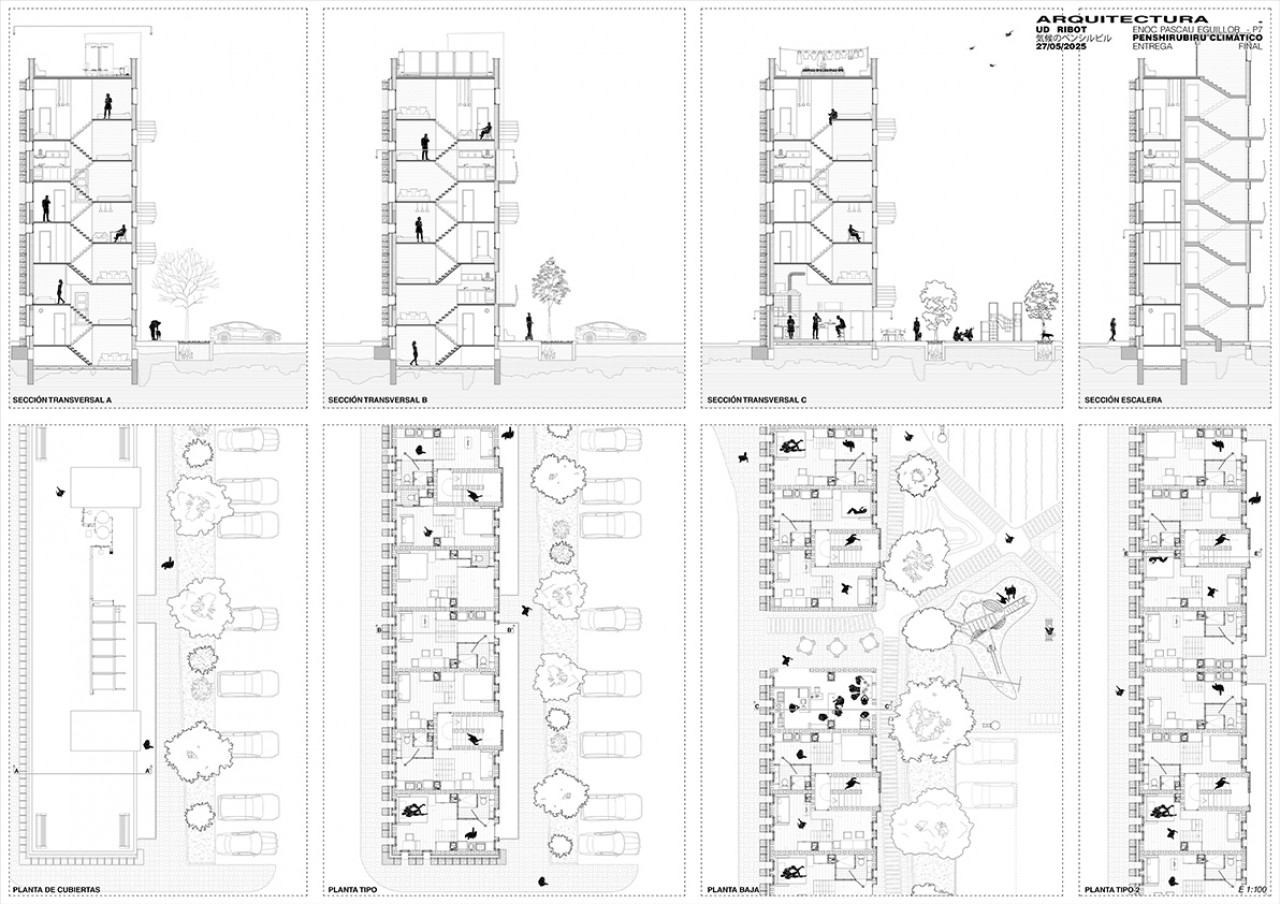
Starting from the existing load-bearing walls, the dwellings are reorganized vertically into distinct functional levels, allowing for a dynamic seasonal occupation. In summer, life shifts to the lower levels, which are cooler and better ventilated. In winter, activity moves to the upper levels, where solar gain and thermal stratification increase comfort.
Each unit allows for different vertical configurations, enabling the adaptation of space according to the season, and even allowing rooms to change their function through mobile furniture. Thus, a single space can function as a bedroom, living room, or workspace, depending on the time of year and thermal logic of the dwelling.
The west façade is reconfigured with the addition of a thermal mass wall made of gabions, filled with rubble from the demolished floor slabs. This element acts as a solar screen and thermal battery, absorbing heat during the day and releasing it gradually at night, contributing to interior thermal balance.
Building systems are concentrated in vertical service cores attached to the structural walls, which streamlines distribution and facilitates maintenance or future adjustments. In terms of access, the project combines the original entrances to one row of dwellings with new lightweight platforms that connect from the staircase landings, generating a dual circulation system that respects and activates the existing structure.
From an environmental perspective, the building operates as a passive climate machine, combining cross-ventilation, thermal mass, and solar orientation. The chimney effect allows hot air to be expelled in summer, while in winter it promotes heat retention.
Finally, the intervention extends to the inter-block public space, which is redefined as a climatic and collective urban void. Permeable pavements, vegetation, and new transitional platforms reinforce its community use and enhance the relationship between architecture and the city.
The result is a resilient, flexible, and sustainable dwelling model capable of responding to climate change by transforming and reusing the existing built fabric.
The proposal seeks to improve both the thermal behavior of the dwellings and their relationship with the urban environment through a structural, bioclimatic, and seasonal design strategy.
Starting from the existing load-bearing walls, the dwellings are reorganized vertically into distinct functional levels, allowing for a dynamic seasonal occupation. In summer, life shifts to the lower levels, which are cooler and better ventilated. In winter, activity moves to the upper levels, where solar gain and thermal stratification increase comfort.
Each unit allows for different vertical configurations, enabling the adaptation of space according to the season, and even allowing rooms to change their function through mobile furniture. Thus, a single space can function as a bedroom, living room, or workspace, depending on the time of year and thermal logic of the dwelling.
The west façade is reconfigured with the addition of a thermal mass wall made of gabions, filled with rubble from the demolished floor slabs. This element acts as a solar screen and thermal battery, absorbing heat during the day and releasing it gradually at night, contributing to interior thermal balance.
Building systems are concentrated in vertical service cores attached to the structural walls, which streamlines distribution and facilitates maintenance or future adjustments. In terms of access, the project combines the original entrances to one row of dwellings with new lightweight platforms that connect from the staircase landings, generating a dual circulation system that respects and activates the existing structure.
From an environmental perspective, the building operates as a passive climate machine, combining cross-ventilation, thermal mass, and solar orientation. The chimney effect allows hot air to be expelled in summer, while in winter it promotes heat retention.
Finally, the intervention extends to the inter-block public space, which is redefined as a climatic and collective urban void. Permeable pavements, vegetation, and new transitional platforms reinforce its community use and enhance the relationship between architecture and the city.
The result is a resilient, flexible, and sustainable dwelling model capable of responding to climate change by transforming and reusing the existing built fabric.



- 00 - Description
- 01 - axo
- 02 - processes
- 03 - situation
- 04 - bioclimatic section
- 05 - architecture
- 06 - parte