
Refugio de un cantero
Access to the plot is gained via a staircase carved directly into the rock. It leads from the lower level up to the higher part of the site and marks the transition from public space to a broad, open landscape. With each step, the view expands: behind, the calm and vast Mediterranean Sea; ahead, the mountains of southern Spain. The plot lies between the two, without clearly defined boundaries, characterized by topography, vegetation, and wind.
The site covers approximately 300,000 square meters. The buildings are dispersed throughout the landscape and respond to existing conditions of height, views, and circulation. They are not conceived as a compact unit, but rather as an ensemble whose form can only be understood through movement across the site. In its overall configuration, the ensemble recalls a shooting star: the main house forms the nucleus, while the so-called trail consists of several secondary volumes—a garden house, a small workshop, and a garage.
The owner is a stonemason, and this fact decisively defines the project. The material used is a red sandstone available in the immediate surroundings, employed consistently across all buildings. The stone is left exposed, and the surfaces retain the traces of manual craftsmanship. The project is not conceived as a new construction in the conventional sense, but as the representation of a state after a certain period of time. The architecture does not appear finished, but rather settled.
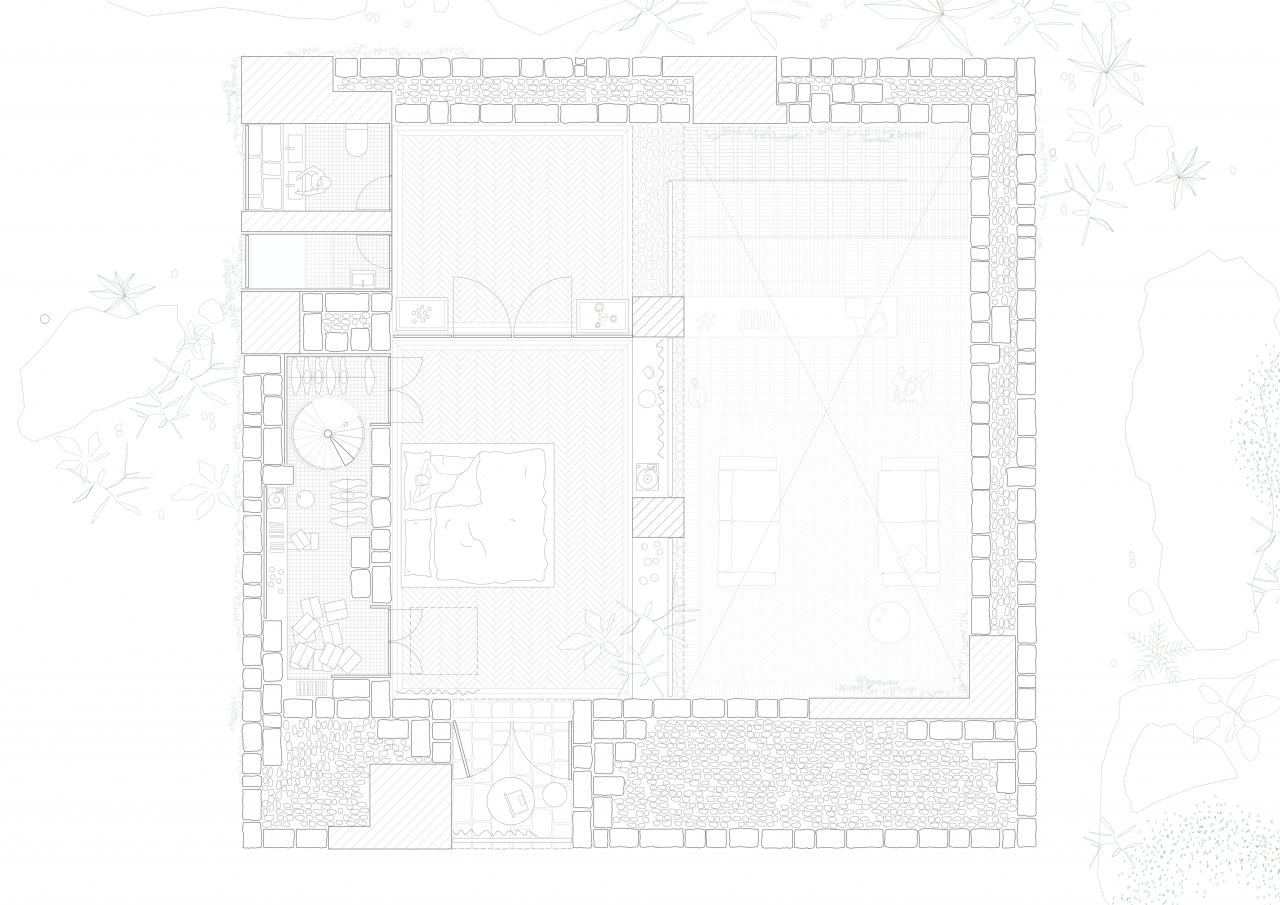
The main house is positioned slightly elevated and acts as the central point of the ensemble. From it, views are deliberately directed toward the landscape. The openings are arranged to frame specific fragments, either toward the mountains or toward the sea. Interior and exterior maintain a close relationship, and the natural light—changing throughout the day—makes the passage of time perceptible within the spaces.
Along a simple path, the trail of the ensemble unfolds. The garden house is located closer to the ground and integrates more directly into the vegetation. It functions as a place of retreat and as a transition between architecture and landscape. The workshop has a functional and restrained character; here, work with stone occupies a central position and is directly visible. The garage, in turn, closes the ensemble and is subordinate to the other buildings in both scale and expression.
All volumes are autonomous, yet they are linked through material, proportions, and their placement within the terrain. Between them, intermediate spaces, paths, and visual relationships emerge. The landscape remains the dominant element and determines the perception of the place. Architecture does not impose an order, but rather accompanies the existing conditions.
Upon leaving the site, it becomes clear that this project does not seek representation, but permanence. The architecture withdraws and makes room for transformation through use, climate, and the passage of time. The ensemble conveys a sense of quiet continuity, rooted in the landscape and shaped by time.
The site covers approximately 300,000 square meters. The buildings are dispersed throughout the landscape and respond to existing conditions of height, views, and circulation. They are not conceived as a compact unit, but rather as an ensemble whose form can only be understood through movement across the site. In its overall configuration, the ensemble recalls a shooting star: the main house forms the nucleus, while the so-called trail consists of several secondary volumes—a garden house, a small workshop, and a garage.
The owner is a stonemason, and this fact decisively defines the project. The material used is a red sandstone available in the immediate surroundings, employed consistently across all buildings. The stone is left exposed, and the surfaces retain the traces of manual craftsmanship. The project is not conceived as a new construction in the conventional sense, but as the representation of a state after a certain period of time. The architecture does not appear finished, but rather settled.
The main house is positioned slightly elevated and acts as the central point of the ensemble. From it, views are deliberately directed toward the landscape. The openings are arranged to frame specific fragments, either toward the mountains or toward the sea. Interior and exterior maintain a close relationship, and the natural light—changing throughout the day—makes the passage of time perceptible within the spaces.
Along a simple path, the trail of the ensemble unfolds. The garden house is located closer to the ground and integrates more directly into the vegetation. It functions as a place of retreat and as a transition between architecture and landscape. The workshop has a functional and restrained character; here, work with stone occupies a central position and is directly visible. The garage, in turn, closes the ensemble and is subordinate to the other buildings in both scale and expression.
All volumes are autonomous, yet they are linked through material, proportions, and their placement within the terrain. Between them, intermediate spaces, paths, and visual relationships emerge. The landscape remains the dominant element and determines the perception of the place. Architecture does not impose an order, but rather accompanies the existing conditions.
Upon leaving the site, it becomes clear that this project does not seek representation, but permanence. The architecture withdraws and makes room for transformation through use, climate, and the passage of time. The ensemble conveys a sense of quiet continuity, rooted in the landscape and shaped by time.




- 00 - Description
- 01 - Plano del entorno
- 02 - Planta baja
- 03 - vista en la casa
- 04 - Planta baja - Casa
- 05 - Planta alta - Casa
- 06 - Sección 1 - Casa
- 07 - Sección 2 - Casa
- 08 - Cobertizo de jardin
- 09 - Fachada oeste
- 10 - suelo mosaiko