
Reviving L'Albufera
One of Spain's most, if not the most, beautiful nature reserves is located just a few kilometers from the country's third-largest city, Valencia. The lake, once vast in size, is now only a fraction of its original size, and the area's significant industrialization has led to a serious deterioration of its environmental values.
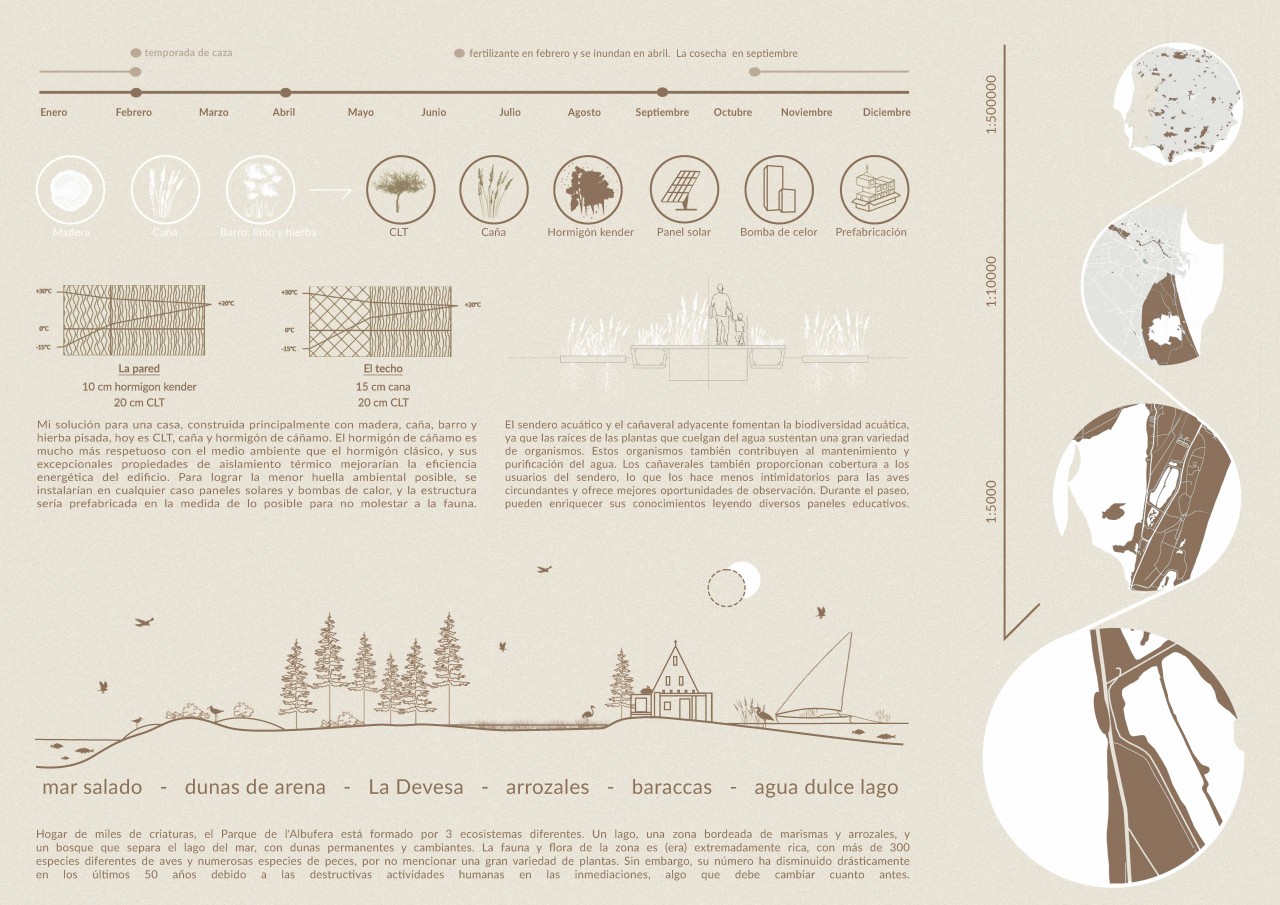
The l'Albufera Park, home to thousands of species, is made up of three distinct ecosystems. A lake, an area bordered by marshes and rice fields, and a forest separating the lake from the sea, with permanent and shifting dunes. The fauna and flora of the area is still extremely rich today, with over 300 different species of birds and numerous species of fish, not to mention a wide variety of plants.
The baracca, a small vernacular building of a simple plan, which was a local feature, has almost disappeared. Traditional houses built with local materials are hardly found in good condition. One of my objectives is to rethink the form and characteristics of this type of traditional architecture to meet contemporary requirements. Using modern-day versions of the materials once used, I have devised an environmentally friendly solution of temporary buildings that will degrade over time. I can envision a house built mainly of wood, reed mud and shredded grass, Cross-laminated timber, reed and hemp concrete bricks. Hempcrete is much more environmentally friendly than classical concrete, and its exceptional thermal insulation properties would improve the building's energy use.
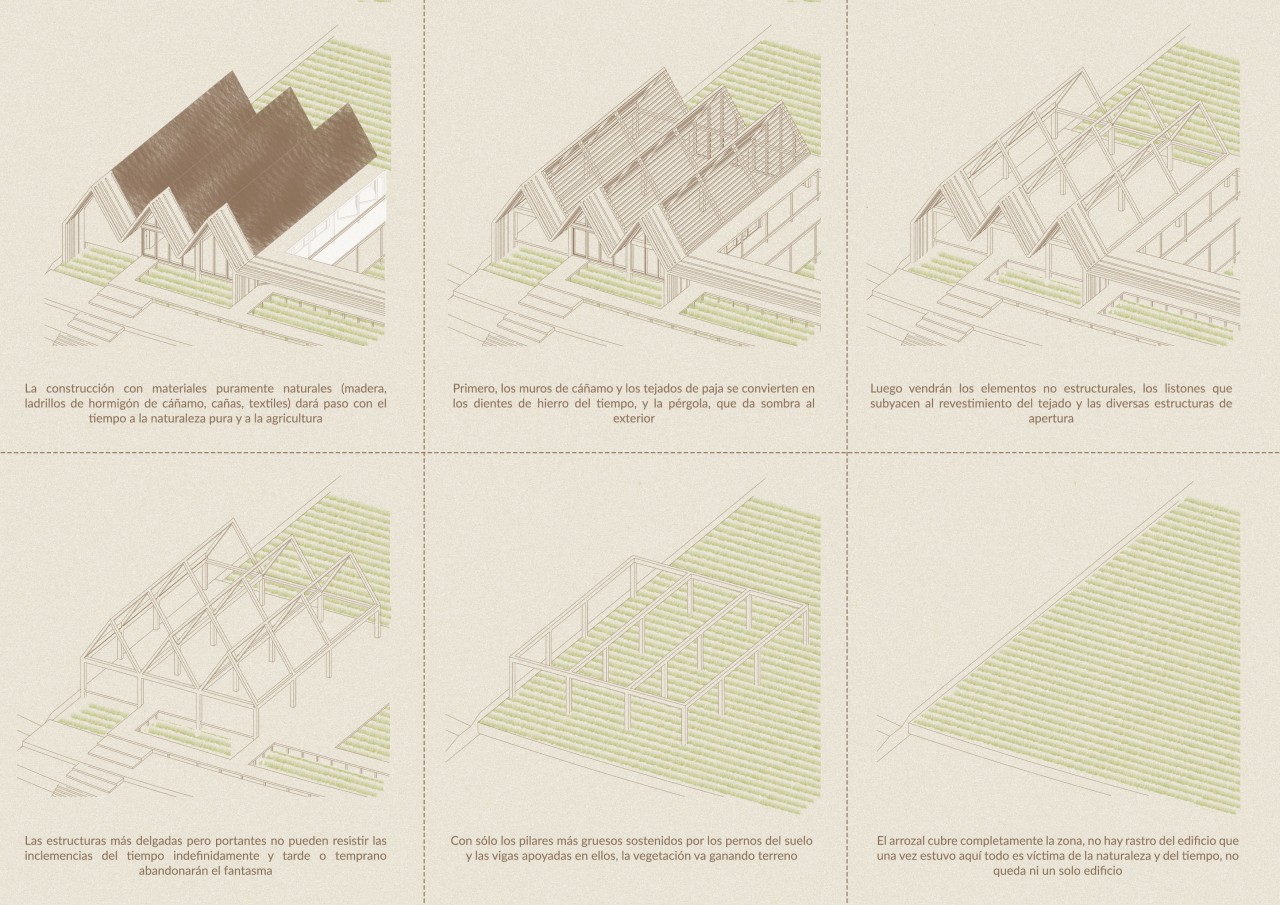
All materials are ephemeral, recyclable, with no structures left behind, so roads and buildings lifted from the ground will in time give way entirely to nature, to the rice paddy that lies beneath them throughout the planning area.
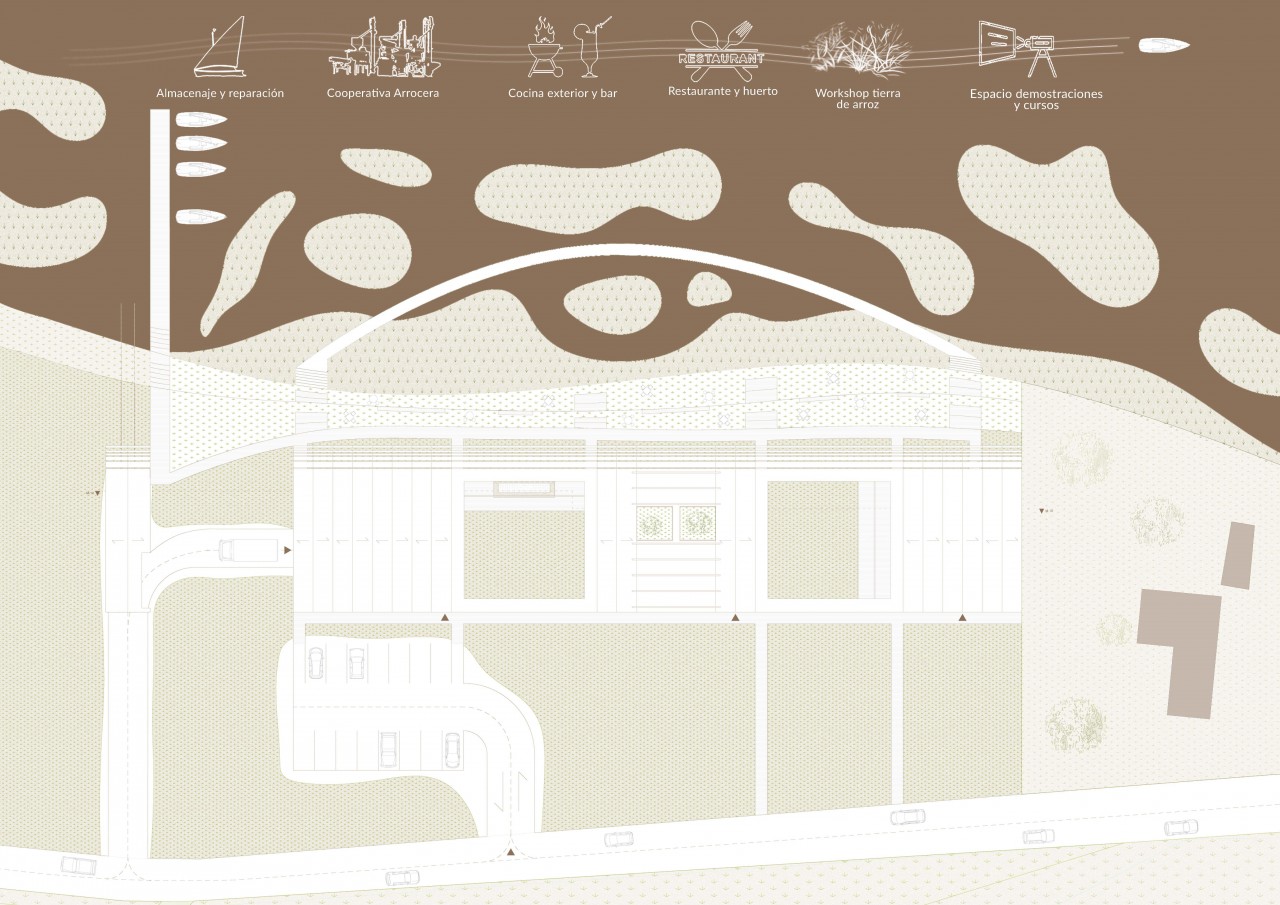
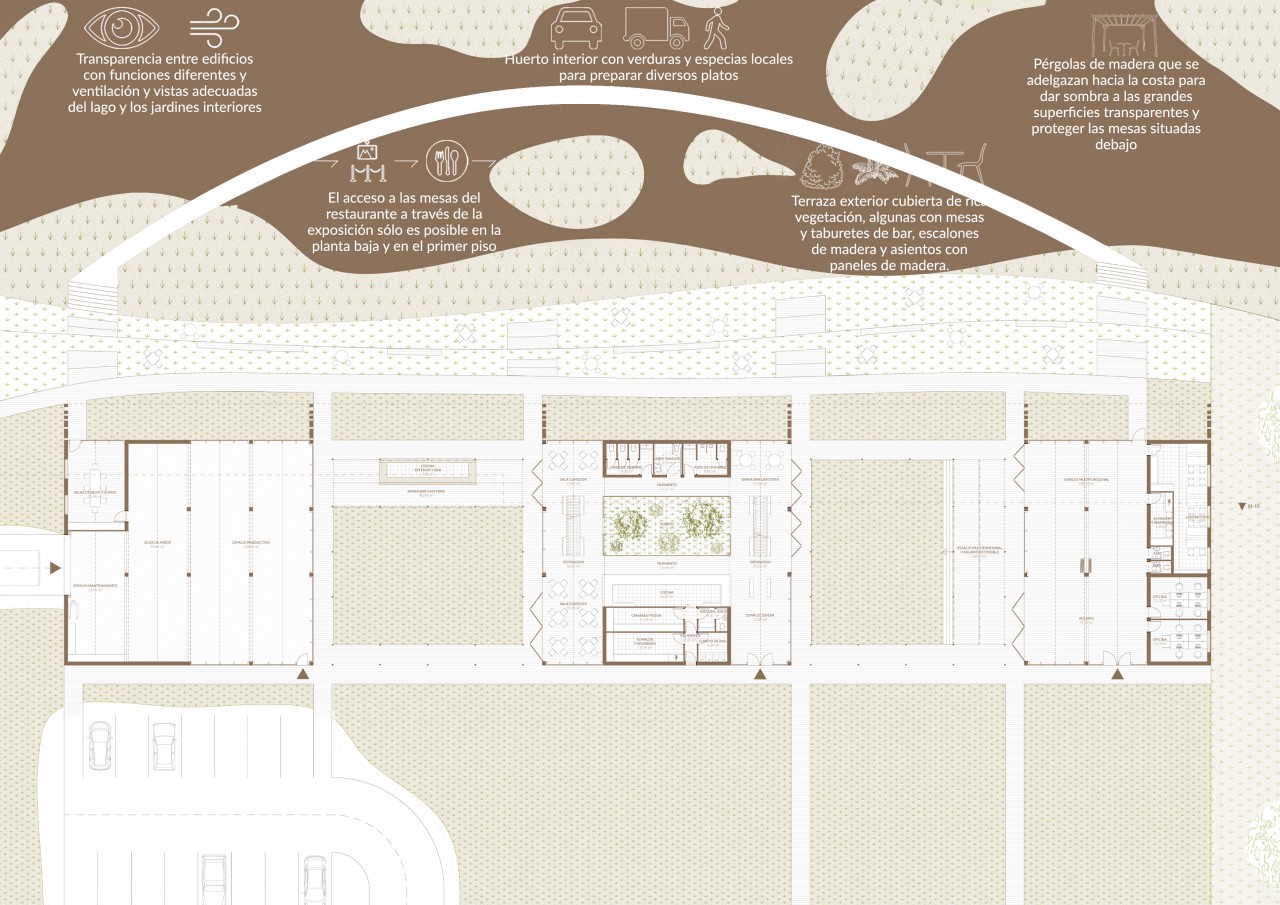
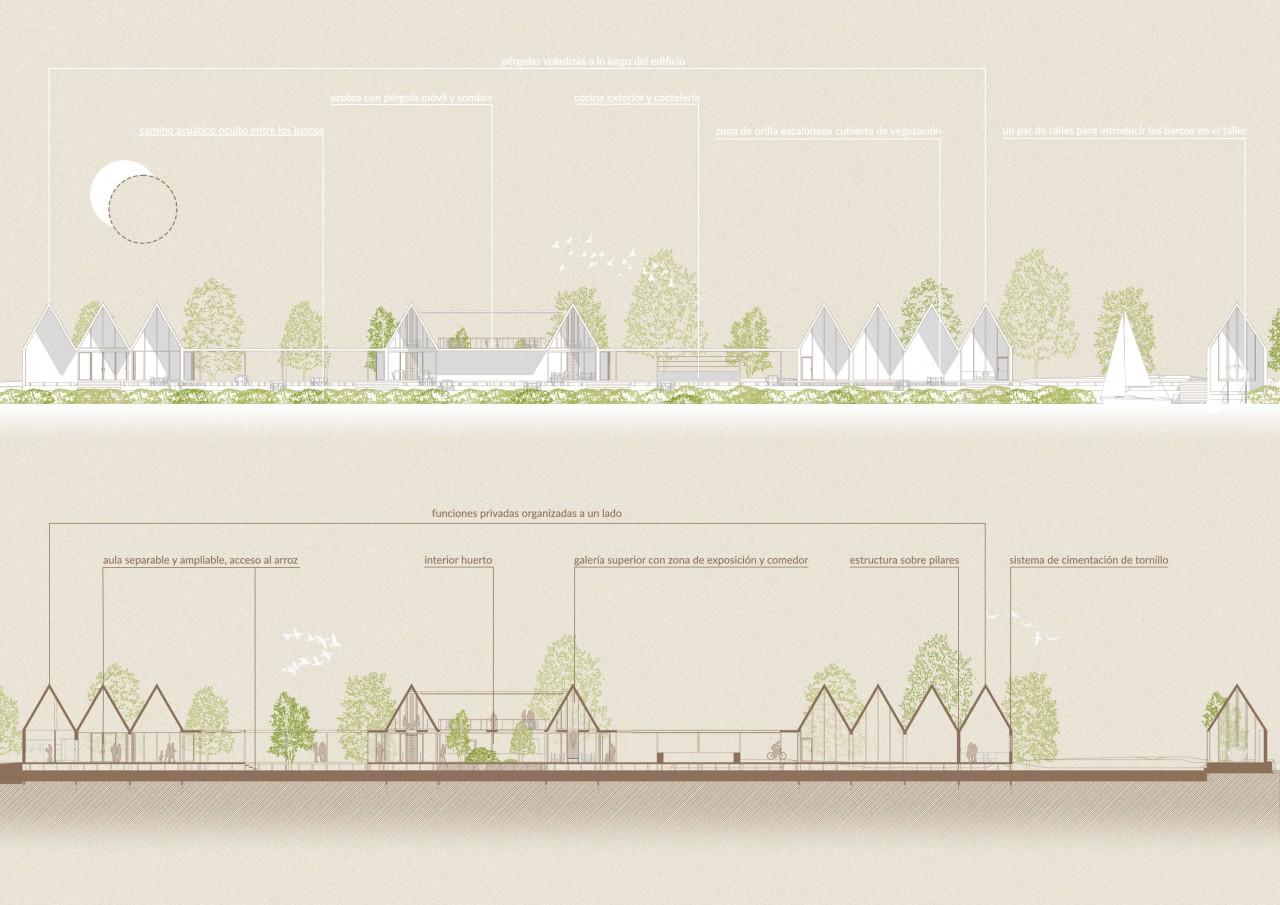
The rhythmical building form, divided by internal gardens, has several different functions. A boat service, storage and packing area, a garden barbecue and cocktail terrace, a restaurant with its own indoor kitchen garden and exhibition space, a small rice field for interactive activities, and educational and laboratory spaces.
In designing my buildings, I tried to keep the characteristics of the original type. I have tried to modernize the design and features of the building. It was important to me to have a clear layout and façade but also to have transparency. The functions of each building are arranged behind each other, allowing views into the other buildings and internal gardens, as well as from the street façade to the lake. The substantial glass surfaces are shaded by a thinning pergola facing the lake. Exposure is also possible under this in a sheltered manner. The restaurant's tables on the ground and first floors can only be accessed through the exhibition in front of the restaurant, and the packing and farming area is fully exposed, helping to promote and understand rice production.
The building offers various options for both indoor and outdoor activities. Whether it's a hearty lunch after a deeper exploration of rice cultivation, followed by a fiesta with a cocktail, then putting what you've learned into practice by trying it and yourself in the rice field. At the end of an exhausting day, it's nice to relax on the grassy beach or on the floating water path while observing the local wildlife.
These design principles have led to the final building, which although temporary, will hopefully make a long-term positive difference to the tourism and environmental impact of the area.
The l'Albufera Park, home to thousands of species, is made up of three distinct ecosystems. A lake, an area bordered by marshes and rice fields, and a forest separating the lake from the sea, with permanent and shifting dunes. The fauna and flora of the area is still extremely rich today, with over 300 different species of birds and numerous species of fish, not to mention a wide variety of plants.
The baracca, a small vernacular building of a simple plan, which was a local feature, has almost disappeared. Traditional houses built with local materials are hardly found in good condition. One of my objectives is to rethink the form and characteristics of this type of traditional architecture to meet contemporary requirements. Using modern-day versions of the materials once used, I have devised an environmentally friendly solution of temporary buildings that will degrade over time. I can envision a house built mainly of wood, reed mud and shredded grass, Cross-laminated timber, reed and hemp concrete bricks. Hempcrete is much more environmentally friendly than classical concrete, and its exceptional thermal insulation properties would improve the building's energy use.
All materials are ephemeral, recyclable, with no structures left behind, so roads and buildings lifted from the ground will in time give way entirely to nature, to the rice paddy that lies beneath them throughout the planning area.
The rhythmical building form, divided by internal gardens, has several different functions. A boat service, storage and packing area, a garden barbecue and cocktail terrace, a restaurant with its own indoor kitchen garden and exhibition space, a small rice field for interactive activities, and educational and laboratory spaces.
In designing my buildings, I tried to keep the characteristics of the original type. I have tried to modernize the design and features of the building. It was important to me to have a clear layout and façade but also to have transparency. The functions of each building are arranged behind each other, allowing views into the other buildings and internal gardens, as well as from the street façade to the lake. The substantial glass surfaces are shaded by a thinning pergola facing the lake. Exposure is also possible under this in a sheltered manner. The restaurant's tables on the ground and first floors can only be accessed through the exhibition in front of the restaurant, and the packing and farming area is fully exposed, helping to promote and understand rice production.
The building offers various options for both indoor and outdoor activities. Whether it's a hearty lunch after a deeper exploration of rice cultivation, followed by a fiesta with a cocktail, then putting what you've learned into practice by trying it and yourself in the rice field. At the end of an exhausting day, it's nice to relax on the grassy beach or on the floating water path while observing the local wildlife.
These design principles have led to the final building, which although temporary, will hopefully make a long-term positive difference to the tourism and environmental impact of the area.




- 00 - Description
- 01 - Axonometric view
- 02 - Sight explanation
- 03 - Structural system
- 04 - As time flies
- 05 - Sight plan
- 06 - Floor plan
- 07 - View from the balcon
- 08 - Work on the field
- 09 - Elevation & section
- 10 - Think about it
- 11 - Video