
Rubrum Quadrato-Mobilia Spatia
During this course, two complementary projects have been developed, located between the rural and the urban.
RUBRUM QUADRATO
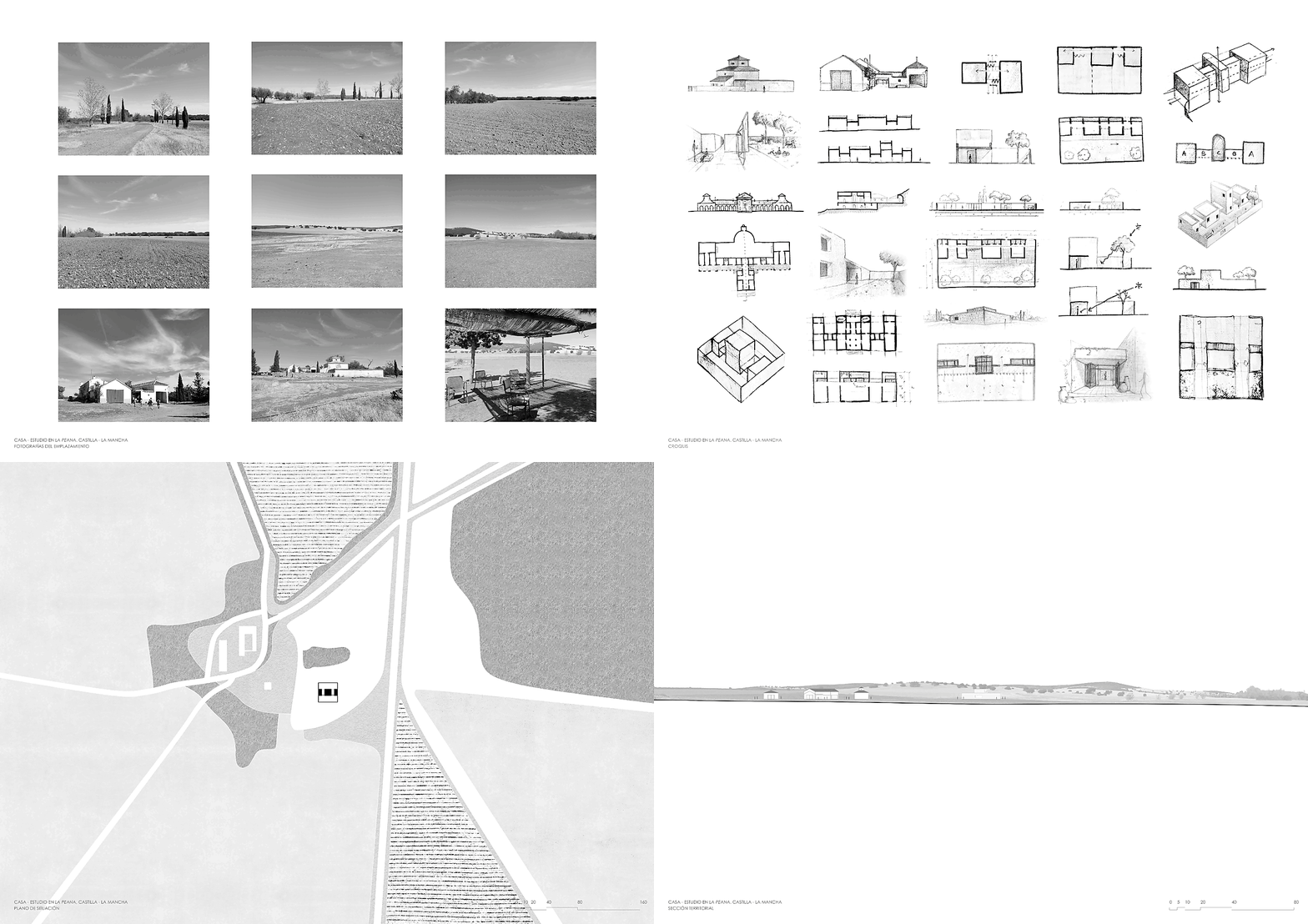
For the first exercise, it is proposed the construction of a single-family house in La Peana, Castilla-la Mancha, next to a farmhouse and an old pigeon house, which are taken as a reference for the development of the project.
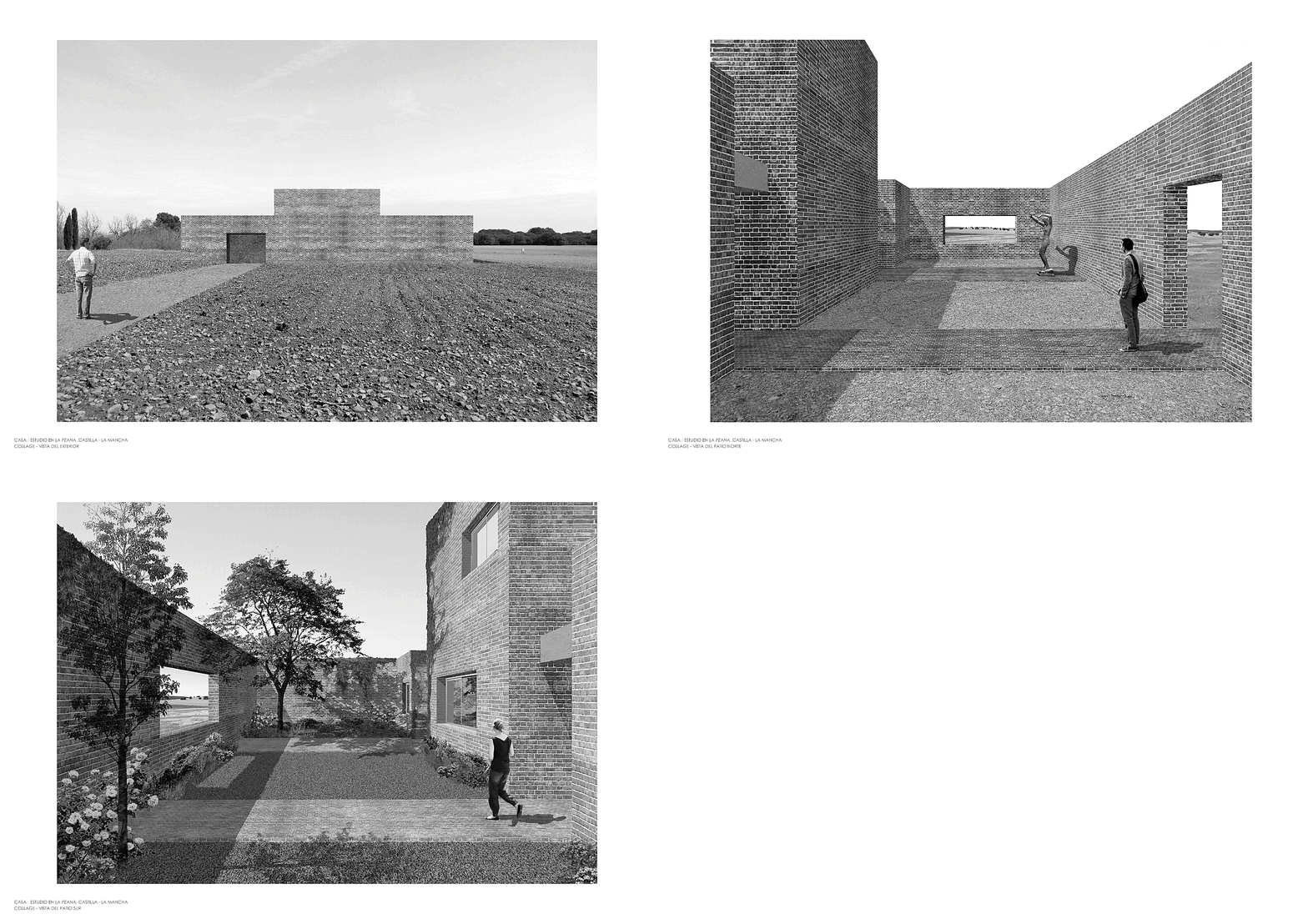
The proposal is based on the idea of the hortus conclusus as an architectural strategy to deal with the extreme character of the landscape at La Mancha.
Taking into account the material nature of the place, it is proposed to build the house using bricks, making the architecture emerge directly from the ground.
The spatial configuration of the house responds to a simple but strict geometric layout. It consists of an square plan divided into spaces of different spatial nature and relationship degree with the outside. The central strip houses the functional program; domestic on the ground floor and workshop-arranged on the upper floor; while the other two strips are courts open to the outside, and connected to each other through open and transparent spaces.
The north patio, rough and dry, is conceived as a prelude to access to the house. The south patio builds a humid garden that works as a small oasis, in contrast to the almost desert-like condition of the landscape.
In short, a house-studio is proposed between two closed courts in the unusual landscape of La Mancha, arranged according to a strict geometric layout and featuring the use of ceramics as the main element of the architectural narrative.
MOBILIA SPATIA
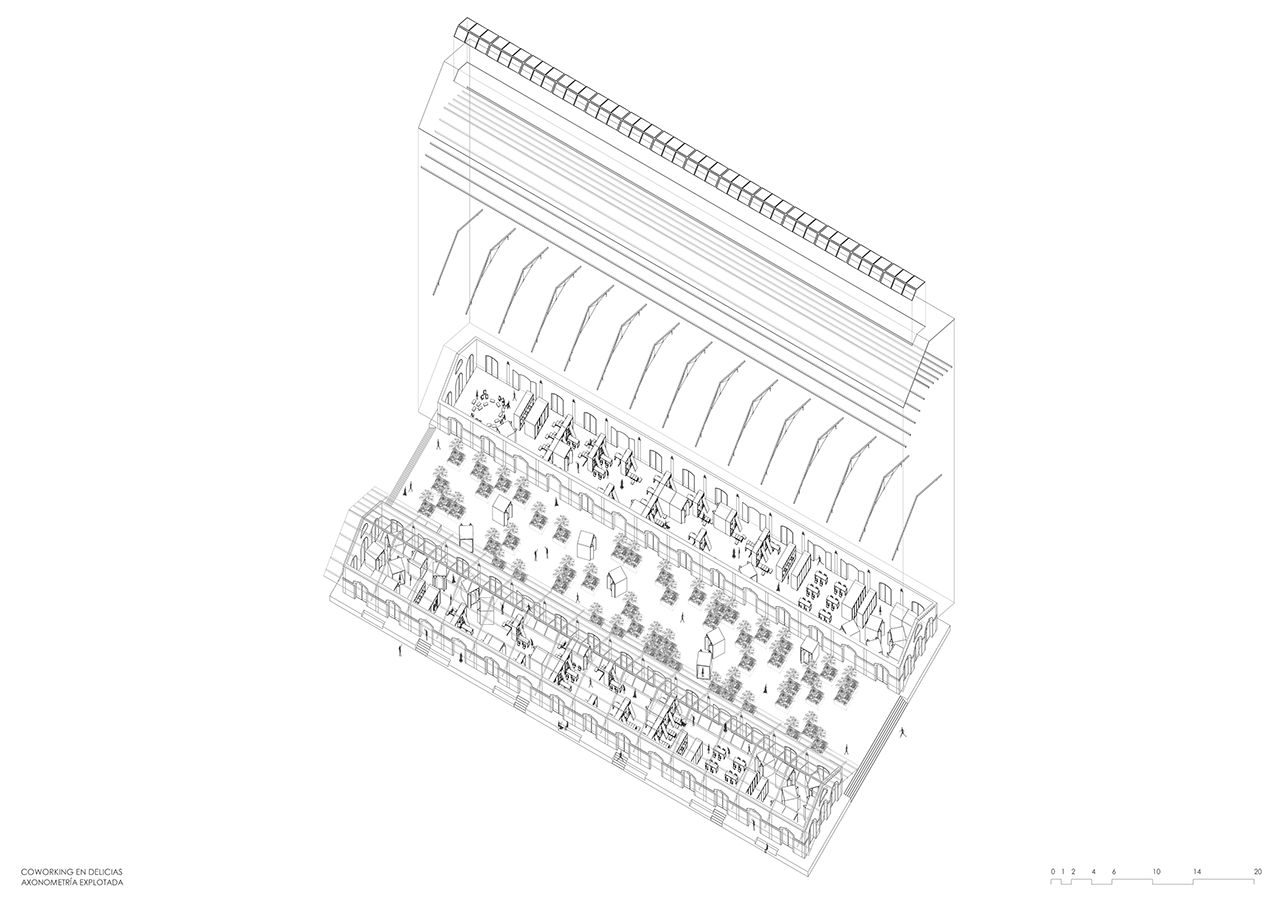
For the second exercise, it is proposed the construction of a coworking space in the Park of Delicias, in Madrid, through the intervention in two warehouses belonging to the old railway complex.
The coworking program requires a series of collective work spaces, rest areas and zones for meetings and conferences, as well as toilets and common kitchens.
To organize these spaces, the proposed project interprets the original operation of the warehouses, which were conceived and used as storage buildings. Originally, the interior space of the warehouses was occupied by shelves and boxes, so it is proposed to recover this use in a symbolic way by introducing, precisely, shelves and boxes.
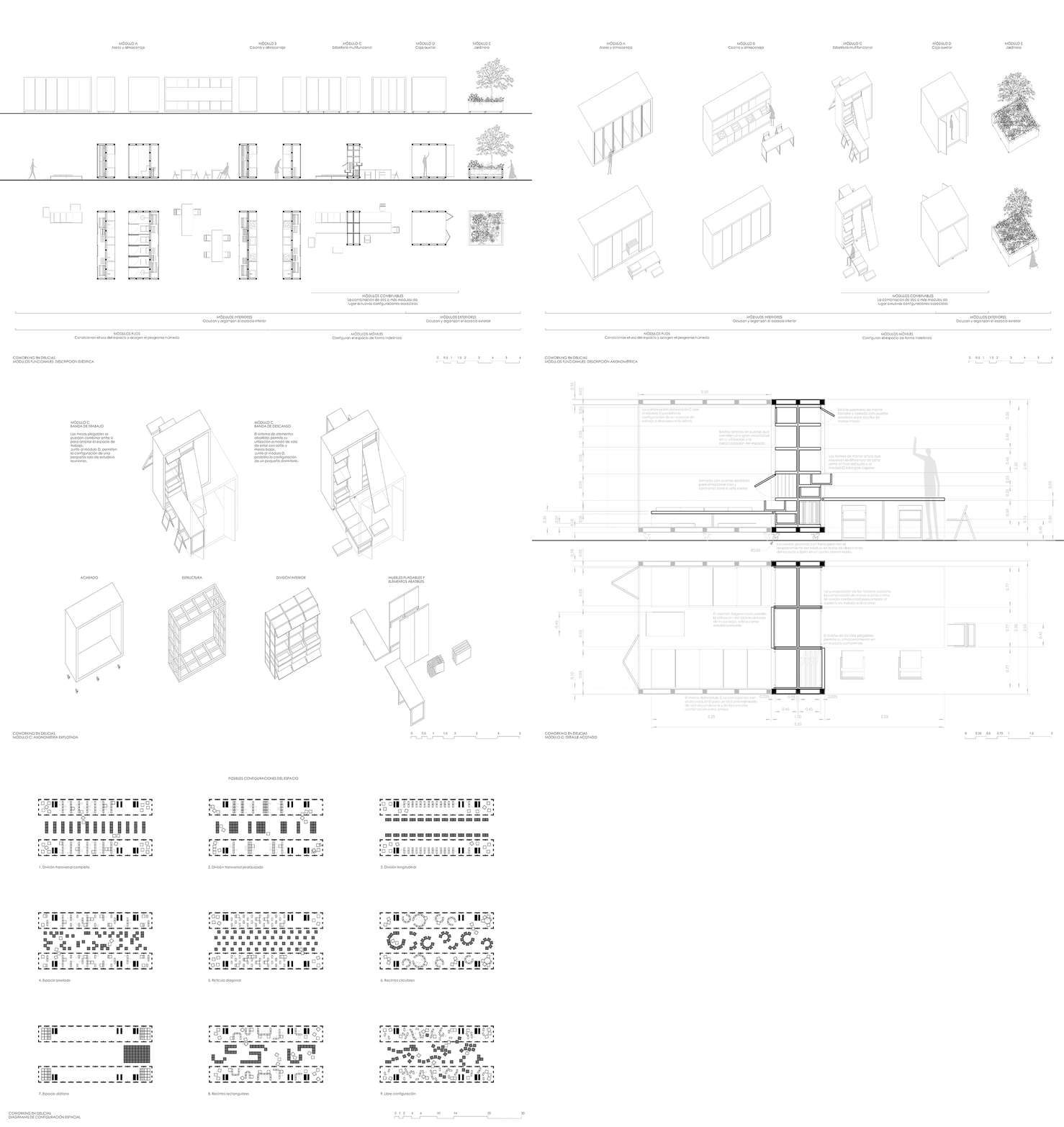
The proposal defines a series of small objects, some of them mobile and others not, that configure variably the work and rest spaces, converting the warehouses into storage buildings that store shelves and boxes inside.
Through this system of mobile and combinable modules, it is possible to organize the coworking space according to different configurations, depending on the general or particular needs of the space. This system also applies to the organization of the garden between the two naves.
In conclusion, a coworking space is proposed, based on a choreography of modular shelves and boxes, recovering the original spatial configuration of the old railway warehouses in Delicias.
RUBRUM QUADRATO
For the first exercise, it is proposed the construction of a single-family house in La Peana, Castilla-la Mancha, next to a farmhouse and an old pigeon house, which are taken as a reference for the development of the project.
The proposal is based on the idea of the hortus conclusus as an architectural strategy to deal with the extreme character of the landscape at La Mancha.
Taking into account the material nature of the place, it is proposed to build the house using bricks, making the architecture emerge directly from the ground.
The spatial configuration of the house responds to a simple but strict geometric layout. It consists of an square plan divided into spaces of different spatial nature and relationship degree with the outside. The central strip houses the functional program; domestic on the ground floor and workshop-arranged on the upper floor; while the other two strips are courts open to the outside, and connected to each other through open and transparent spaces.
The north patio, rough and dry, is conceived as a prelude to access to the house. The south patio builds a humid garden that works as a small oasis, in contrast to the almost desert-like condition of the landscape.
In short, a house-studio is proposed between two closed courts in the unusual landscape of La Mancha, arranged according to a strict geometric layout and featuring the use of ceramics as the main element of the architectural narrative.
MOBILIA SPATIA
For the second exercise, it is proposed the construction of a coworking space in the Park of Delicias, in Madrid, through the intervention in two warehouses belonging to the old railway complex.
The coworking program requires a series of collective work spaces, rest areas and zones for meetings and conferences, as well as toilets and common kitchens.
To organize these spaces, the proposed project interprets the original operation of the warehouses, which were conceived and used as storage buildings. Originally, the interior space of the warehouses was occupied by shelves and boxes, so it is proposed to recover this use in a symbolic way by introducing, precisely, shelves and boxes.
The proposal defines a series of small objects, some of them mobile and others not, that configure variably the work and rest spaces, converting the warehouses into storage buildings that store shelves and boxes inside.
Through this system of mobile and combinable modules, it is possible to organize the coworking space according to different configurations, depending on the general or particular needs of the space. This system also applies to the organization of the garden between the two naves.
In conclusion, a coworking space is proposed, based on a choreography of modular shelves and boxes, recovering the original spatial configuration of the old railway warehouses in Delicias.





- 00 - Description
- 01 - E1 SKETCHES
- 02 - E1 PLANS
- 03 - E1 SECTIONS
- 04 - E1 AXO
- 05 - E1 COLLAGES
- 06 - E2 SKETCHES
- 07 - E2 MODULES
- 08 - E2 PLANS
- 09 - E2 AXO
- 10 - E2 COLLAGES
- 11 - Video