
SilkLoop
This project was done in collaboration with MARIANA CALVO ÁLVAREZ-CASTELAO, SOFÍA HERNÁNDEZ LÓPEZ and ADRIANA RODRÍGUEZ GARCÍA
The silk production factory project emerges with the ambition of becoming a parasitic organism capable of colonizing the towers of the Yuzhong district in Chongqing. This initial concept not only defines its placement but also structures the entire architectural and programmatic system.
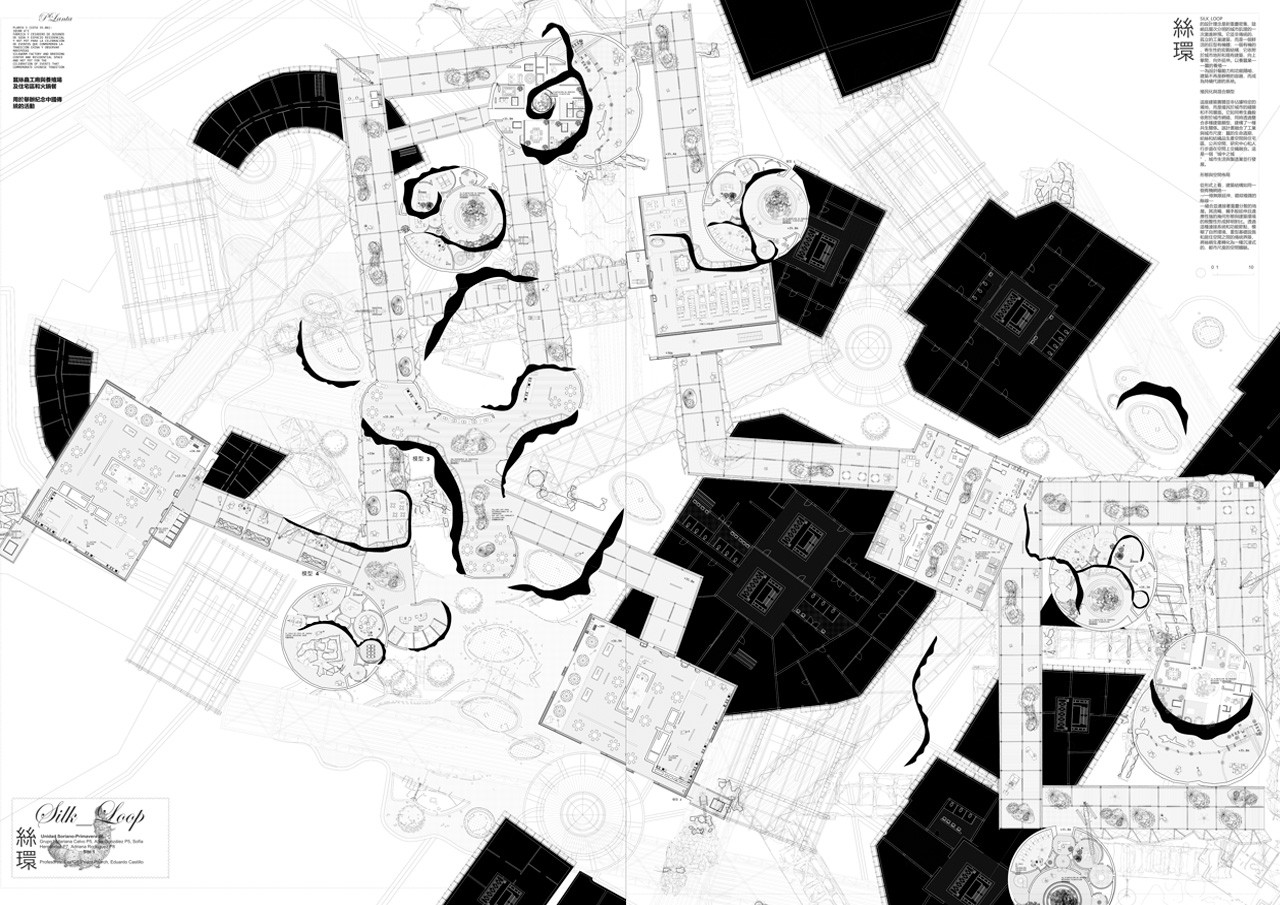
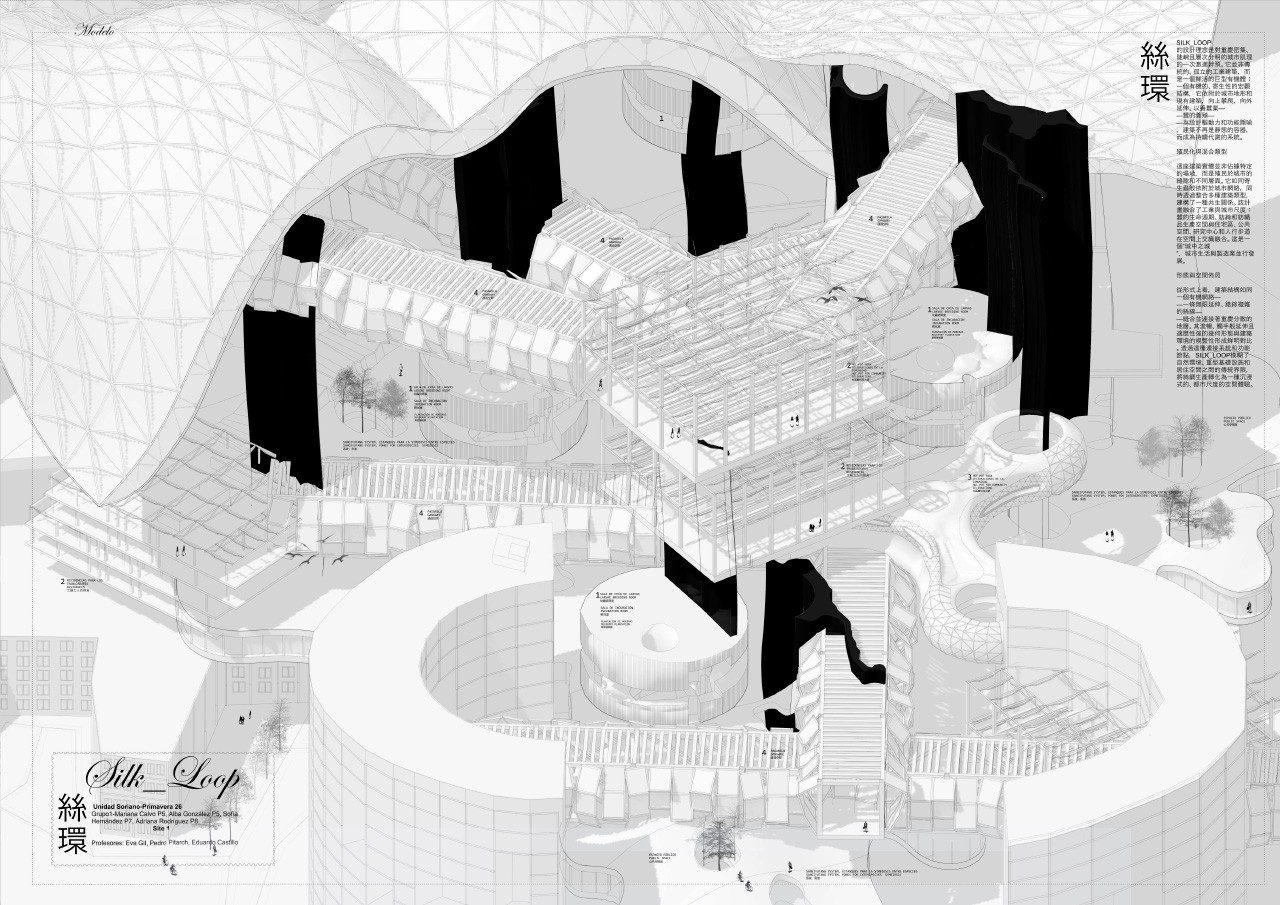
To materialize this idea, the plan is organized through a clearly defined structural and geometric hierarchy. Prominent within this system are organic concrete forms that constitute the building’s primary structure: large masses that originate at the lowest level and support the entirety of the loads. This lower level houses the breeding system, characterized by circular geometries. As the structure extrudes and adapts to these base circles, the walls acquire a dual material condition, presenting a smooth surface on one side and a rougher texture on the other.
The programmatic organization relies on this geometric logic to establish a clear separation of uses. Circular elements concentrate the productive and industrial functions, accommodating breeding centers, laboratories, and thread-processing areas. In contrast, more rectilinear volumes are dedicated to the human dimension, incorporating collective housing and shared spaces for workers, such as social areas linked to hot pot culture.
The system of walkways acts as the connective tissue of the project, stitching together its dispersed components. Beyond their circulatory role, these walkways are conceived as productive landscapes, integrating mulberry cultivation and thus closing the ecological cycle of the factory between worker, food source, and silkworm.
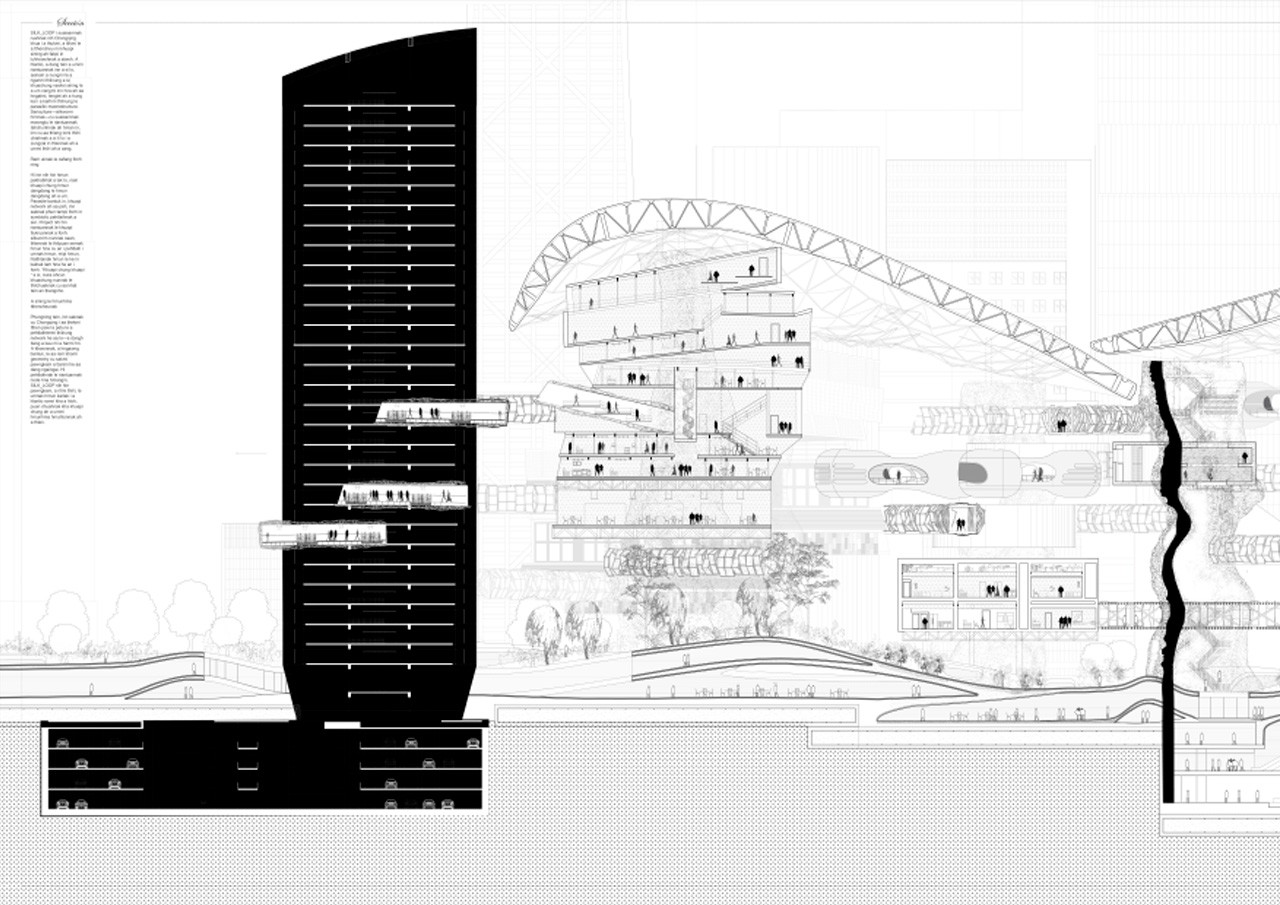
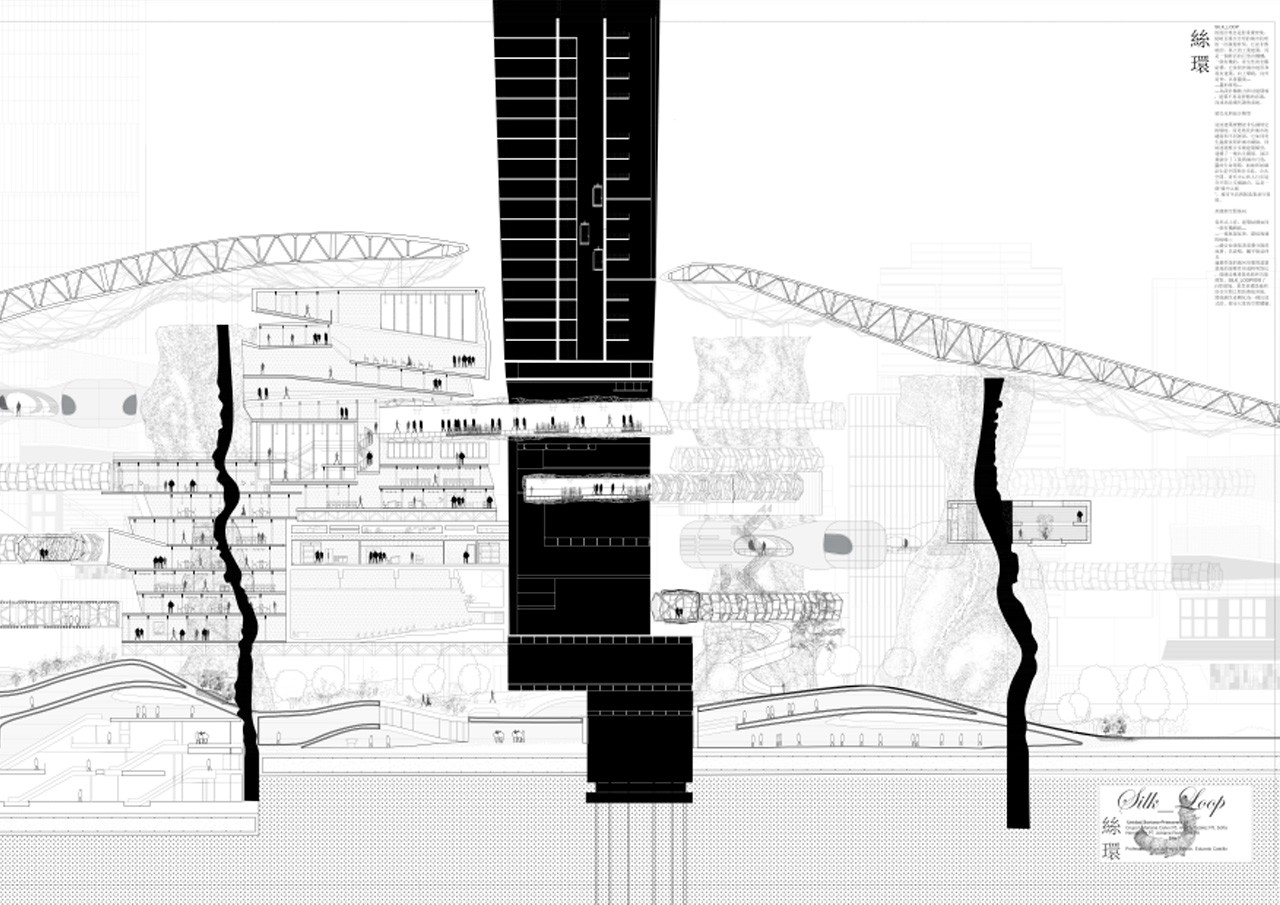
In section, the project is conceived as a vertical structure that connects the different urban levels of the city while inserting itself between existing towers. At the underground level, the first layer consists of a large continuous post-tensioned concrete slab. This undulating surface is perforated by circular courtyards and accommodates public and civic space, extending and linking existing plazas. Gardens, pathways, and areas for rest are generated across its surface.
From this level, the main concrete structures rise, traversing the entire section to support the elevated volumes. Their geometry adapts to programmatic needs, expanding, contracting, or deforming accordingly. Walkways rest upon these cores, contributing both to load transfer and spatial articulation.
At the upper levels, the system becomes progressively lighter and more open. The envelope gains transparency, and the structural system transitions from concrete to steel. Horizontal and diagonal slabs are introduced to differentiate uses: orthogonal planes accommodate offices, housing, and workspaces, while inclined surfaces generate more collective and commercial environments. Interior voids and strategic openings create visual connections between levels, making the building’s activity visible throughout its full height.
The roof is conceived as a lightweight steel mesh spanning large distances, unifying the various volumes into a cohesive whole and giving the project a recognizable presence within Chongqing’s skyline. It also functions as a climatic envelope and as a device for capturing and filtering natural light.
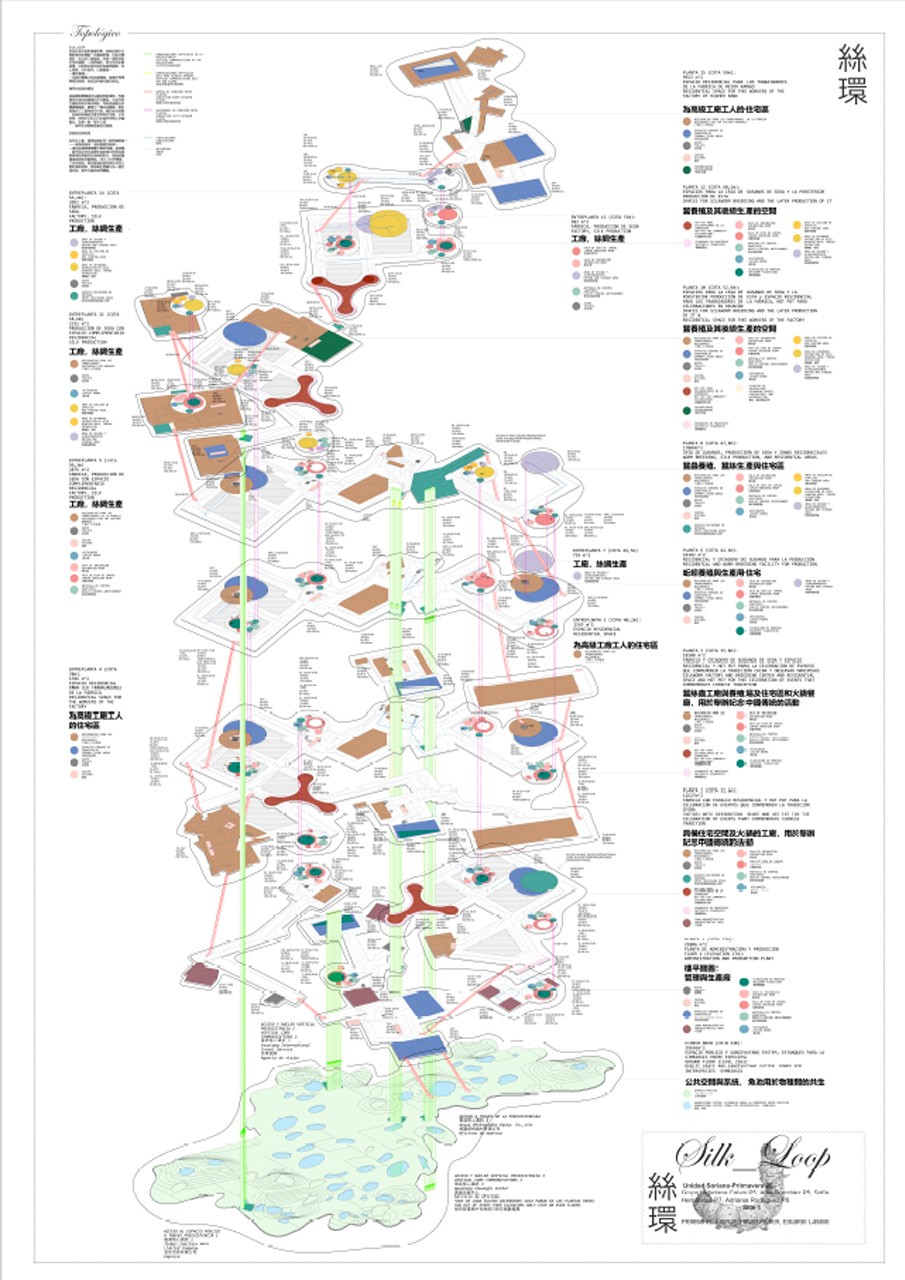
To achieve a deeper understanding of the project, complementary design tools were developed. A topological diagram helped resolve vertical circulation by utilizing existing cores and introducing punctual connections between levels to articulate more isolated areas. Additionally, the programmatic distribution was precisely defined, both for residential and productive spaces, incorporating the specific hygrothermal conditions derived from the study of the silkworm life cycle.
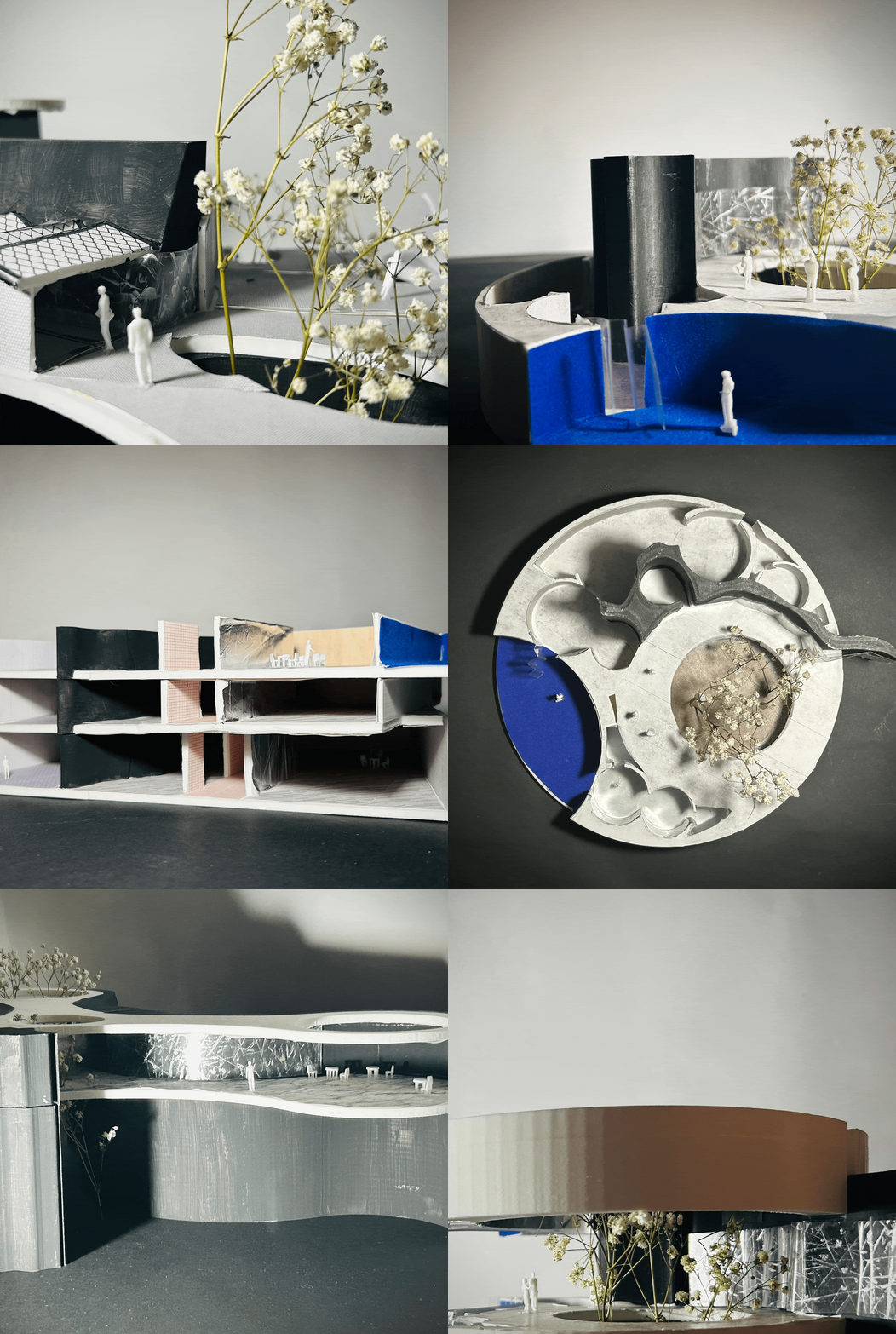
From a material perspective, a series of finish models were produced to explore the contrast between the project’s industrial character and a more domestic atmosphere, through the use of color, textures, and construction detailing. Finally, a set of images, or “postcards,” was developed to convey the atmospheric qualities of the project at a more intimate scale, addressing aspects that could not be fully represented in other documents.
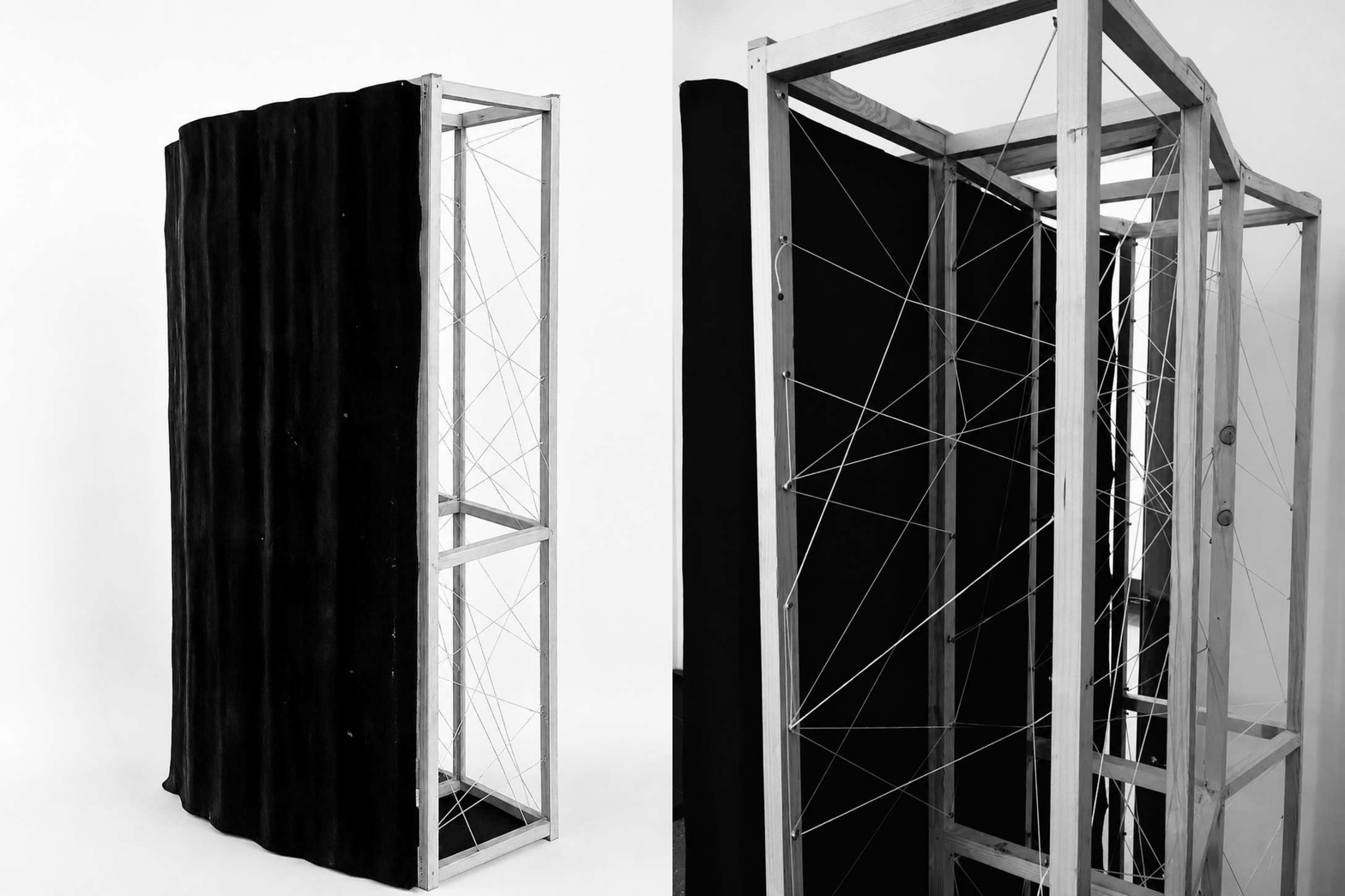
To further test and validate the architectural proposal, a series of three physical prototypes was developed in parallel with the design process. These prototypes investigated key aspects of the project at a material and structural level, allowing the proposed geometries and construction systems to be assessed beyond the digital model.
Each prototype focused on a specific challenge. The first explored the stability and fabrication of the primary structural components; the second examined the system of connections and walkways that articulate the project; and the third investigated the envelope and surface textures, seeking to physically translate the architecture’s organic and eroded character.
One of the main challenges was working at a near 1:1 scale, which required addressing real-world issues of weight, assembly, structural behavior, and fabrication processes that do not typically emerge in conventional architectural models.
As a result, the prototypes evolved beyond representational devices and became essential design tools. Their construction enabled the physical validation of key architectural decisions and provided a deeper understanding of how the proposed system could ultimately be materialized and built.
The silk production factory project emerges with the ambition of becoming a parasitic organism capable of colonizing the towers of the Yuzhong district in Chongqing. This initial concept not only defines its placement but also structures the entire architectural and programmatic system.
To materialize this idea, the plan is organized through a clearly defined structural and geometric hierarchy. Prominent within this system are organic concrete forms that constitute the building’s primary structure: large masses that originate at the lowest level and support the entirety of the loads. This lower level houses the breeding system, characterized by circular geometries. As the structure extrudes and adapts to these base circles, the walls acquire a dual material condition, presenting a smooth surface on one side and a rougher texture on the other.
The programmatic organization relies on this geometric logic to establish a clear separation of uses. Circular elements concentrate the productive and industrial functions, accommodating breeding centers, laboratories, and thread-processing areas. In contrast, more rectilinear volumes are dedicated to the human dimension, incorporating collective housing and shared spaces for workers, such as social areas linked to hot pot culture.
The system of walkways acts as the connective tissue of the project, stitching together its dispersed components. Beyond their circulatory role, these walkways are conceived as productive landscapes, integrating mulberry cultivation and thus closing the ecological cycle of the factory between worker, food source, and silkworm.
In section, the project is conceived as a vertical structure that connects the different urban levels of the city while inserting itself between existing towers. At the underground level, the first layer consists of a large continuous post-tensioned concrete slab. This undulating surface is perforated by circular courtyards and accommodates public and civic space, extending and linking existing plazas. Gardens, pathways, and areas for rest are generated across its surface.
From this level, the main concrete structures rise, traversing the entire section to support the elevated volumes. Their geometry adapts to programmatic needs, expanding, contracting, or deforming accordingly. Walkways rest upon these cores, contributing both to load transfer and spatial articulation.
At the upper levels, the system becomes progressively lighter and more open. The envelope gains transparency, and the structural system transitions from concrete to steel. Horizontal and diagonal slabs are introduced to differentiate uses: orthogonal planes accommodate offices, housing, and workspaces, while inclined surfaces generate more collective and commercial environments. Interior voids and strategic openings create visual connections between levels, making the building’s activity visible throughout its full height.
The roof is conceived as a lightweight steel mesh spanning large distances, unifying the various volumes into a cohesive whole and giving the project a recognizable presence within Chongqing’s skyline. It also functions as a climatic envelope and as a device for capturing and filtering natural light.
To achieve a deeper understanding of the project, complementary design tools were developed. A topological diagram helped resolve vertical circulation by utilizing existing cores and introducing punctual connections between levels to articulate more isolated areas. Additionally, the programmatic distribution was precisely defined, both for residential and productive spaces, incorporating the specific hygrothermal conditions derived from the study of the silkworm life cycle.
From a material perspective, a series of finish models were produced to explore the contrast between the project’s industrial character and a more domestic atmosphere, through the use of color, textures, and construction detailing. Finally, a set of images, or “postcards,” was developed to convey the atmospheric qualities of the project at a more intimate scale, addressing aspects that could not be fully represented in other documents.
To further test and validate the architectural proposal, a series of three physical prototypes was developed in parallel with the design process. These prototypes investigated key aspects of the project at a material and structural level, allowing the proposed geometries and construction systems to be assessed beyond the digital model.
Each prototype focused on a specific challenge. The first explored the stability and fabrication of the primary structural components; the second examined the system of connections and walkways that articulate the project; and the third investigated the envelope and surface textures, seeking to physically translate the architecture’s organic and eroded character.
One of the main challenges was working at a near 1:1 scale, which required addressing real-world issues of weight, assembly, structural behavior, and fabrication processes that do not typically emerge in conventional architectural models.
As a result, the prototypes evolved beyond representational devices and became essential design tools. Their construction enabled the physical validation of key architectural decisions and provided a deeper understanding of how the proposed system could ultimately be materialized and built.
- 00 - Description
- 01 - Floor plan
- 02 - Section1
- 03 - Section2
- 04 - 3D Model
- 05 - Topological analysis
- 06 - Prototype
- 07 - Postcards