
The Bridge As Home
Located in Madrid's Delicias neighbourhood, the project proposes a different way of living in the city. The site is largely disconnected from its surroundings and stands out for its salvage character.
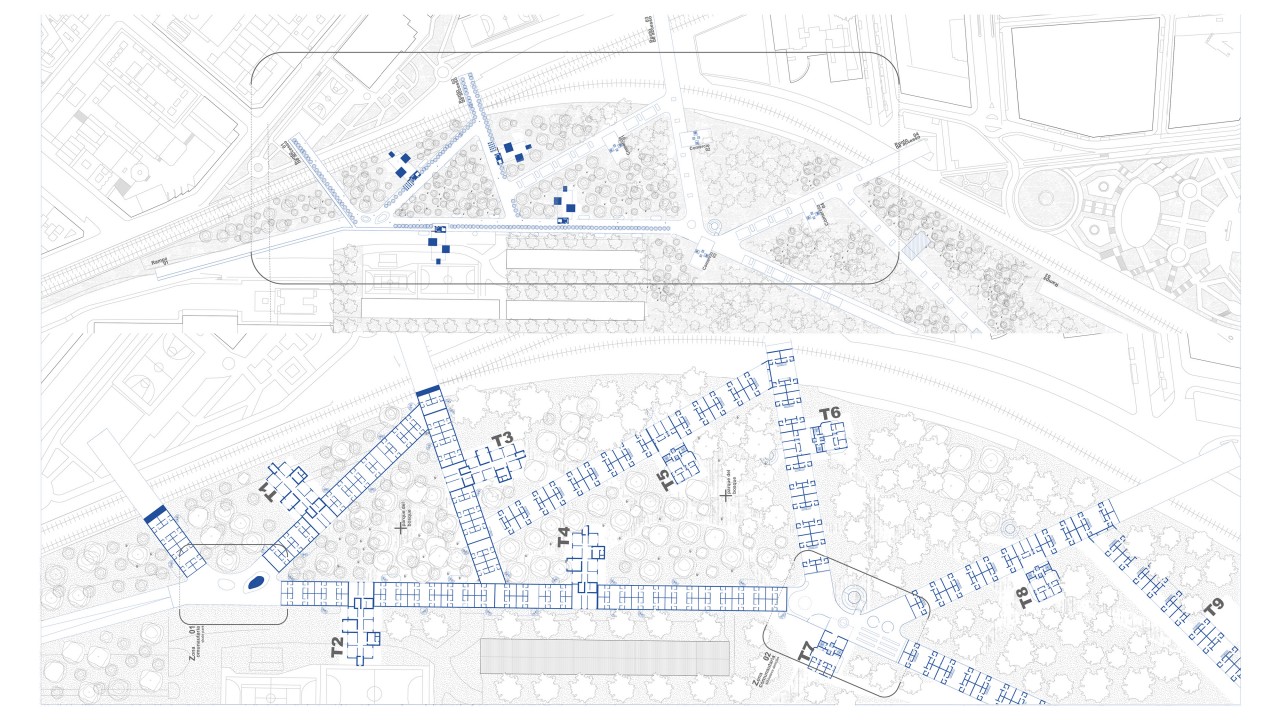
Urban planning was first discussed in teams. We wanted to preserve this urban wilderness, so we created this livable urban forest. Inside the forest, a habitable bridge was inserted between the trees.
To continue developing the project in individual parts, we decided to reinterpret the exquisite cadaver and adapt it to the project. We had union points, and then each team member interpreted its separate part.
The part I developed is composed of two main axes, the first one being the horizontal one, which consists of communitarian housing, while the second axis, the vertical one, stands out as more privative.
At ground level, public spaces create a secondary pathway, connecting the towers and allowing users to walk through the urban forest.
At 6 meters above the ground, between the trees, shared housing with cross-ventilation is divided into servant and served bands.
On the upper level, an elevated street is created, providing access to the homes in the towers and the bridge.
The towers, constructed from wood with a cork panel envelope, propose a way of inhabiting the walls and openings. Given that the needs of each family member vary, the windows in each room are arranged in such a way that each person can inhabit the space in their way.
Along with the collaborative exquisite cadaver, I applied the narrative to the project presentation. I presented the project in a fold-out, level by level, concluding this investigation into living beneath a bridge. My goal was to turn the negative effect of living under a bridge into a virtue by developing this elevated habitat among the tree trunks in the heart of Madrid.
Urban planning was first discussed in teams. We wanted to preserve this urban wilderness, so we created this livable urban forest. Inside the forest, a habitable bridge was inserted between the trees.
To continue developing the project in individual parts, we decided to reinterpret the exquisite cadaver and adapt it to the project. We had union points, and then each team member interpreted its separate part.
The part I developed is composed of two main axes, the first one being the horizontal one, which consists of communitarian housing, while the second axis, the vertical one, stands out as more privative.
At ground level, public spaces create a secondary pathway, connecting the towers and allowing users to walk through the urban forest.
At 6 meters above the ground, between the trees, shared housing with cross-ventilation is divided into servant and served bands.
On the upper level, an elevated street is created, providing access to the homes in the towers and the bridge.
The towers, constructed from wood with a cork panel envelope, propose a way of inhabiting the walls and openings. Given that the needs of each family member vary, the windows in each room are arranged in such a way that each person can inhabit the space in their way.
Along with the collaborative exquisite cadaver, I applied the narrative to the project presentation. I presented the project in a fold-out, level by level, concluding this investigation into living beneath a bridge. My goal was to turn the negative effect of living under a bridge into a virtue by developing this elevated habitat among the tree trunks in the heart of Madrid.



- 00 - Description
- 01 - Analysis
- 02 - Collaborative Plan
- 03 - Model
- 04 - Layout Plan
- 05 - Plans - Puente
- 06 - Plans - Torre
- 07 - Axonometry
- 08 - Exquisite Cadaver
- 09 - Video