
THE RING
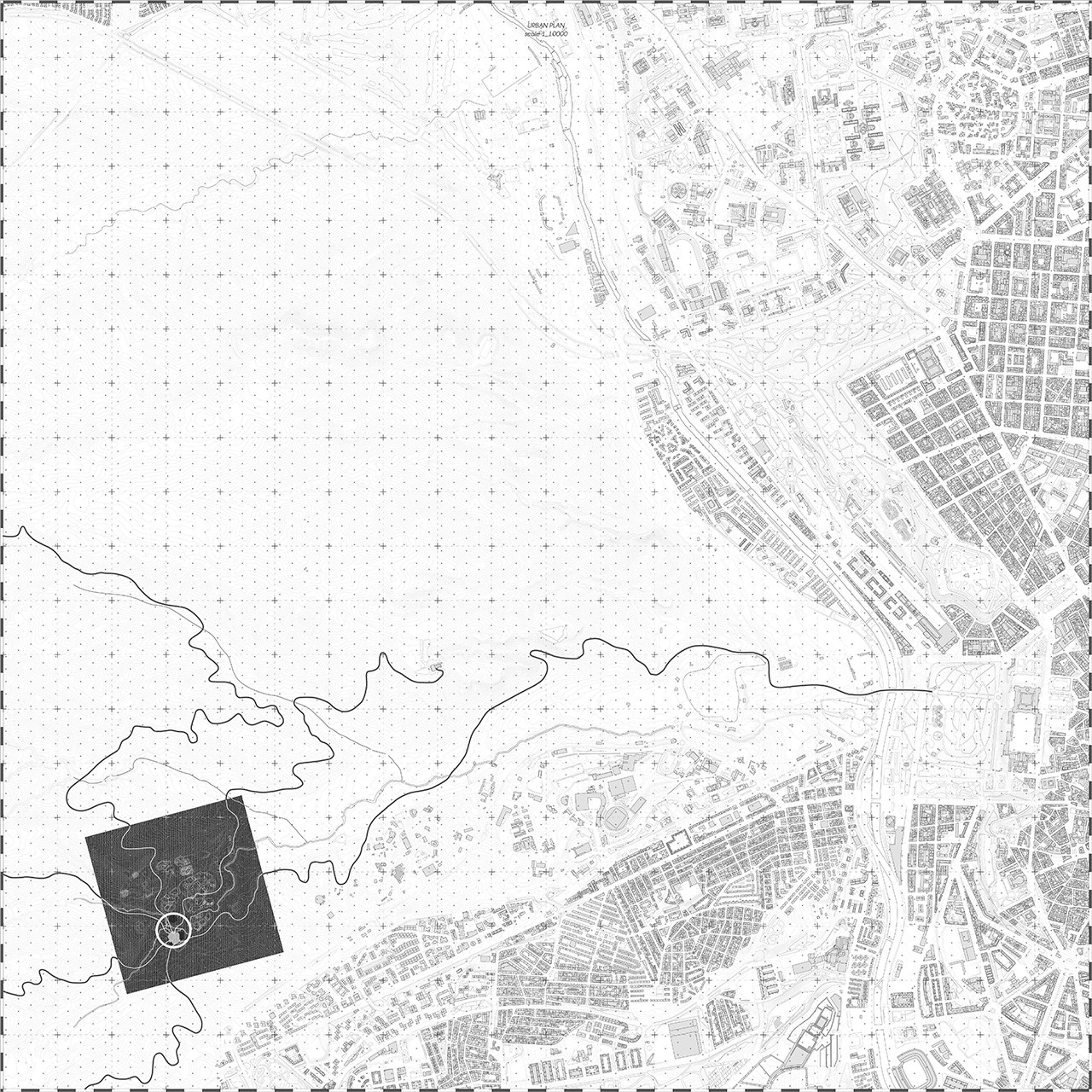
Working in the Casa de Campo, and precisely in the whole of the Zoo, means relating to a place that is on the urban limit, between the city and nature. This relationship requires a linear condition, capable of generating an enclosure. Delimiting where action is taken becomes the principle of project implementation.
The key to this project idea lies in knowing what the shape of this enclosure and its appropriate dimension is, in order to achieve a balance between the built and the resulting vacuum, and thus link them in a permanent way. It is, in fact, a very powerful relationship that opposes what is created, clearly artificial, and nature itself. That violence, however, strikes a balance.
In fact, the project proposal, which is a large circular ring, can be understood as a rather violent intervention, because it wants to say that it is completely foreign to the place, but at the same time generates a balance between intervention and pre-existence.
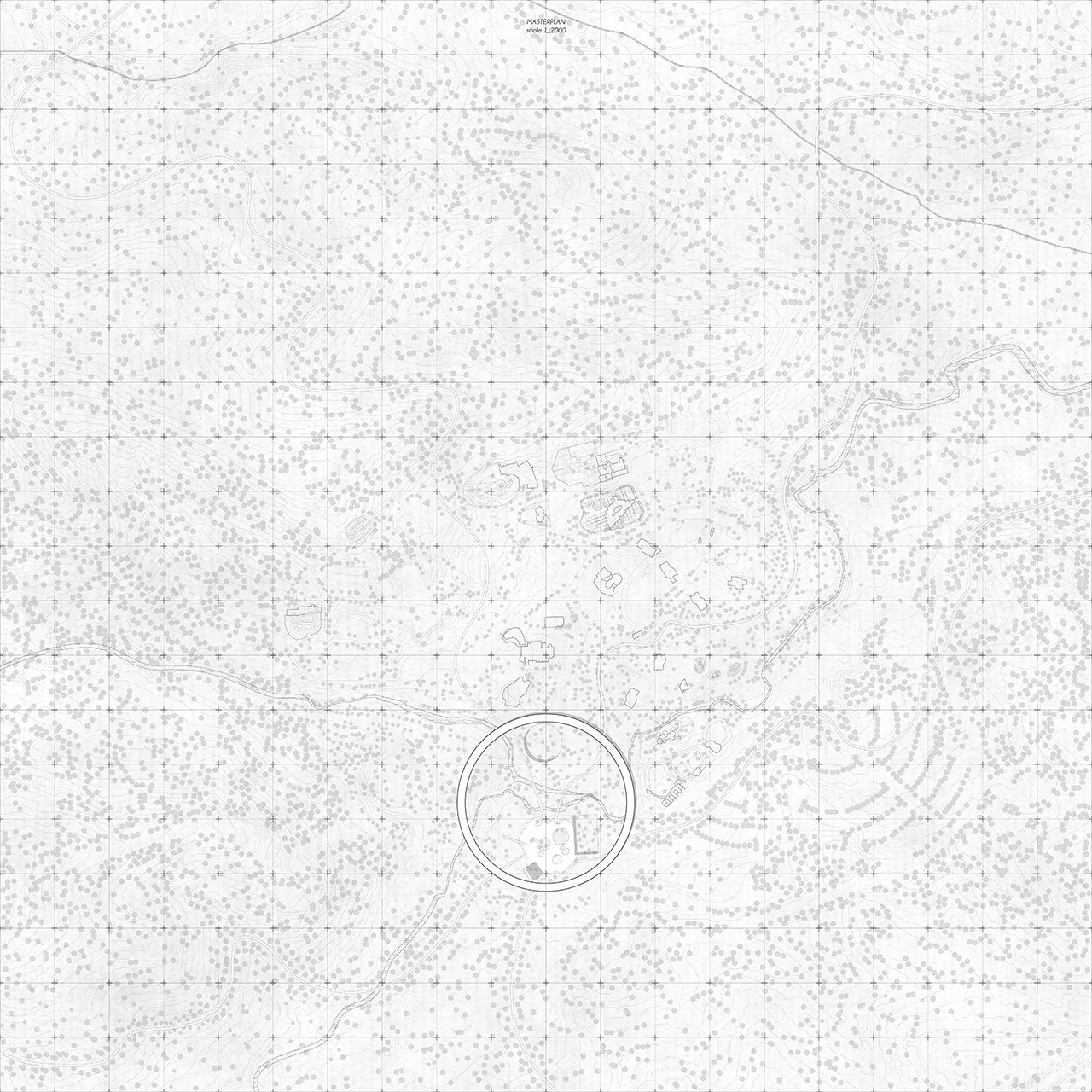
The project develops a program of sports activities that include a meeting and sports center and a technical center. The circle has a diameter of 164 m, so that the building is always perceived in a partial way. That is, in a fragment the whole building is understood, but the only possible way to appreciate the totality is from the air.
The building, composed of one part off the ground and one part buried, is located at the intersection of the two branches of the Stream of “Meaques”: the upper floor, circular, is totally dedicated to the practice of sports and defines an internal environment different from the exterior, favouring the relationship between the users of the building and increasing the sense of community and sportsmanship among athletes.The underground plan, on the other hand, is characterized by rectangular spaces interconnected and interspersed by empty spaces, courtyards, which, in addition to representing the only access to the underlying spaces, create a physical and visual relationship between the world above and the world below.
The building rises from the ground without modifying the topography. Thus, the impact on the site is almost nil. Its character, external to the environment, is underlined by establishing a varied and complex spatial relationship with the topography.
The building is completely covered by vertical plates, a visual and physical diaphragm that connects the new intervention and the architectural antiquity of the place, that is, the buildings originally designed by Carvajal.
The key to this project idea lies in knowing what the shape of this enclosure and its appropriate dimension is, in order to achieve a balance between the built and the resulting vacuum, and thus link them in a permanent way. It is, in fact, a very powerful relationship that opposes what is created, clearly artificial, and nature itself. That violence, however, strikes a balance.
In fact, the project proposal, which is a large circular ring, can be understood as a rather violent intervention, because it wants to say that it is completely foreign to the place, but at the same time generates a balance between intervention and pre-existence.
The project develops a program of sports activities that include a meeting and sports center and a technical center. The circle has a diameter of 164 m, so that the building is always perceived in a partial way. That is, in a fragment the whole building is understood, but the only possible way to appreciate the totality is from the air.
The building, composed of one part off the ground and one part buried, is located at the intersection of the two branches of the Stream of “Meaques”: the upper floor, circular, is totally dedicated to the practice of sports and defines an internal environment different from the exterior, favouring the relationship between the users of the building and increasing the sense of community and sportsmanship among athletes.The underground plan, on the other hand, is characterized by rectangular spaces interconnected and interspersed by empty spaces, courtyards, which, in addition to representing the only access to the underlying spaces, create a physical and visual relationship between the world above and the world below.
The building rises from the ground without modifying the topography. Thus, the impact on the site is almost nil. Its character, external to the environment, is underlined by establishing a varied and complex spatial relationship with the topography.
The building is completely covered by vertical plates, a visual and physical diaphragm that connects the new intervention and the architectural antiquity of the place, that is, the buildings originally designed by Carvajal.


- 00 - Description
- 01 - Urban plan
- 02 - Masterplan
- 03 - -1 floor plan
- 04 - 1 floor plan
- 05 - Cross section
- 06 - Facade
- 07 - Axonometric view
- 08 - Exterior view
- 09 - Interior view
- 10 - Maquette