
Torre AVA
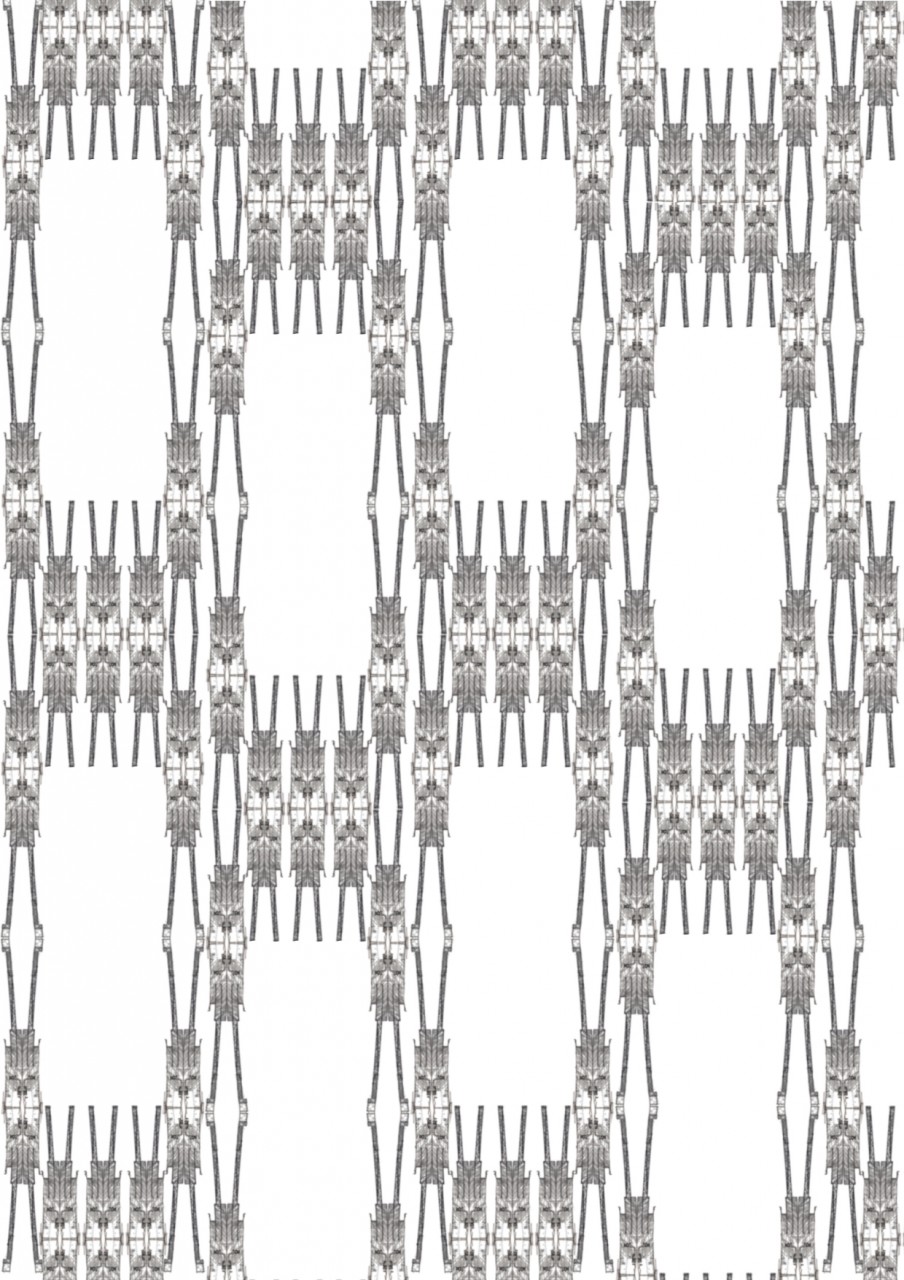
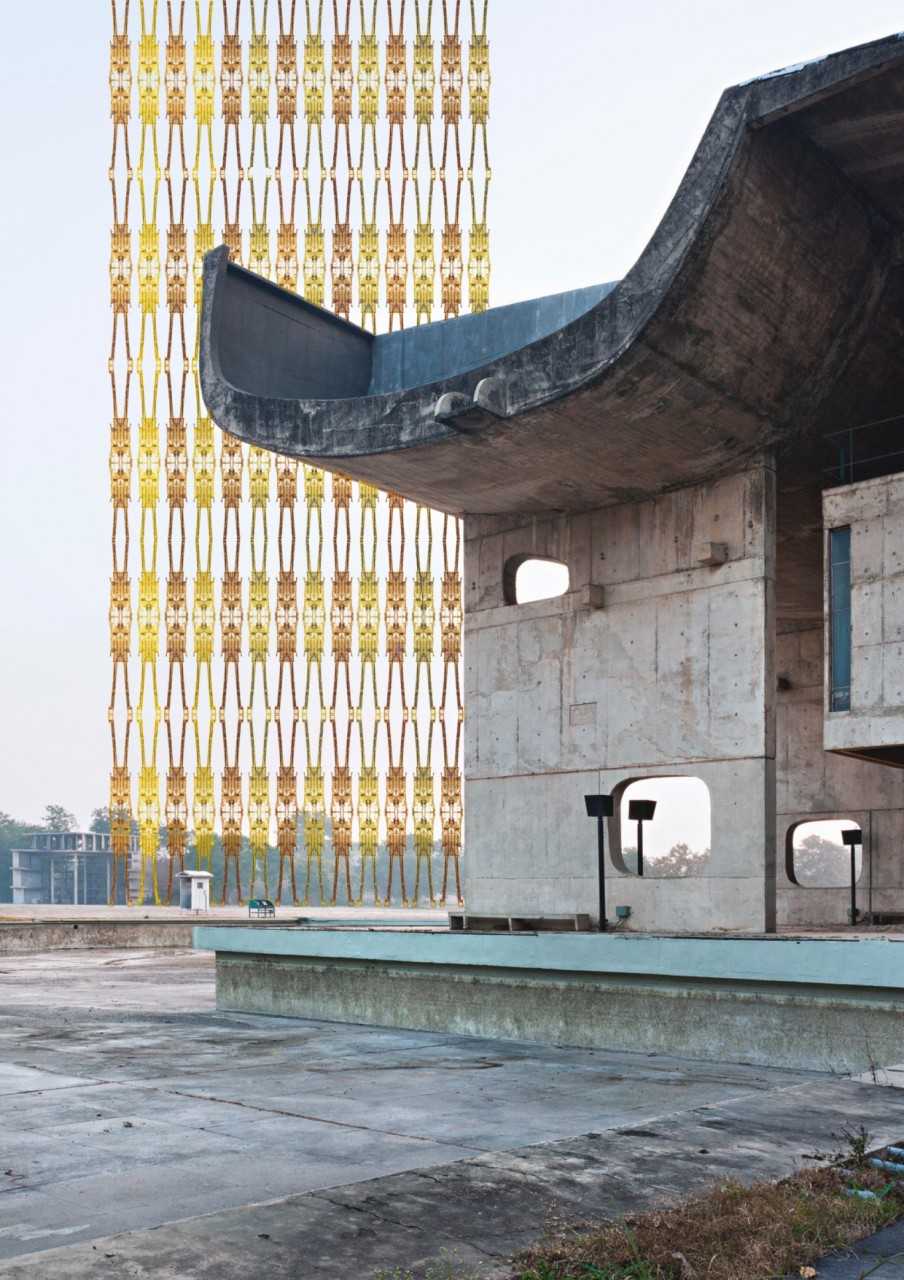
A collection of fragmented plans was the foundation for the project. The reference architect was Le Corbusier. The first step was to identify what interested me about his drawings: the defined parallel lines. Playing with those—repeating, rotating, scaling, multiplying, and unifying—but the result was an undefined network. I needed to focus on the idea of the tower. I decided to eliminate the excessive amount of information and move toward a simpler figure with axial symmetries. When inscribed in an orderly grid, it achieved the structure I was looking for—monumental yet maintaining a certain rhythm with its broken lines.
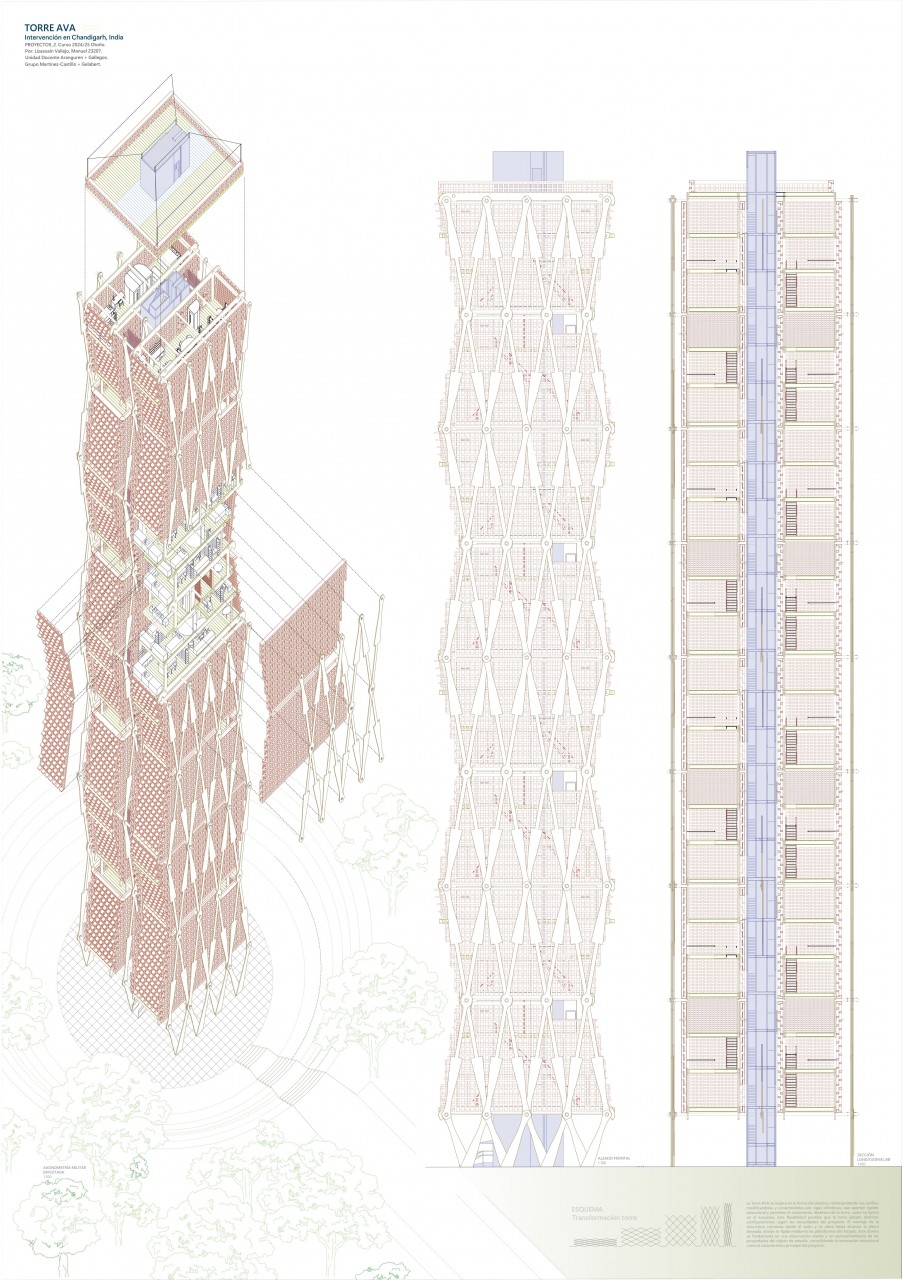
The first part of the course had given me the chance to create from forms. In this second part, I had to materialize the concept. It was time to find an element to serve as the module for representing the drawing. The choice was clear: the fan, which echoed those forms while being an object full of movement. Since I wanted to preserve the idea of a curtain wall enclosing one face of the tower, I had to create a screen supported by a structure.
However, when working with an object as dynamic as the fan, I didn’t want it to remain static. By modifying its ribs, I was able to create a piece that, combined with circular-section beams, could elevate and transition from a horizontal to a vertical position while maintaining the necessary firmness. But since the building needed a fixed position, I designed floor slabs that connect to the structure.
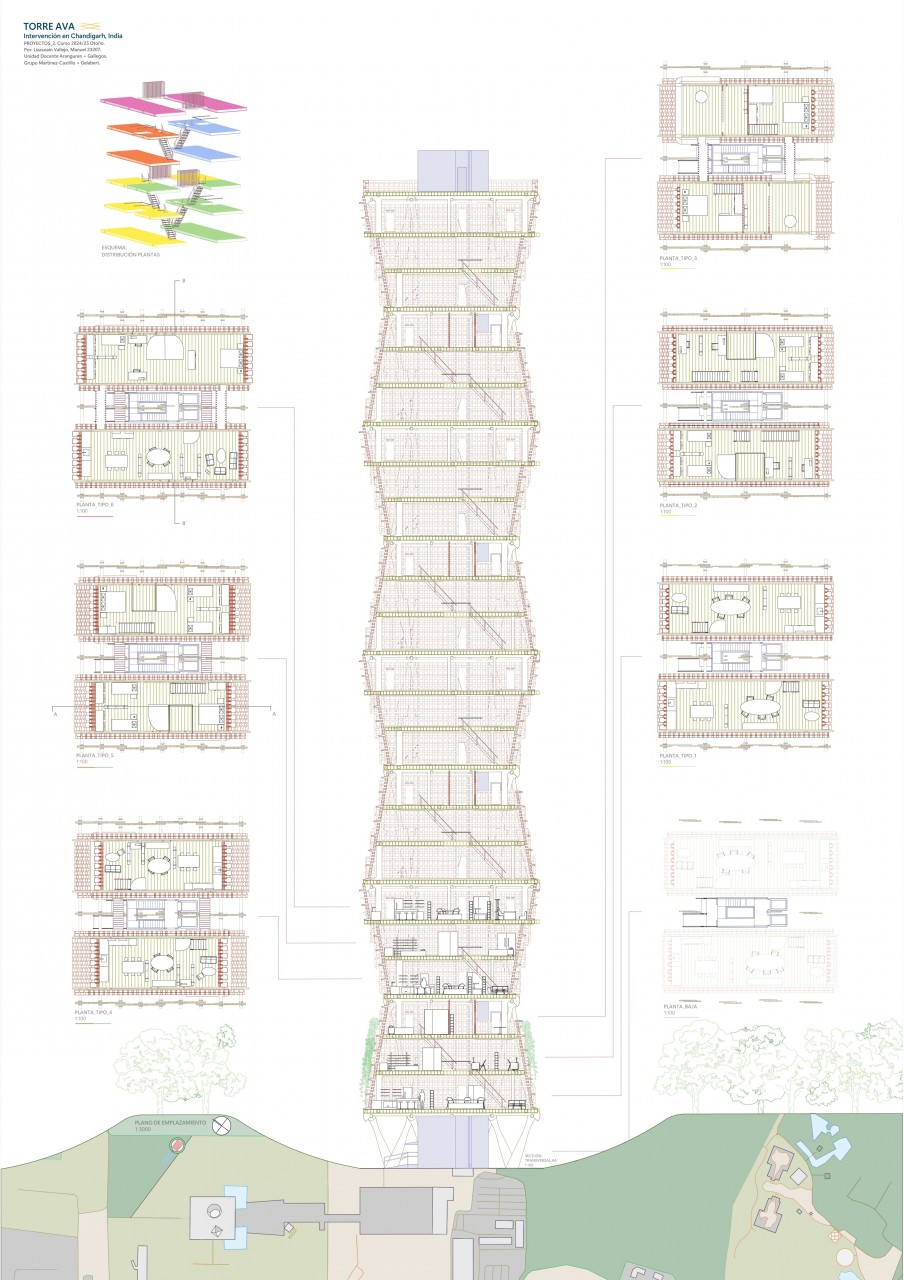
It was time to define the interior layout. As the structure consisted of three screens, I was clear that vertical circulation had to be central, with the two residential blocks on either side. The proportions of the base constrained the dimensions of the slabs, forcing me to think about how to combine different levels. This led to three types of residential layouts, adapted to the shape of the tower.
The first type spans three levels on one side of the tower, varying on the third level, where half of the floor is in one block and the other half in the adjacent block, connected by a walkway. The layout on the opposite side is symmetrical to maximize space. The second layout spans only two levels, connecting with their corresponding counterparts. The third layout reuses the walkways to utilize an entire floor, joining both blocks.
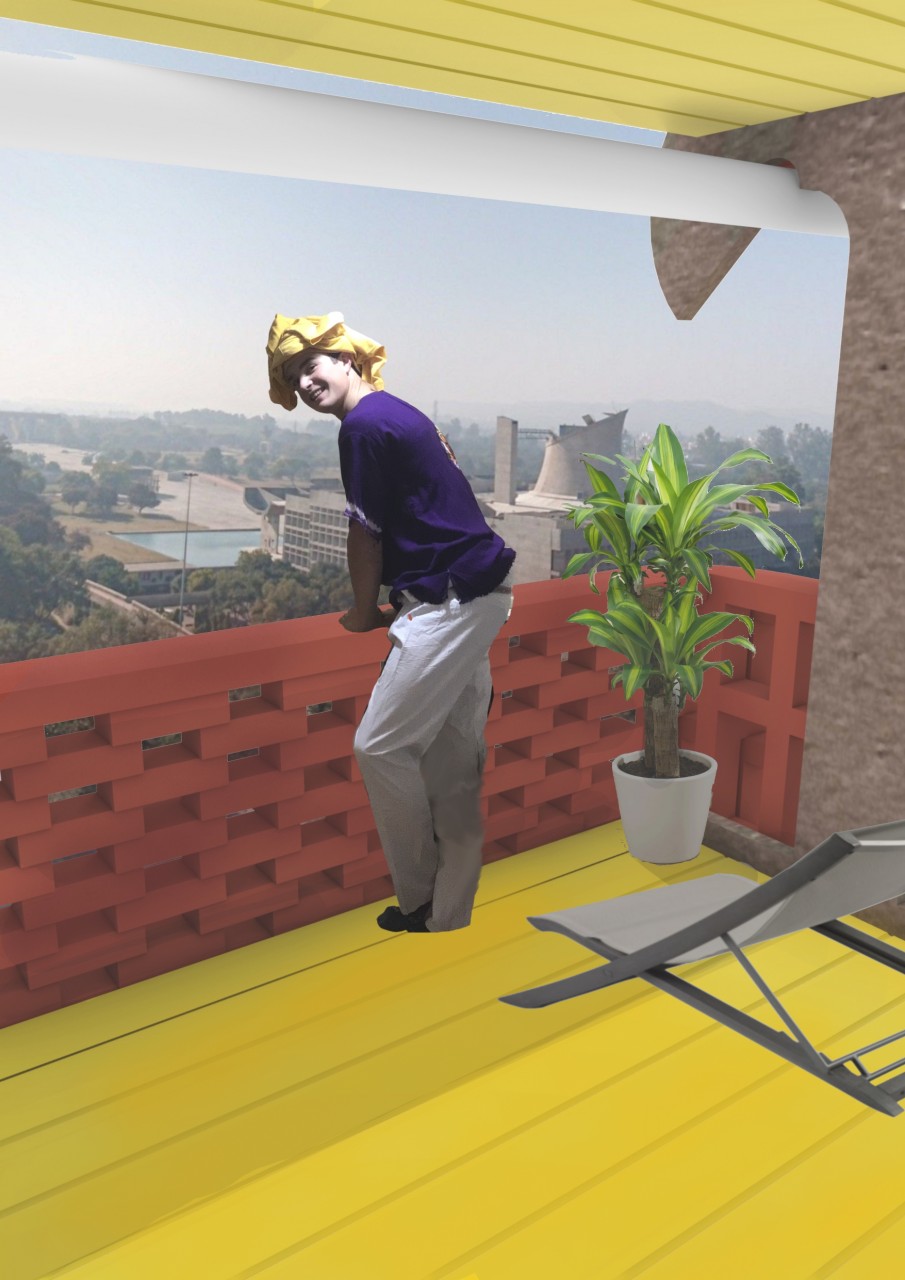
For the facade, I wanted it to adapt to the building's form and use a material that gave the exterior character. Therefore, I selected two types of brick latticework to allow light and ventilation, considering the climate of India, where the project is located.
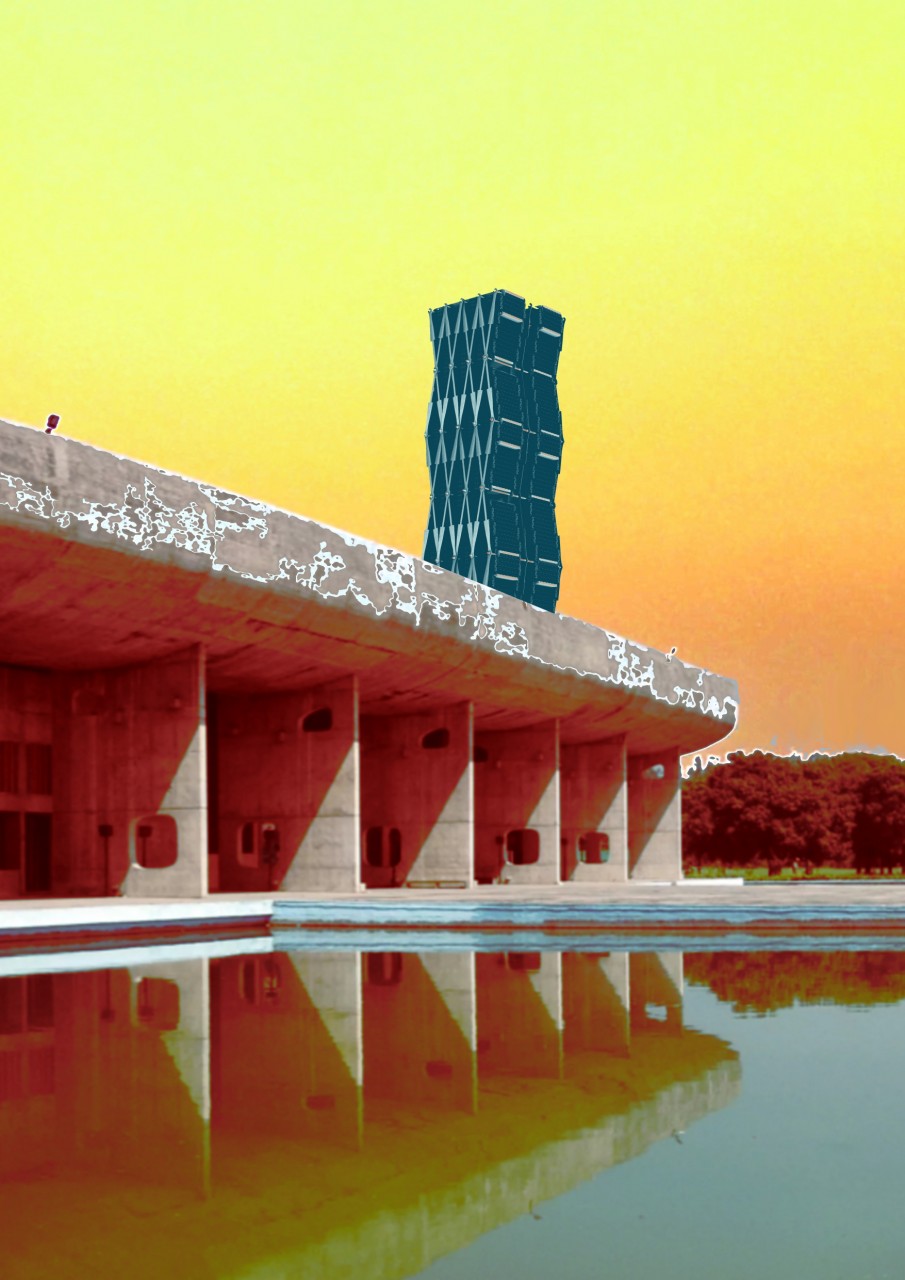
All these elements come together to form the AVA Tower, which starts from a highly systematic organization to end in a dynamic, changing structure.
The first part of the course had given me the chance to create from forms. In this second part, I had to materialize the concept. It was time to find an element to serve as the module for representing the drawing. The choice was clear: the fan, which echoed those forms while being an object full of movement. Since I wanted to preserve the idea of a curtain wall enclosing one face of the tower, I had to create a screen supported by a structure.
However, when working with an object as dynamic as the fan, I didn’t want it to remain static. By modifying its ribs, I was able to create a piece that, combined with circular-section beams, could elevate and transition from a horizontal to a vertical position while maintaining the necessary firmness. But since the building needed a fixed position, I designed floor slabs that connect to the structure.
It was time to define the interior layout. As the structure consisted of three screens, I was clear that vertical circulation had to be central, with the two residential blocks on either side. The proportions of the base constrained the dimensions of the slabs, forcing me to think about how to combine different levels. This led to three types of residential layouts, adapted to the shape of the tower.
The first type spans three levels on one side of the tower, varying on the third level, where half of the floor is in one block and the other half in the adjacent block, connected by a walkway. The layout on the opposite side is symmetrical to maximize space. The second layout spans only two levels, connecting with their corresponding counterparts. The third layout reuses the walkways to utilize an entire floor, joining both blocks.
For the facade, I wanted it to adapt to the building's form and use a material that gave the exterior character. Therefore, I selected two types of brick latticework to allow light and ventilation, considering the climate of India, where the project is located.
All these elements come together to form the AVA Tower, which starts from a highly systematic organization to end in a dynamic, changing structure.

- 00 - Description
- 01 - Line collage1_1
- 02 - Line collage1_2
- 03 - Line collage1_3
- 04 - Panel_1
- 05 - Panel_2
- 06 - Photomontage_1
- 07 - Photomontage_1
- 08 - Video