
VV SOUTH GATE
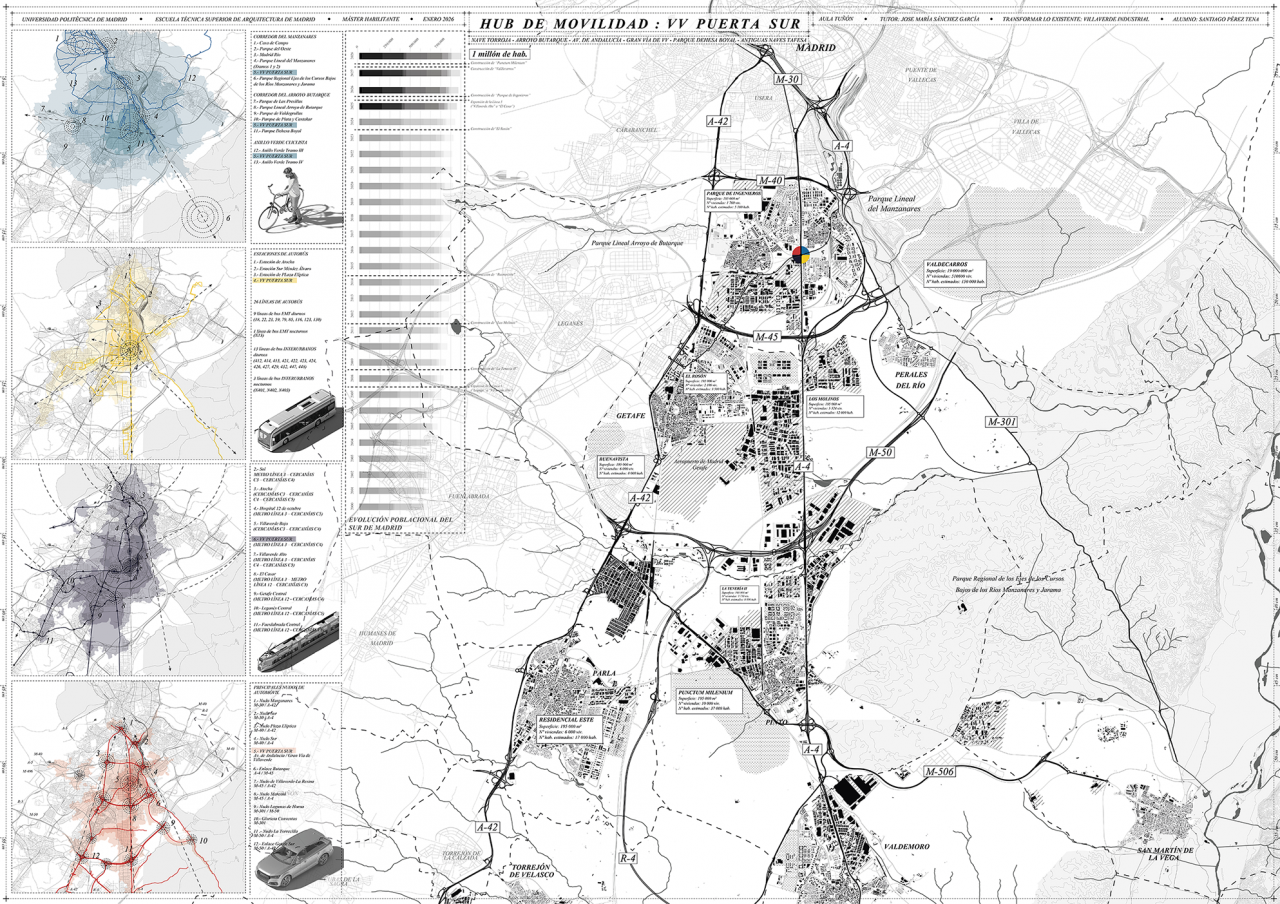
VV South Gate proposes the creation of a metropolitan mobility hub in Villaverde, a district that concentrates a significant share of the access flows to the south of Madrid in a context of strong demographic growth and real-estate pressure. The recent extension of Metro Line 3, the saturation of existing infrastructures, and the foreseeable tightening of restrictions on private traffic in the city centre make it essential to anticipate a system capable of absorbing these movements, reducing the entry of private vehicles, and enabling an efficient modal shift before reaching the consolidated city.
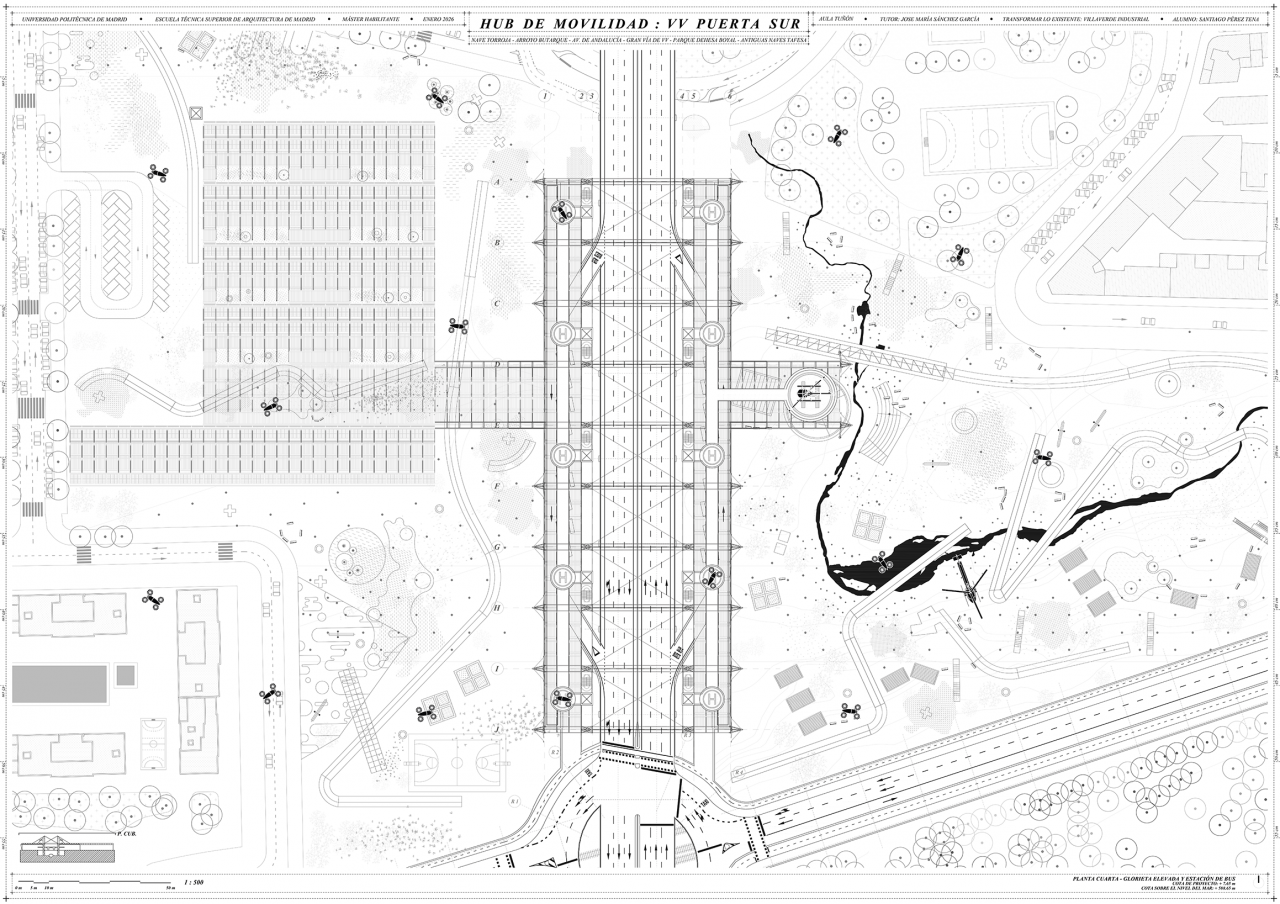
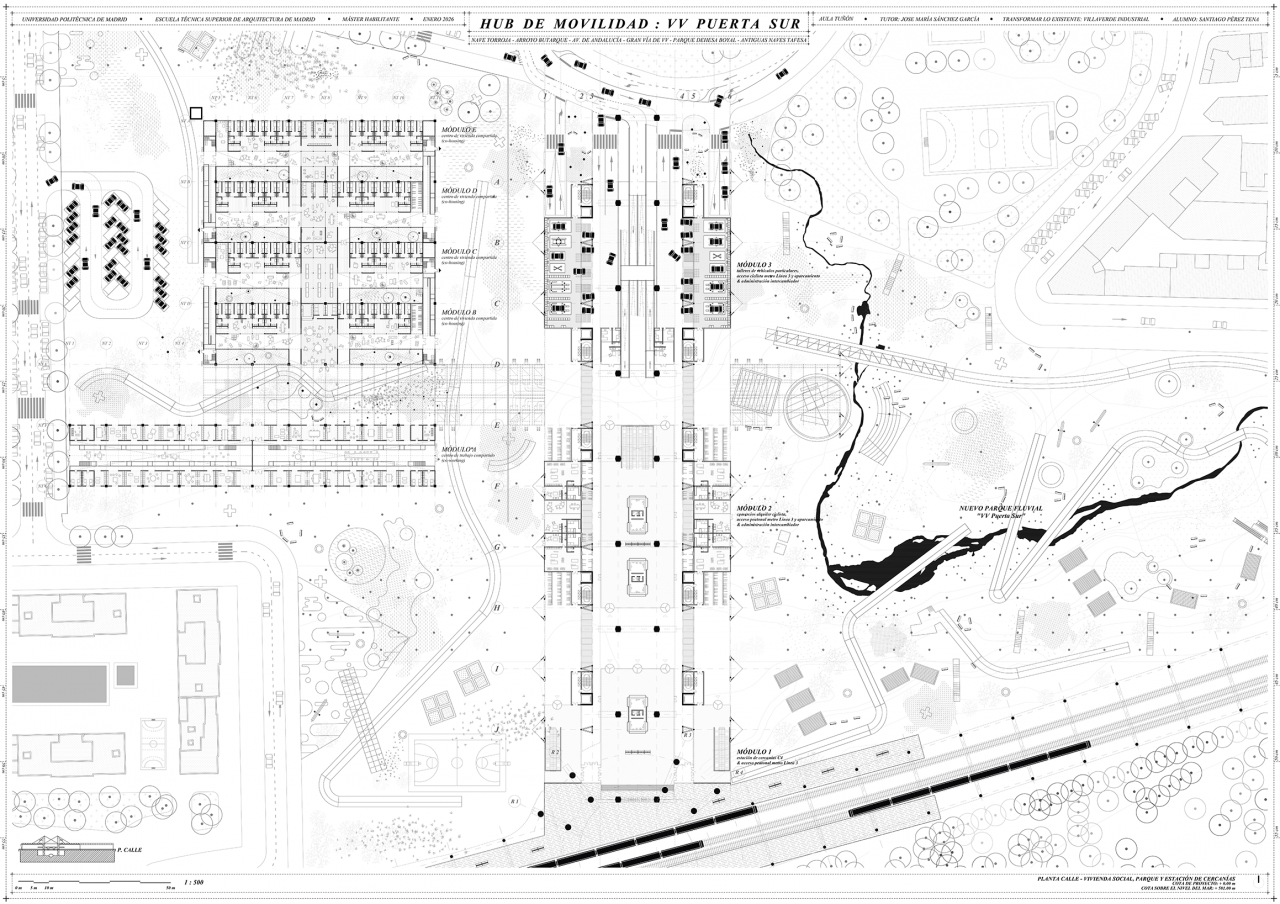
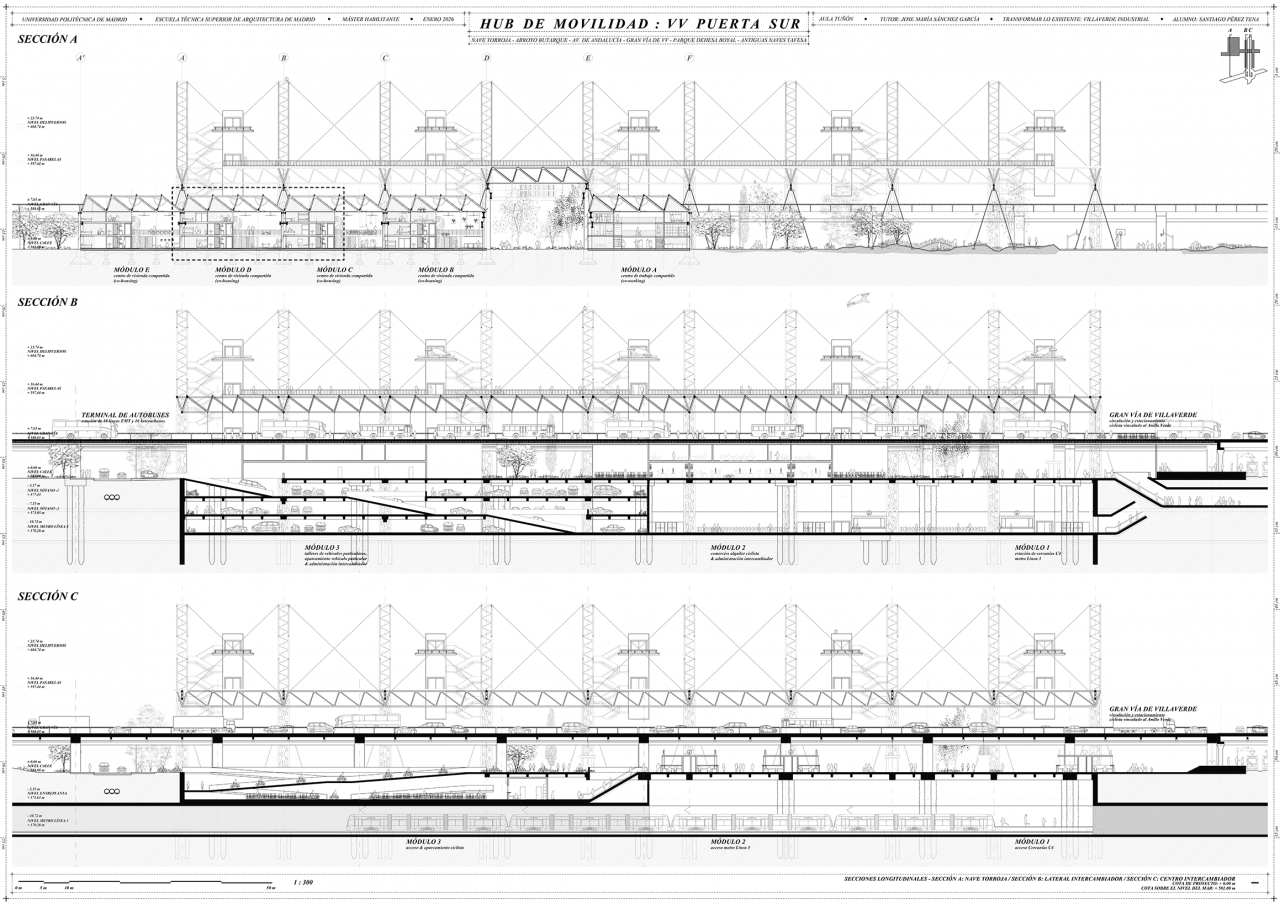
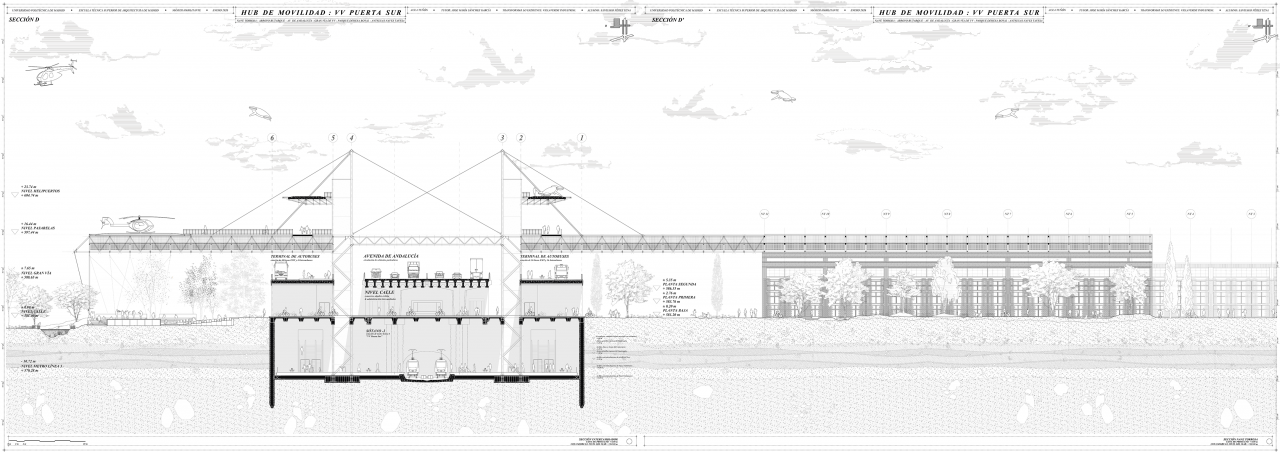
The project is located in a strategic enclave at the geometric centre of the district, where the metro, commuter rail, major road infrastructures, and a metropolitan-scale cycling network converge. Through an intermodal organisation integrating the metro, Cercanías C4, urban and interurban buses, private vehicles, bicycles, and pedestrians, the hub resolves Villaverde’s territorial fragmentation and consolidates its role as Madrid’s southern gateway and a key metropolitan node. This infrastructure is also conceived from a forward-looking perspective, incorporating platforms for new systems of aerial and personal mobility.
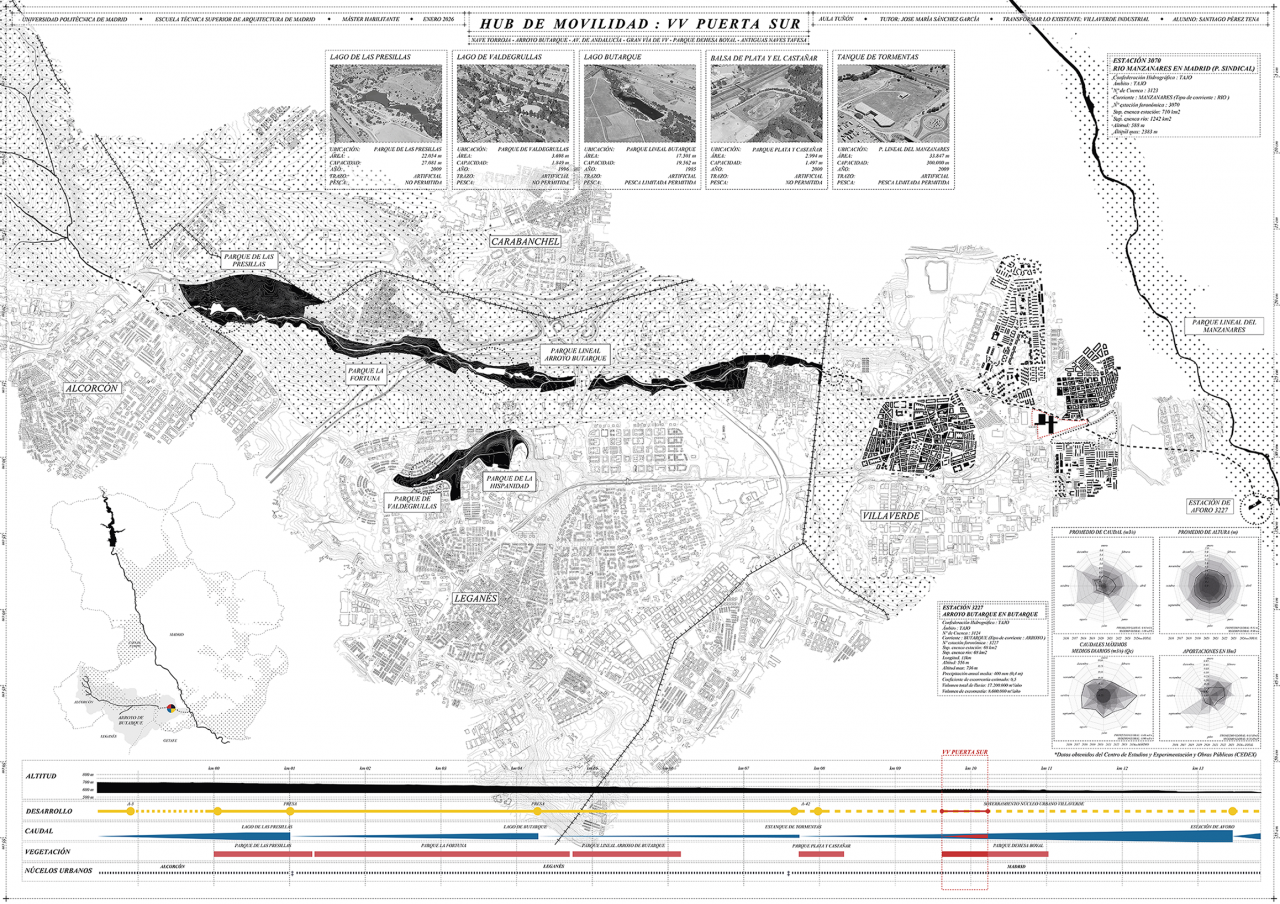
The intervention takes advantage of the district’s fragmented condition and the presence of large elevated infrastructures as an opportunity to generate a unifying space. The renaturalisation of the Butarque stream, currently buried underground, structures a linear park that connects the main surrounding green spaces and integrates into the green infrastructure of southern Madrid, fostering sustainable mobility and environmental recovery through the reintroduction of native species.
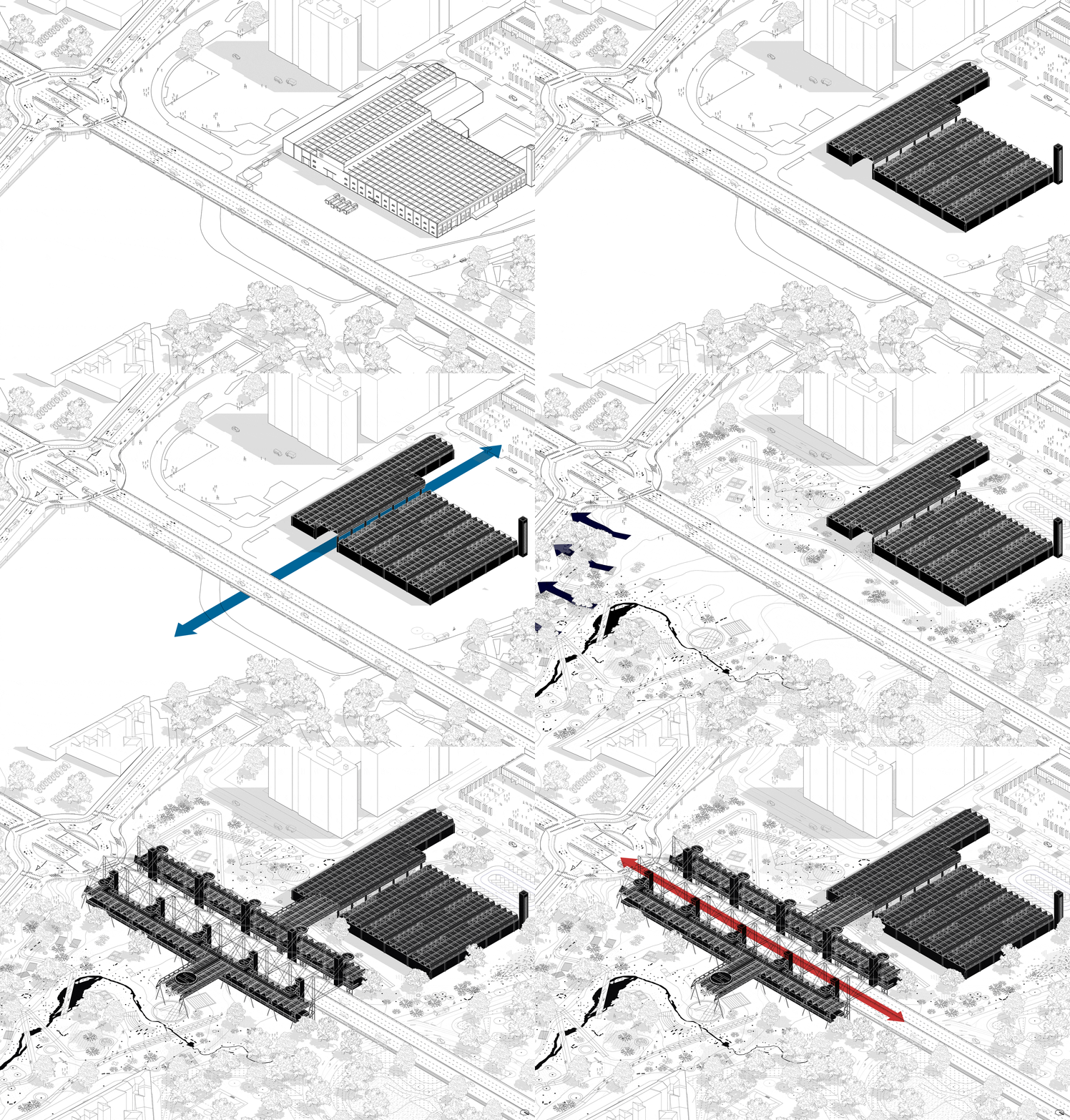
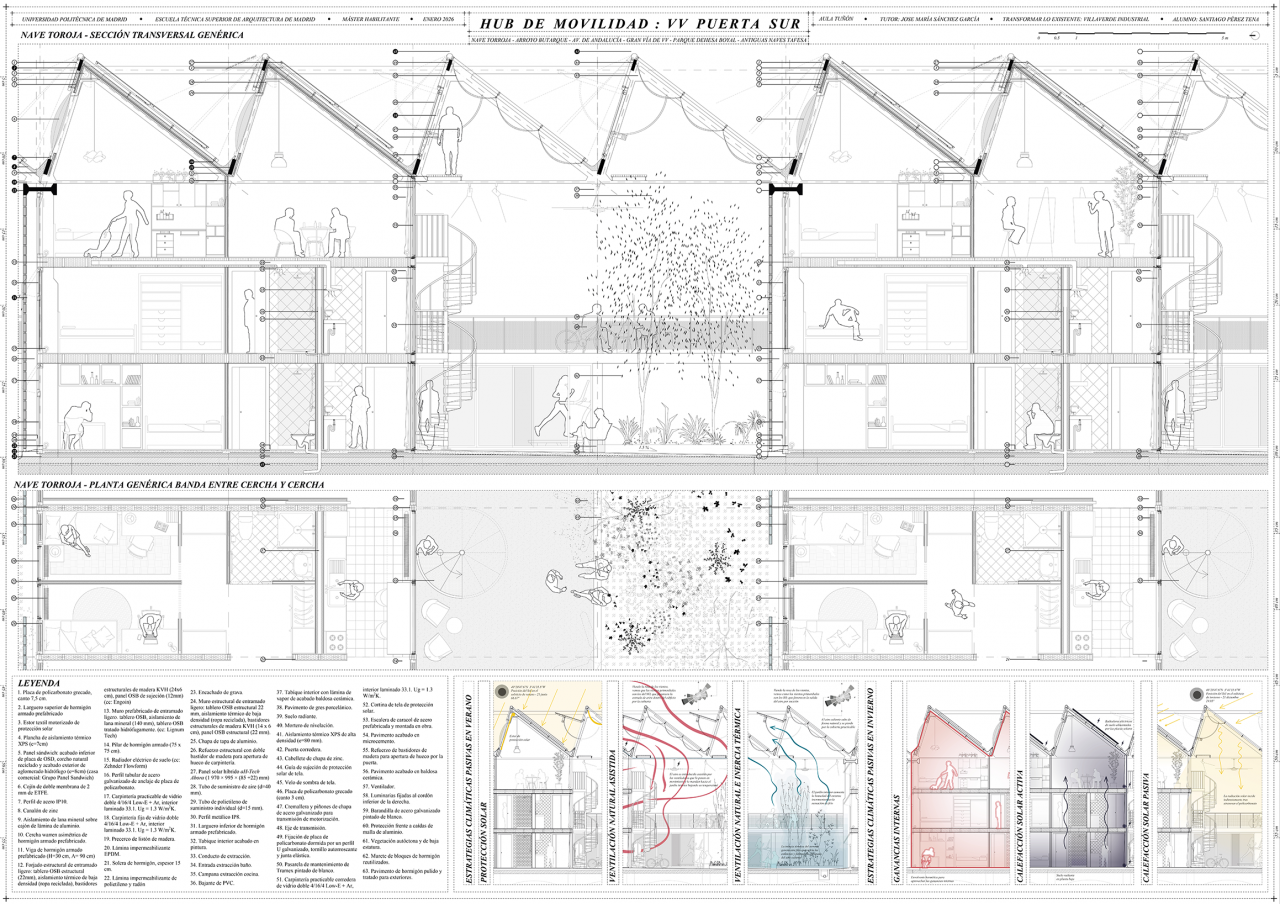
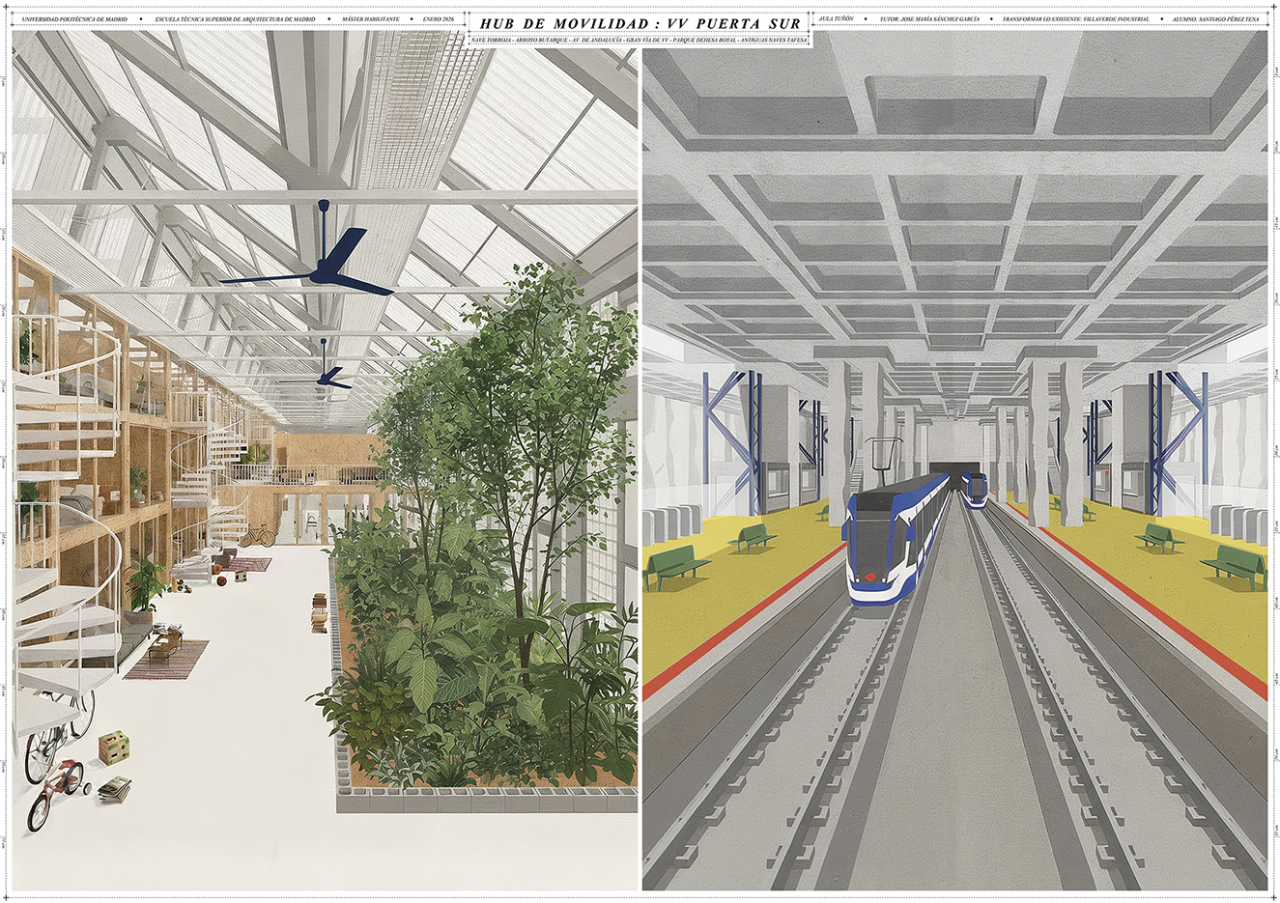
In this context, the "Nave Torroja" is recovered and enhanced: an industrial pre-existence of high heritage value designed by Eduardo Torroja in 1942. Its structural system of asymmetric prefabricated reinforced-concrete Warren trusses is preserved and adapted to the new programme through a minimal intervention, incorporating structural lightening strategies such as replacing glazing systems with ETFE cushions and reusing materials as an exercise in urban mining. The nave is transformed into a social and productive centre housing co-living and co-working spaces, conceived as a prototype of communal living and working managed through municipal and associative frameworks.
The project adopts the typology of the linear house (longhouse) as a spatial and social reference, proposing an organisation that dissolves the boundaries between public and private and generates a gradient of spaces from the intimate to the collective. This strategy responds both to new ways of living and working derived from remote work and to the need to provide the district with spaces for social interaction, economic activity, and social support, including emergency accommodation for vulnerable populations.
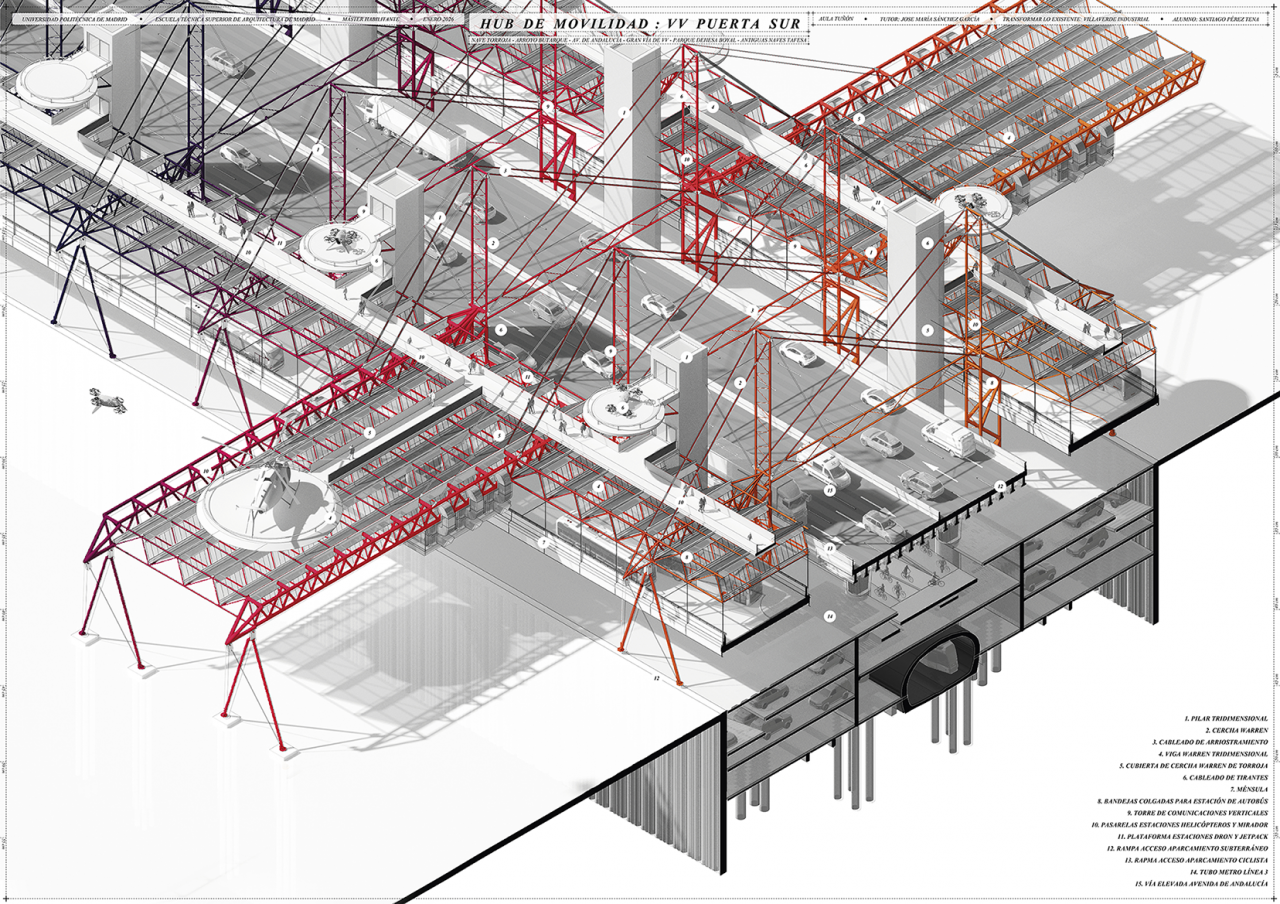
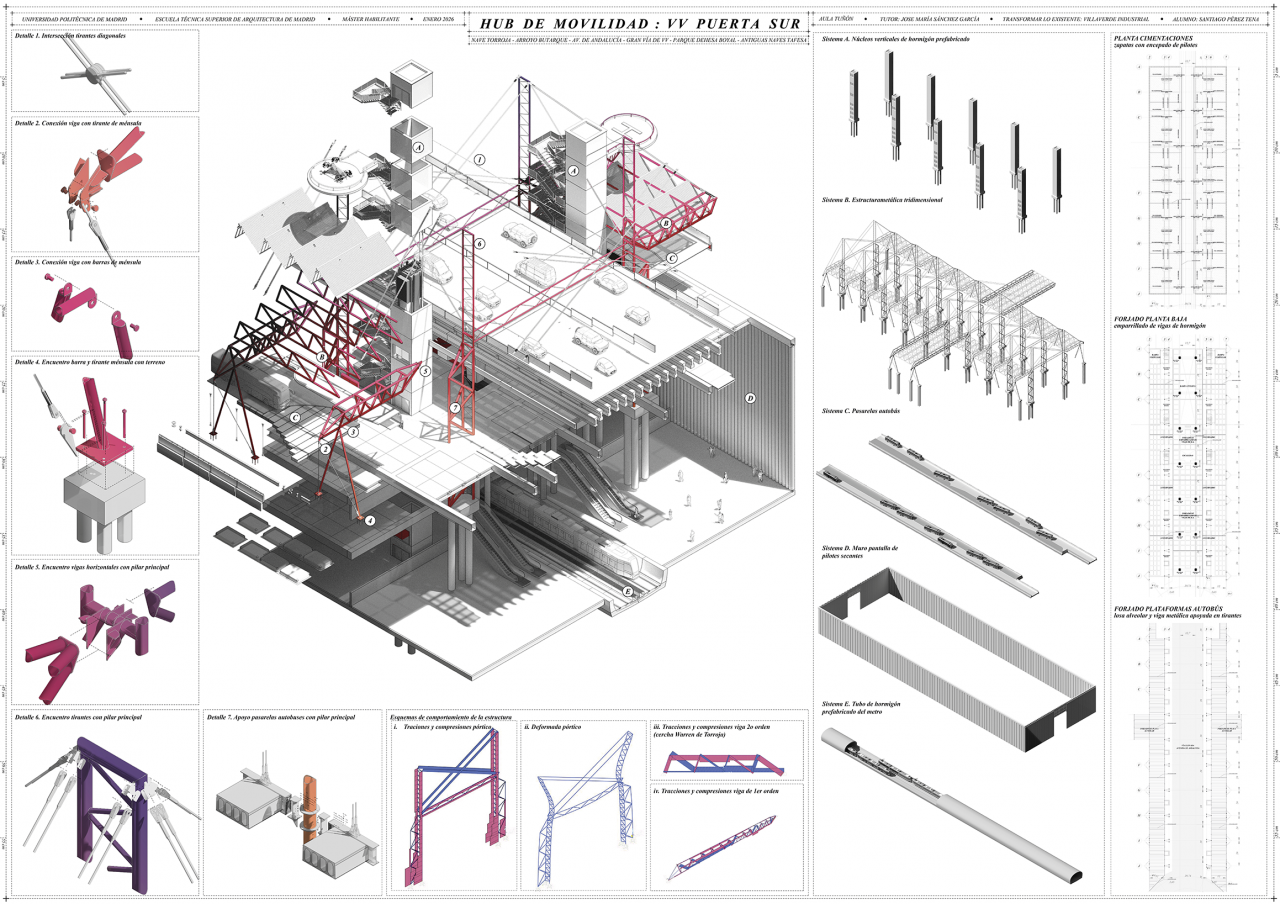
The new interchange is developed linearly along Avenida de Andalucía, taking as reference the structural module of the "Nave Torroja" and reinterpreting its logic through a prefabricated steel structure. Inspired by hanging architecture, the solution minimises the presence of columns, frees the ground level as a continuous urban space, and reinforces permeability and the coexistence of flows. Prefabrication, structural independence from existing infrastructures, and local production enable an efficient, legible execution consistent with Villaverde’s industrial character.
VV South Gate transcends the condition of a transport infrastructure to become an integral urban project combining mobility, landscape, heritage, and social cohesion. Through the reuse of industrial legacy, the activation of new social and productive programmes, and the construction of a flexible and forward-looking infrastructure, the project transforms a metropolitan bottleneck into a new urban threshold, capable of articulating the growth of southern Madrid and reinforcing Villaverde’s role as a new metropolitan centrality.
The project is located in a strategic enclave at the geometric centre of the district, where the metro, commuter rail, major road infrastructures, and a metropolitan-scale cycling network converge. Through an intermodal organisation integrating the metro, Cercanías C4, urban and interurban buses, private vehicles, bicycles, and pedestrians, the hub resolves Villaverde’s territorial fragmentation and consolidates its role as Madrid’s southern gateway and a key metropolitan node. This infrastructure is also conceived from a forward-looking perspective, incorporating platforms for new systems of aerial and personal mobility.
The intervention takes advantage of the district’s fragmented condition and the presence of large elevated infrastructures as an opportunity to generate a unifying space. The renaturalisation of the Butarque stream, currently buried underground, structures a linear park that connects the main surrounding green spaces and integrates into the green infrastructure of southern Madrid, fostering sustainable mobility and environmental recovery through the reintroduction of native species.
In this context, the "Nave Torroja" is recovered and enhanced: an industrial pre-existence of high heritage value designed by Eduardo Torroja in 1942. Its structural system of asymmetric prefabricated reinforced-concrete Warren trusses is preserved and adapted to the new programme through a minimal intervention, incorporating structural lightening strategies such as replacing glazing systems with ETFE cushions and reusing materials as an exercise in urban mining. The nave is transformed into a social and productive centre housing co-living and co-working spaces, conceived as a prototype of communal living and working managed through municipal and associative frameworks.
The project adopts the typology of the linear house (longhouse) as a spatial and social reference, proposing an organisation that dissolves the boundaries between public and private and generates a gradient of spaces from the intimate to the collective. This strategy responds both to new ways of living and working derived from remote work and to the need to provide the district with spaces for social interaction, economic activity, and social support, including emergency accommodation for vulnerable populations.
The new interchange is developed linearly along Avenida de Andalucía, taking as reference the structural module of the "Nave Torroja" and reinterpreting its logic through a prefabricated steel structure. Inspired by hanging architecture, the solution minimises the presence of columns, frees the ground level as a continuous urban space, and reinforces permeability and the coexistence of flows. Prefabrication, structural independence from existing infrastructures, and local production enable an efficient, legible execution consistent with Villaverde’s industrial character.
VV South Gate transcends the condition of a transport infrastructure to become an integral urban project combining mobility, landscape, heritage, and social cohesion. Through the reuse of industrial legacy, the activation of new social and productive programmes, and the construction of a flexible and forward-looking infrastructure, the project transforms a metropolitan bottleneck into a new urban threshold, capable of articulating the growth of southern Madrid and reinforcing Villaverde’s role as a new metropolitan centrality.
- 00 - Description
- 01 - TRANSPORT
- 02 - BUTARQUE
- 03 - CONTEXT
- 04 - DRONE & RIDE
- 05 - BIKE & TRAIN
- 06 - AXO
- 07 - LONG. SECTIONS
- 08 - TORROJA
- 09 - STRUCTURE
- 10 - SECTION
- 11 - VISUALISATIONS
- 12 - Video