
ARTIFICIAL LAN
When reality is limited, the evolution is virtual. Schools are in charge of this progress, and the best way to teaching knowledge is from practical experience. The number 20 of Rodas Street will be the center of experimentation, the transition from Physical reality to virtual reality.
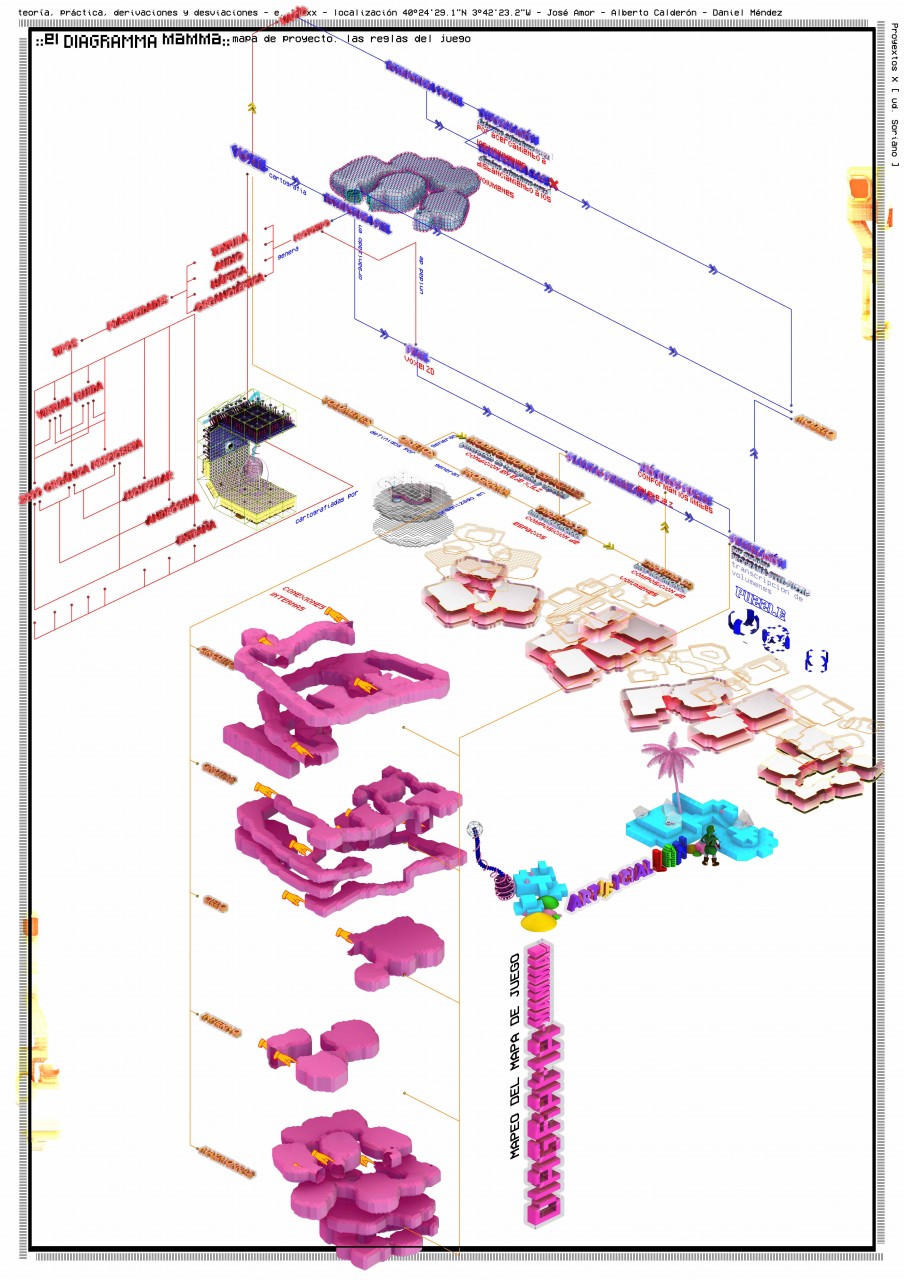
The model for the creation of a tangible world with its virtual relative is in the maps and video game supports, the logic of which will be applied to the organization of the building.
As in the possibilities of open world video games, where users decide their own experience, a micro universe is generated.
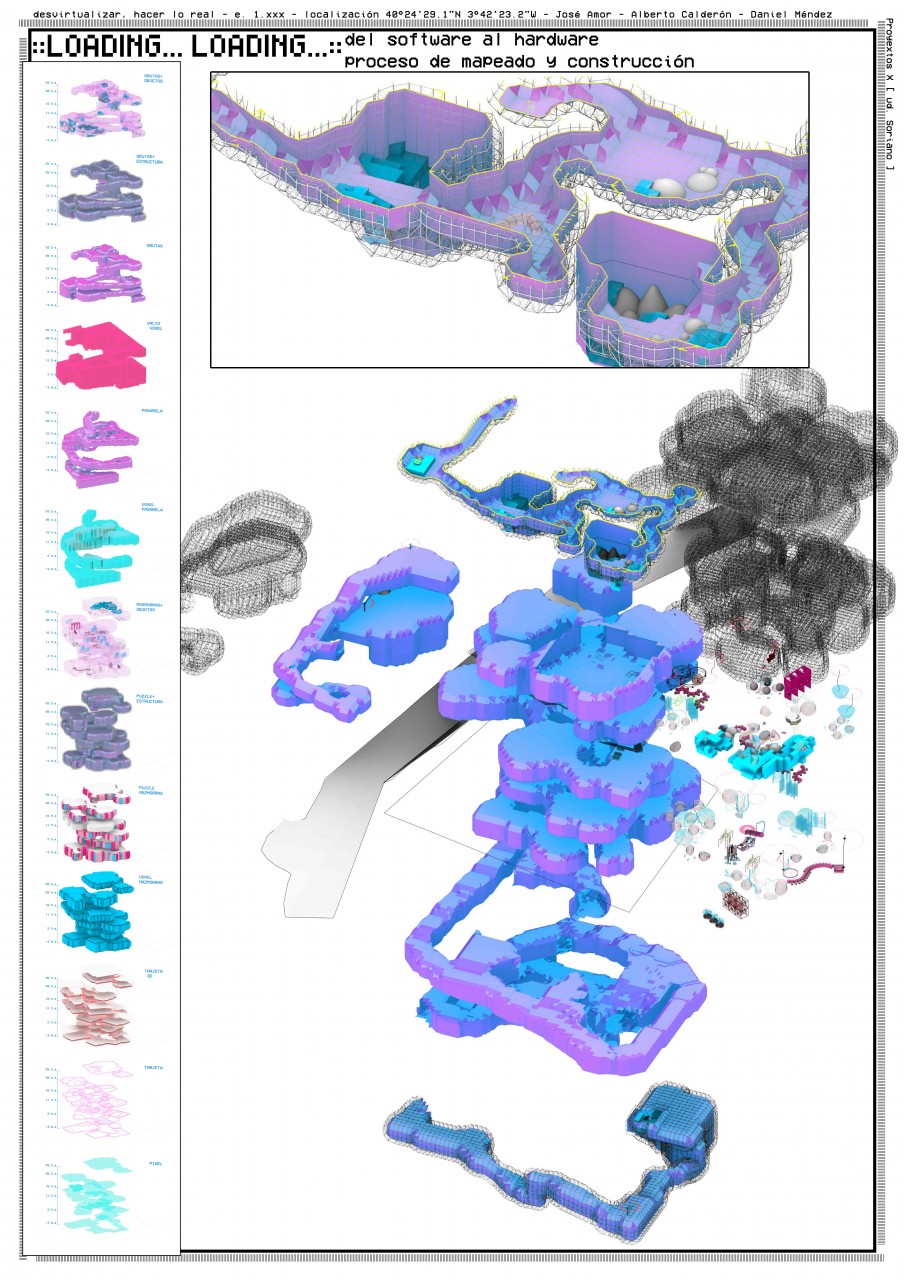
The plot is mapped with the new measurement unit: the voxel. It’s a cubic pixel that reacts to the empty space, the interior space and the structural skin of the inserted volumes.
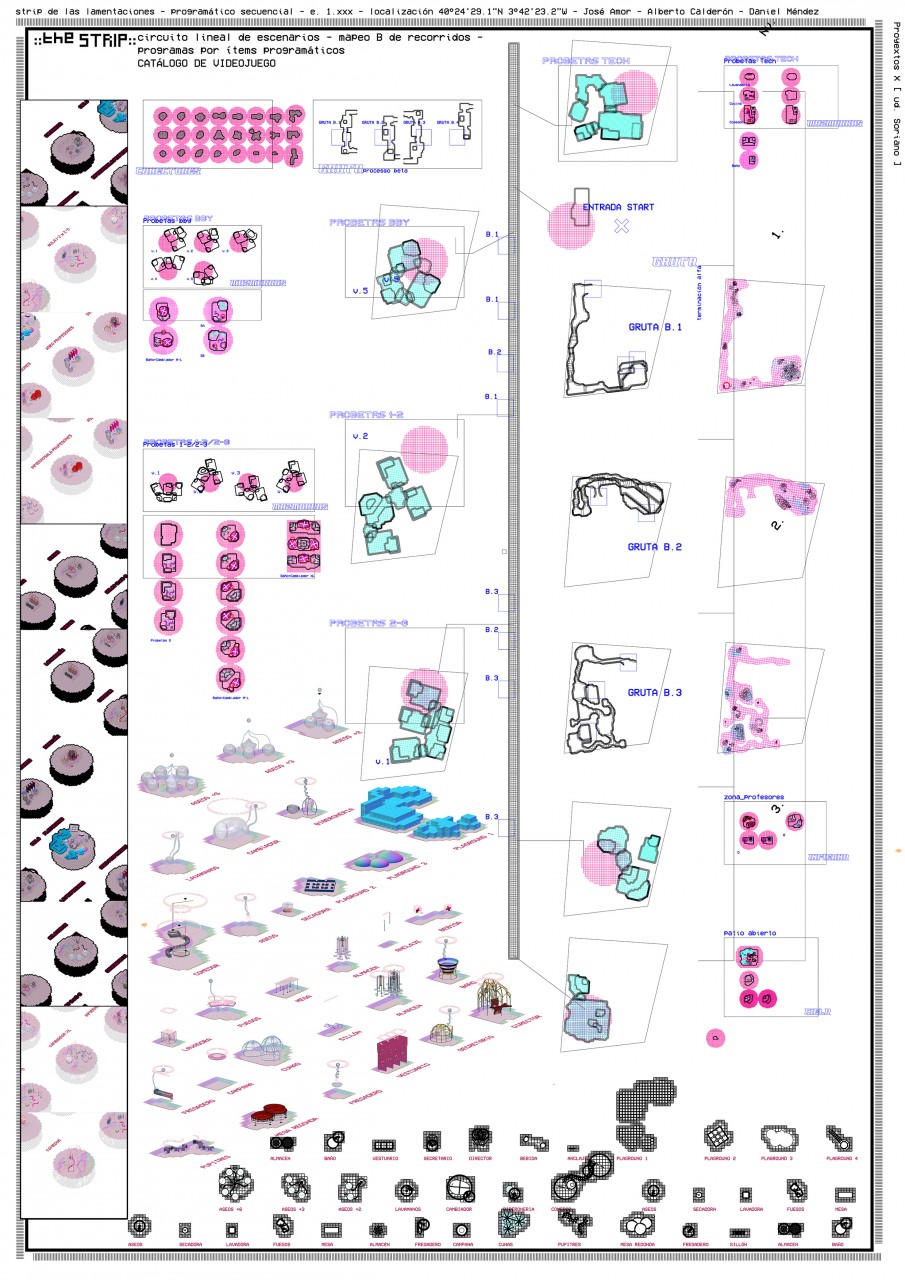
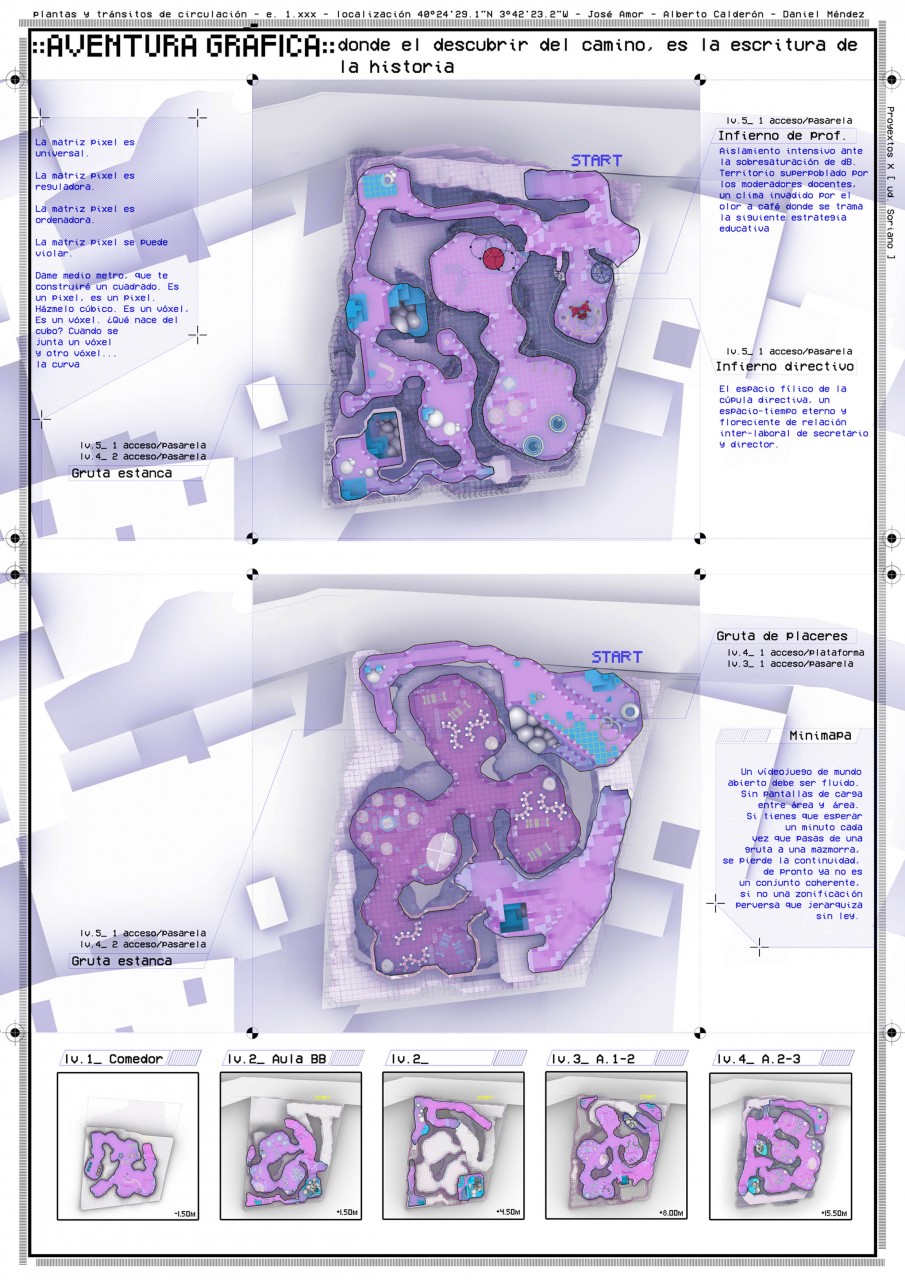
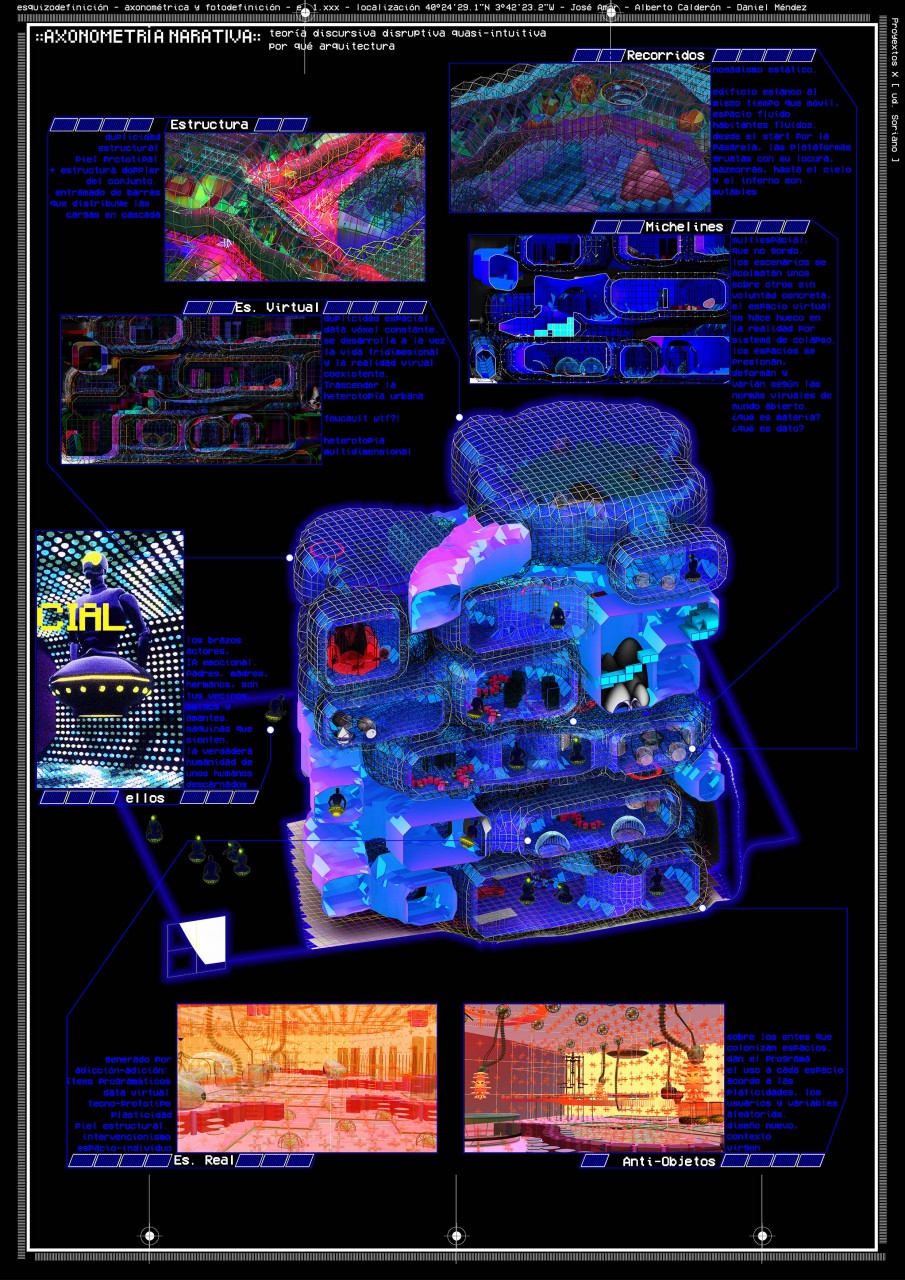
Artificial LAN, as in an inmersive game, is organized by program levels, in scenarios with different routes, main and secondary connections, and different degrees of obstacles, following the rules developed in open-world video games. Thus, users, according to their knowledge and development, will be able to take multiple paths.
The program levels are given by the objects that populate it; As on a game screen, the tour guides decide the type of scenario we are in, whether it is a forest, temple or underwater city. The space is offered by multiple and completely variable.
Video
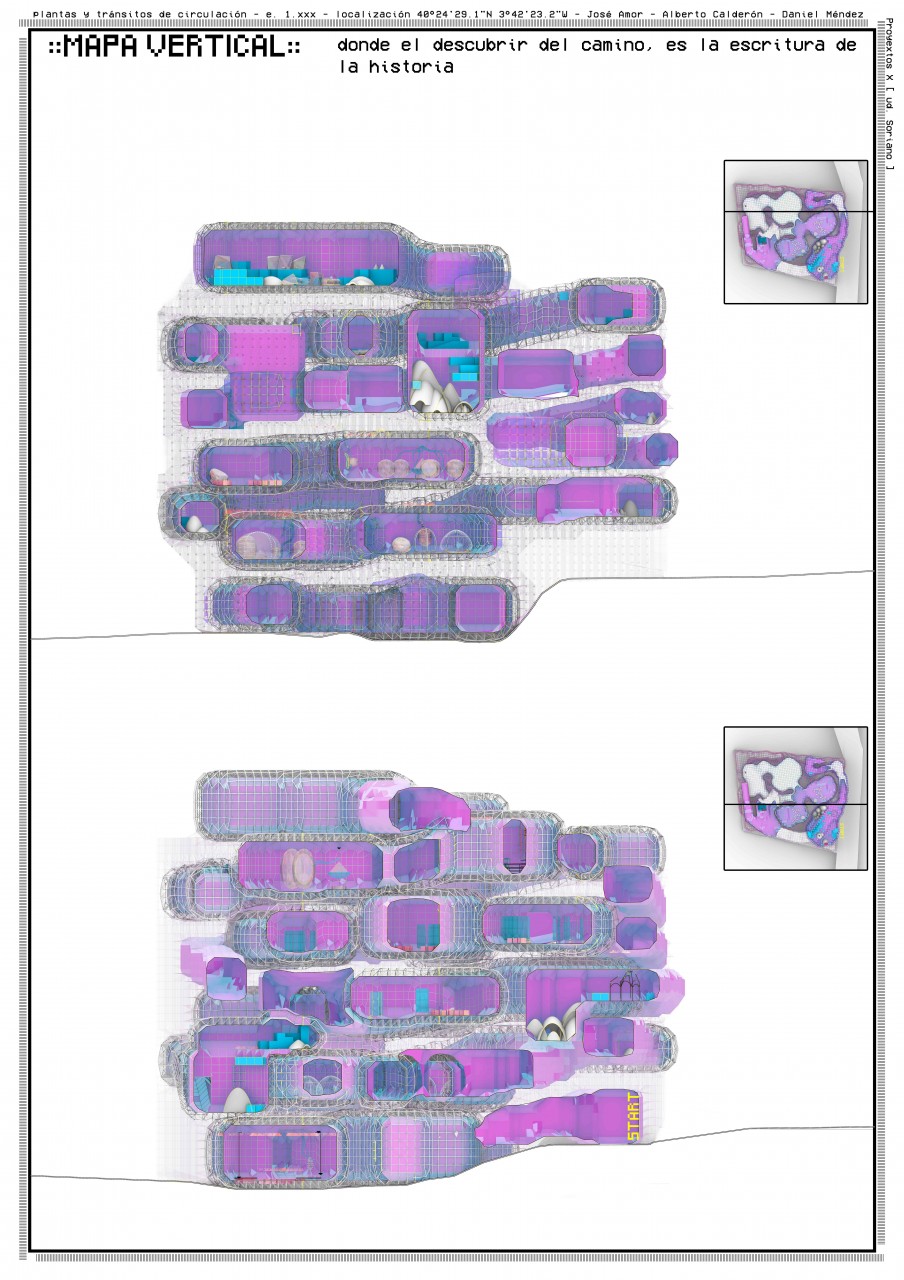
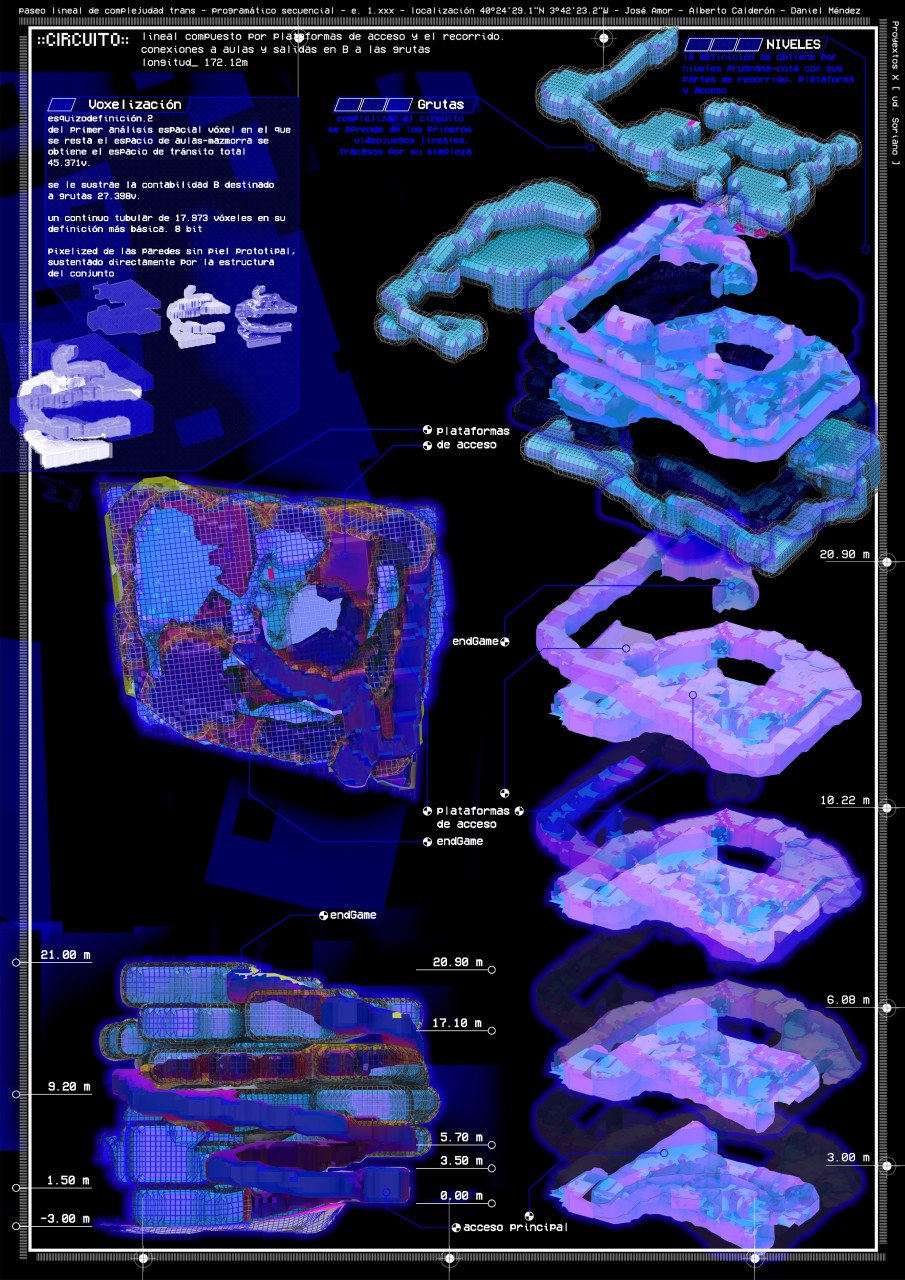
These programmatic objects deform the base space; the limits of wall, floor and ceiling, which collide with each other and generate sets, overlapping on 6 levels of specific uses, and connected to each other by a linear circuit, from the start to the highest space.
To this set, some spaces are glued that do not appear in the initial mapping; Alternative connections, which allow multiple non-intuitive routes, which are acquired with the experience of the individual in the building.
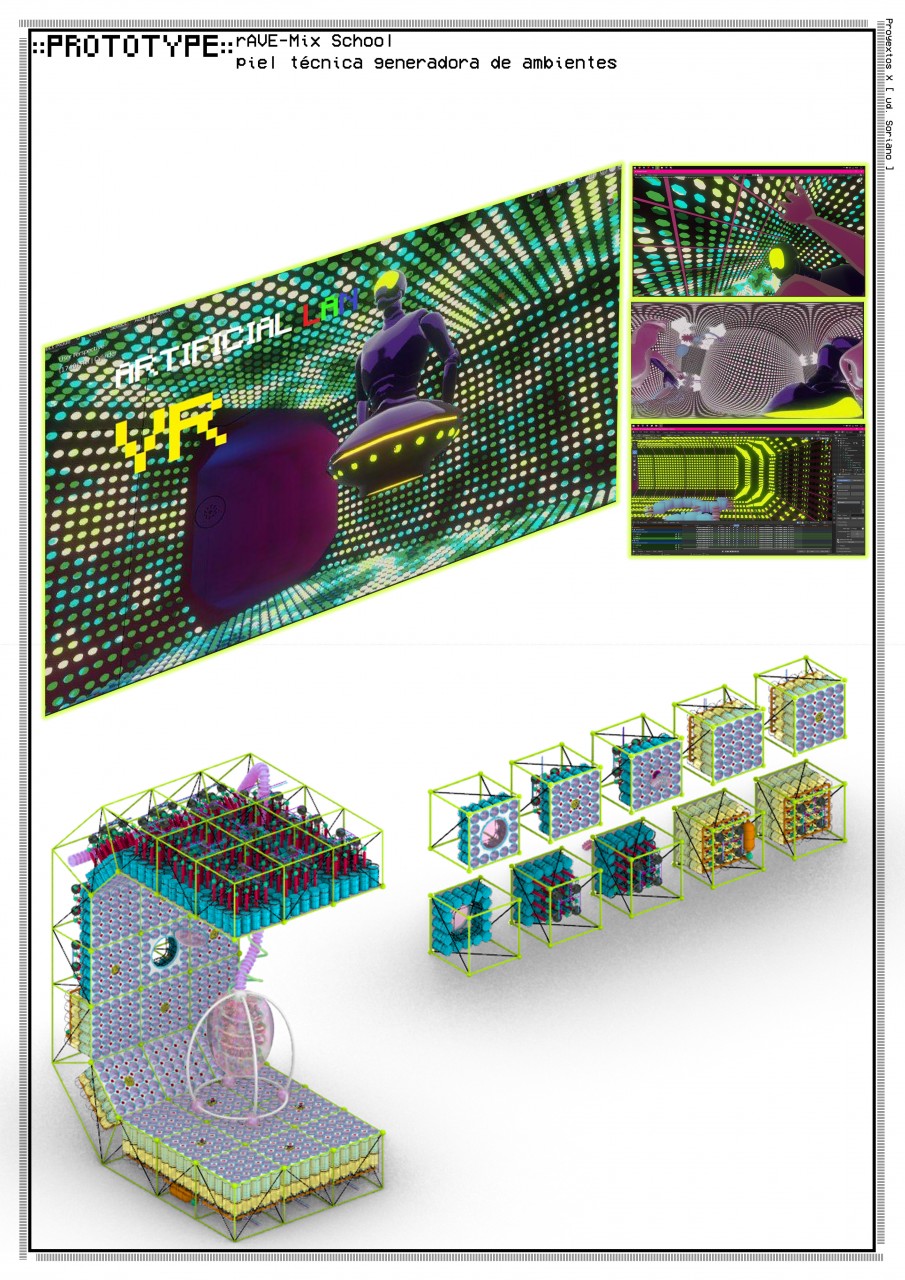
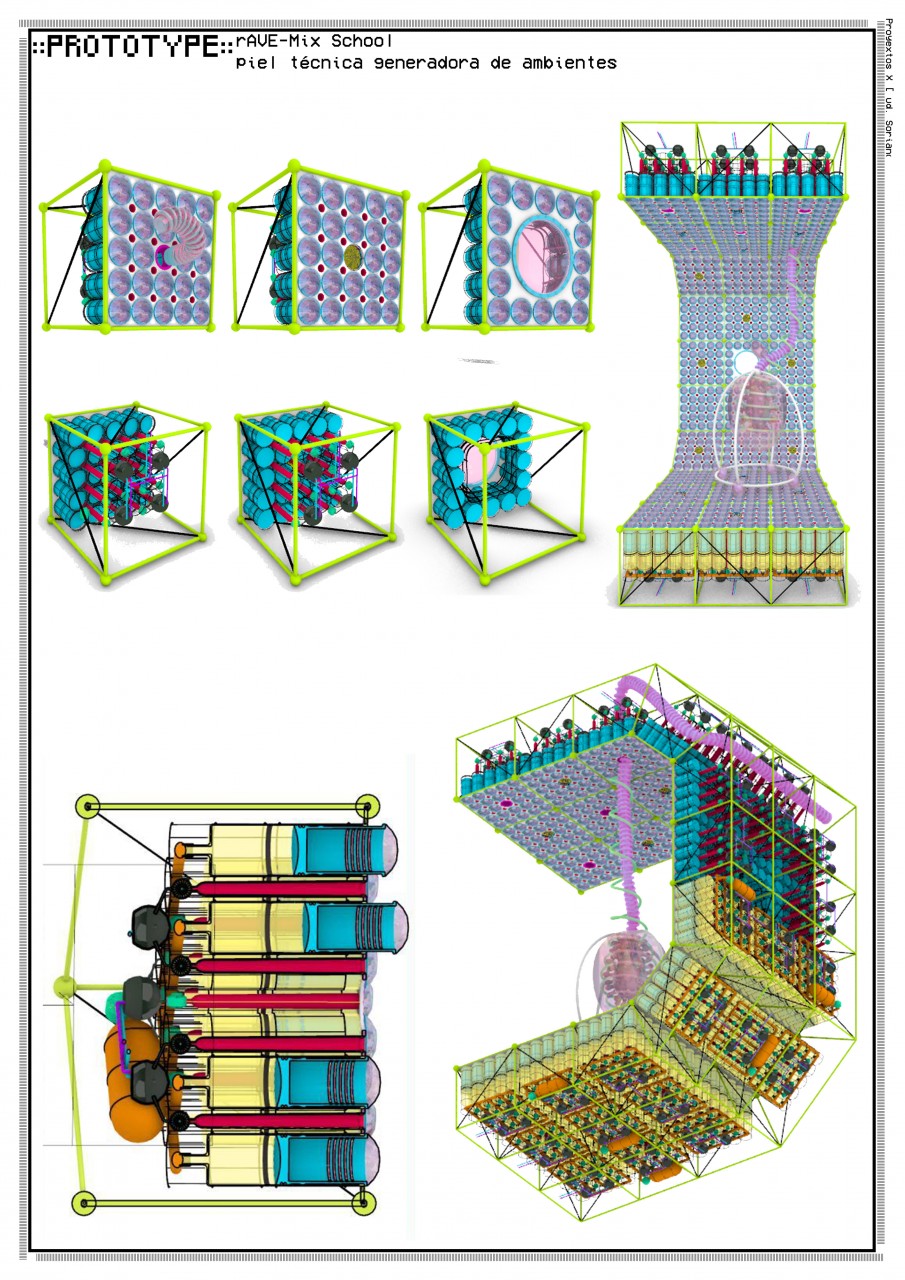
The walls of the spaces are pixelized in metallic structural modules, closed by a technical skin that confers the character of the interior space. By this, the environments, taken from the virtual simulation, are built in the textures, the illuminations, the senses and the pressure that the platforms simulate.
These variable spaces are mapped, at all times, by the voxel network, which records the characteristics of each room in the building, and responds to it by deforming and adapting to the exterior of each level. These variations in the spatial mesh become a supporting structure, which disappears as soon as it is adapted to the original voxel. This is how the exterior structure is built, which unifies the set of different levels and alternative circuits in a single building.
The goal is a free education, the new generation Junk Playground, in which human babies learn by choice, not by imposition.
<3
Virtual Reality video_https://www.youtube.com/watch?v=V4UYDGy3KMw
MIRO_https://miro.com/app/board/o9J_ksT0Jss=/
issuu CURSO_https://issuu.com/albertocalderonrivas/docs/a6_alberto-compressed
issuu PROYECTO FINAL_ https://issuu.com/albertocalderonrivas/docs/artificial_lan_proyecto_final
The model for the creation of a tangible world with its virtual relative is in the maps and video game supports, the logic of which will be applied to the organization of the building.
As in the possibilities of open world video games, where users decide their own experience, a micro universe is generated.
The plot is mapped with the new measurement unit: the voxel. It’s a cubic pixel that reacts to the empty space, the interior space and the structural skin of the inserted volumes.
Artificial LAN, as in an inmersive game, is organized by program levels, in scenarios with different routes, main and secondary connections, and different degrees of obstacles, following the rules developed in open-world video games. Thus, users, according to their knowledge and development, will be able to take multiple paths.
The program levels are given by the objects that populate it; As on a game screen, the tour guides decide the type of scenario we are in, whether it is a forest, temple or underwater city. The space is offered by multiple and completely variable.
Video
These programmatic objects deform the base space; the limits of wall, floor and ceiling, which collide with each other and generate sets, overlapping on 6 levels of specific uses, and connected to each other by a linear circuit, from the start to the highest space.
To this set, some spaces are glued that do not appear in the initial mapping; Alternative connections, which allow multiple non-intuitive routes, which are acquired with the experience of the individual in the building.
The walls of the spaces are pixelized in metallic structural modules, closed by a technical skin that confers the character of the interior space. By this, the environments, taken from the virtual simulation, are built in the textures, the illuminations, the senses and the pressure that the platforms simulate.
These variable spaces are mapped, at all times, by the voxel network, which records the characteristics of each room in the building, and responds to it by deforming and adapting to the exterior of each level. These variations in the spatial mesh become a supporting structure, which disappears as soon as it is adapted to the original voxel. This is how the exterior structure is built, which unifies the set of different levels and alternative circuits in a single building.
The goal is a free education, the new generation Junk Playground, in which human babies learn by choice, not by imposition.
<3
Virtual Reality video_https://www.youtube.com/watch?v=V4UYDGy3KMw
MIRO_https://miro.com/app/board/o9J_ksT0Jss=/
issuu CURSO_https://issuu.com/albertocalderonrivas/docs/a6_alberto-compressed
issuu PROYECTO FINAL_ https://issuu.com/albertocalderonrivas/docs/artificial_lan_proyecto_final

- 00 - Description
- 01 - Diagrama
- 02 - Strip
- 03 - Plantas
- 04 - Secciones
- 05 - Proceso
- 06 - Axonometría
- 07 - Grutas
- 08 - Circuito
- 09 - Prototipo
- 10 - Detalle
- 11 - Video