
FOLDING INTO SILENCE
In the vibrant heart of Madrid, where the rush dictates the rhythm of life, the noise never ceases, and the lights never fade, a proposal emerges for a timeless refuge: a new cathedral, an eternal symbol of silence, where the transcendent and the human intertwine.
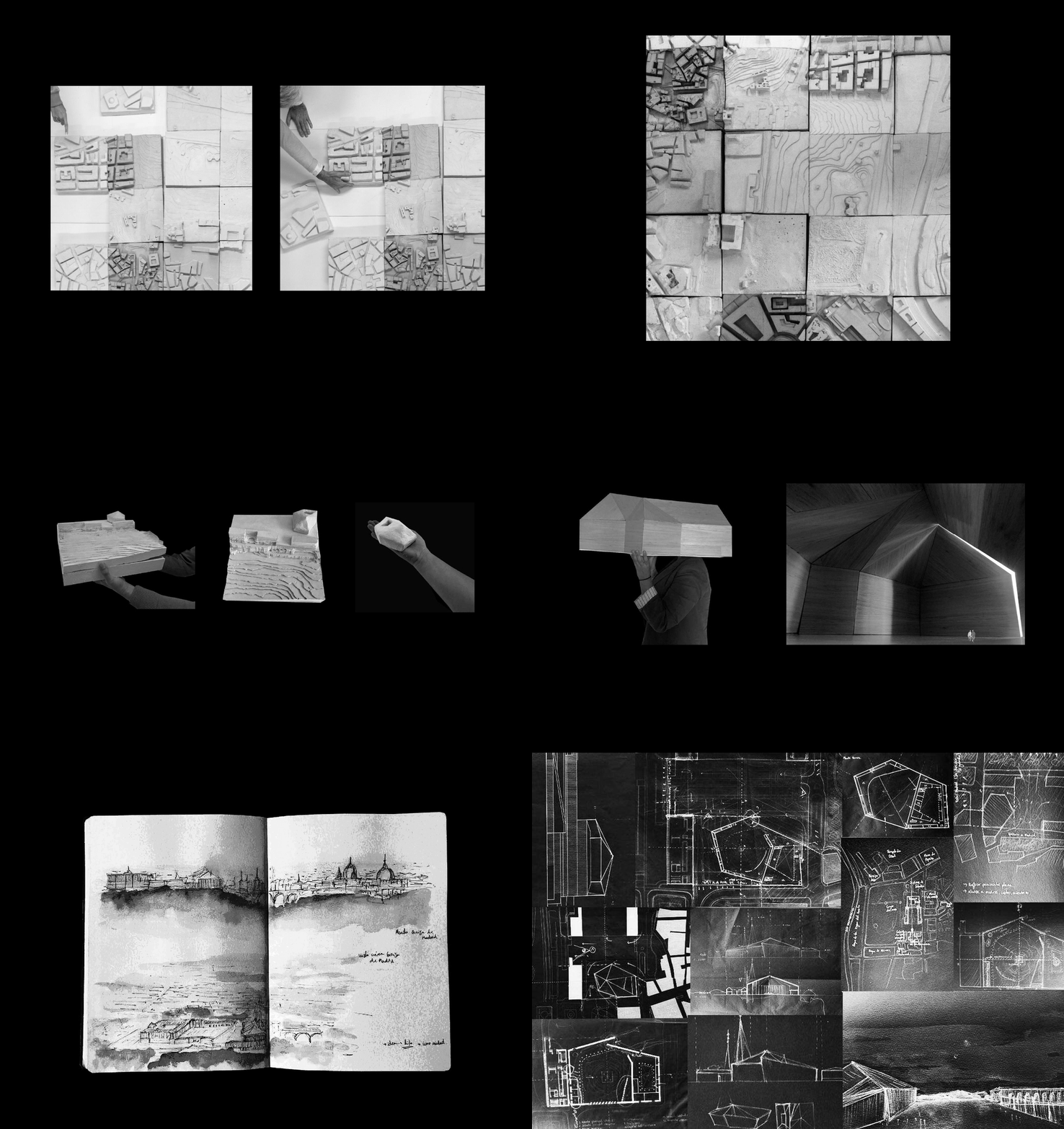
The main idea of the project is the fold, a strategy that gives the cathedral a unique architectural identity, standing out as a landmark in Madrid’s landscape. This fold not only shapes the architecture but also invites us to fold into silence, to reflect, and to step out of ourselves in service to those most in need.
Located on the iconic Madrid cornice, next to the Royal Palace and the Royal Collections, the Cathedral places the Plaza de la Armería at the center of the intervention.
The language of folds opens the square, tracing a diagonal that visually connects to the Sunset Viewpoint, oriented westward, overlooking Madrid Río and the Sierra de Guadarrama. A second viewpoint, the Noon Viewpoint, oriented southward, offers a new perspective featuring the Basilica of San Francisco el Grande.
The façades, aligned with Bailén and Mayor streets, maintain continuity with the existing urban fabric. The pavement unifies the square, and the strategic use of trees creates a visual transition, extending the lines marked by the arms of the Royal Palace.
This grand building seeks to update the historical roots of the Church through a contemporary reinterpretation of architecture. Two complementary programs are proposed: the temple, dedicated to worship, and the Refuge City, designed to shelter those in need.
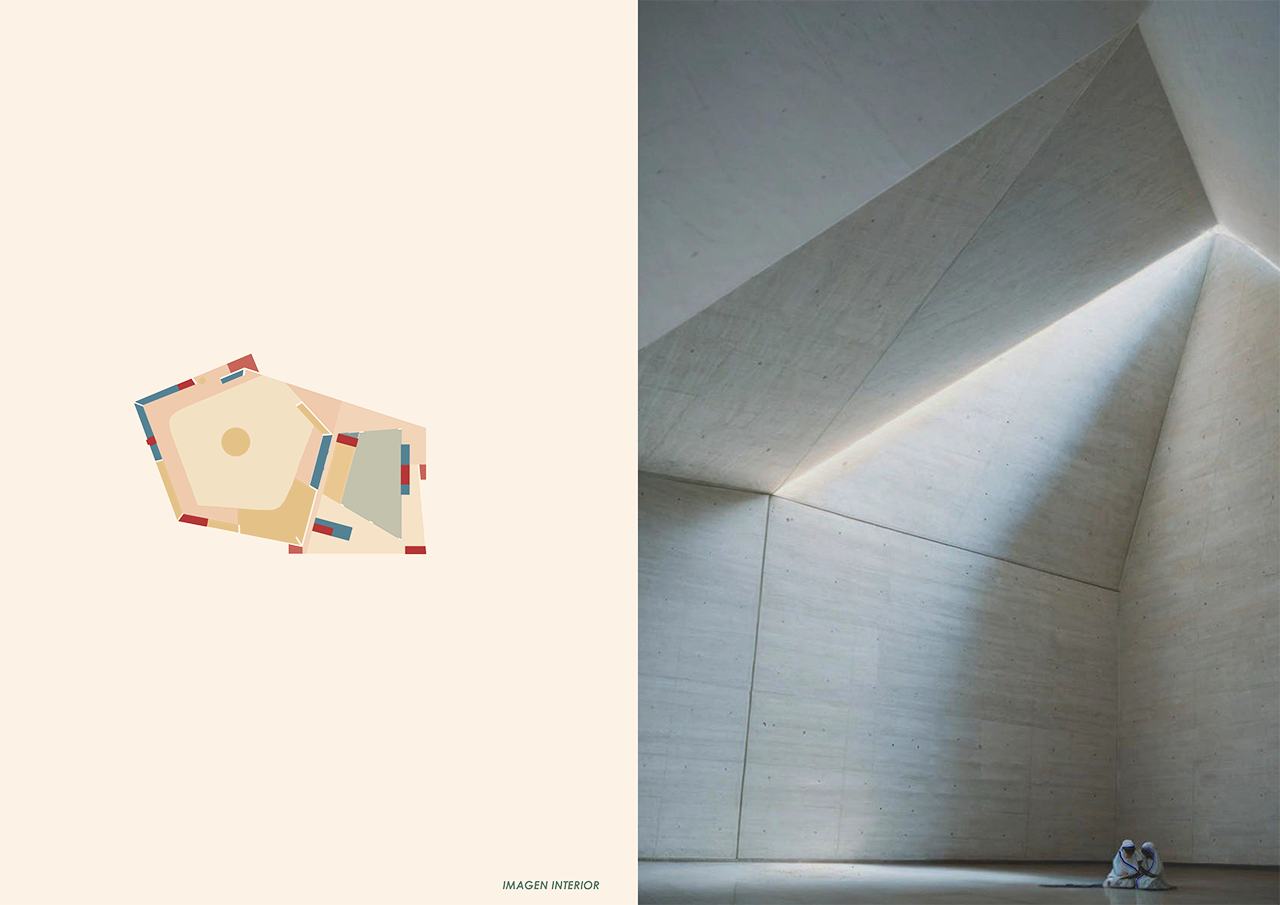
The Cathedral organizes the space in service of the liturgy and revives the concept of the ambulatory route, characteristic of historical cathedrals. The circular design guides worshippers and places the altar as the spiritual and architectural axis. Suspended above the altar, illuminated by a large influx of light, a cross highlights the centrality of Christ in the faith. Once again, the folds in the roof allow natural light to penetrate every corner, illuminating the sacred spaces, chapels, and sacraments.
The concept of the cloister is revived, inspired by ancient monasteries, housing common spaces on the ground floor and accommodating up to 200 people on the following three floors, thanks to the patio, which acts as a unifying element providing natural light. The rooms, while shared, offer privacy through the furniture.
The new cathedral is a manifestation of transcendence, where architecture becomes a refuge and a place of encounter. Its folds, more than just a form, are a profound gesture inviting prayer, service, and community, leaving an enduring mark as a landmark of Madrid.
The main idea of the project is the fold, a strategy that gives the cathedral a unique architectural identity, standing out as a landmark in Madrid’s landscape. This fold not only shapes the architecture but also invites us to fold into silence, to reflect, and to step out of ourselves in service to those most in need.
Located on the iconic Madrid cornice, next to the Royal Palace and the Royal Collections, the Cathedral places the Plaza de la Armería at the center of the intervention.
The language of folds opens the square, tracing a diagonal that visually connects to the Sunset Viewpoint, oriented westward, overlooking Madrid Río and the Sierra de Guadarrama. A second viewpoint, the Noon Viewpoint, oriented southward, offers a new perspective featuring the Basilica of San Francisco el Grande.
The façades, aligned with Bailén and Mayor streets, maintain continuity with the existing urban fabric. The pavement unifies the square, and the strategic use of trees creates a visual transition, extending the lines marked by the arms of the Royal Palace.
This grand building seeks to update the historical roots of the Church through a contemporary reinterpretation of architecture. Two complementary programs are proposed: the temple, dedicated to worship, and the Refuge City, designed to shelter those in need.
The Cathedral organizes the space in service of the liturgy and revives the concept of the ambulatory route, characteristic of historical cathedrals. The circular design guides worshippers and places the altar as the spiritual and architectural axis. Suspended above the altar, illuminated by a large influx of light, a cross highlights the centrality of Christ in the faith. Once again, the folds in the roof allow natural light to penetrate every corner, illuminating the sacred spaces, chapels, and sacraments.
The concept of the cloister is revived, inspired by ancient monasteries, housing common spaces on the ground floor and accommodating up to 200 people on the following three floors, thanks to the patio, which acts as a unifying element providing natural light. The rooms, while shared, offer privacy through the furniture.
The new cathedral is a manifestation of transcendence, where architecture becomes a refuge and a place of encounter. Its folds, more than just a form, are a profound gesture inviting prayer, service, and community, leaving an enduring mark as a landmark of Madrid.




- 00 - Description
- 01 - Location
- 02 - Elevations
- 03 - Exterior image
- 04 - Site plans
- 05 - Distant sections
- 06 - Interior image
- 07 - Plans
- 08 - Close-up sections
- 09 - Diagrams
- 10 - Models and sketches
- 11 - Video