
Inflatowharf
The project is set in MacArthur’s Wharf, located in the Island of Guimaras, in the Philippines. By the year 2116, the site will be under extreme climatic and environmental threats.
The project proposes a multi programmatic wharf laced over the pre existing wharf, which lies flooded beneath, betting on the future of MacArthur's as a strategic connection point for the island of Guimarás.
A series of contextual analysis define the new scenery of MacArthur’s Wharf. The different data recorded assembles as a set of interactive sliders that measure threatening parameters such as the population’s exponential growth, rising sea level, periodicity and intensity of cyclones, tourism statistics, and fishing seasons.
The project works as a layered system where different scenes are intertwined, switched on and off. Relationships arise between them and between their users as an answer to the temporal condition of the site.
The project proposes to assume the pre-existing scene of MacArthur’s Wharf by taking on its preceding activities, making them compatible with the introduction of four new different scenes that result from the contextual analysis. The Commercial Scene consists of a Fish Market that exports 550.000 tons of fish daily; the Productive Scene includes a Mango Research Lab that protects the uniquely sweet flavored Guimaras Mangoes; and the Domestic Scene with permanent housing for cyclone refugees and temporary housing for fisherfolk and researchers.
In addition to these main scenes, another one related to energy generation is proposed. By taking advantage of the high wind potential of cyclones, the proposed infrastructure allows the stable generation of energy. This energy is transformed and stored as compressed air and can be released according to demand.
The latent energy crisis and re-evaluation of energy systems leads to a simultaneous rethinking of the physical enclosure. The inexpensive power and utility of air to create both structure and environmental moderation suggests new modes and means of climatic enclosures and a redefinition of the physical interaction between the architecture, the environment and human beings.
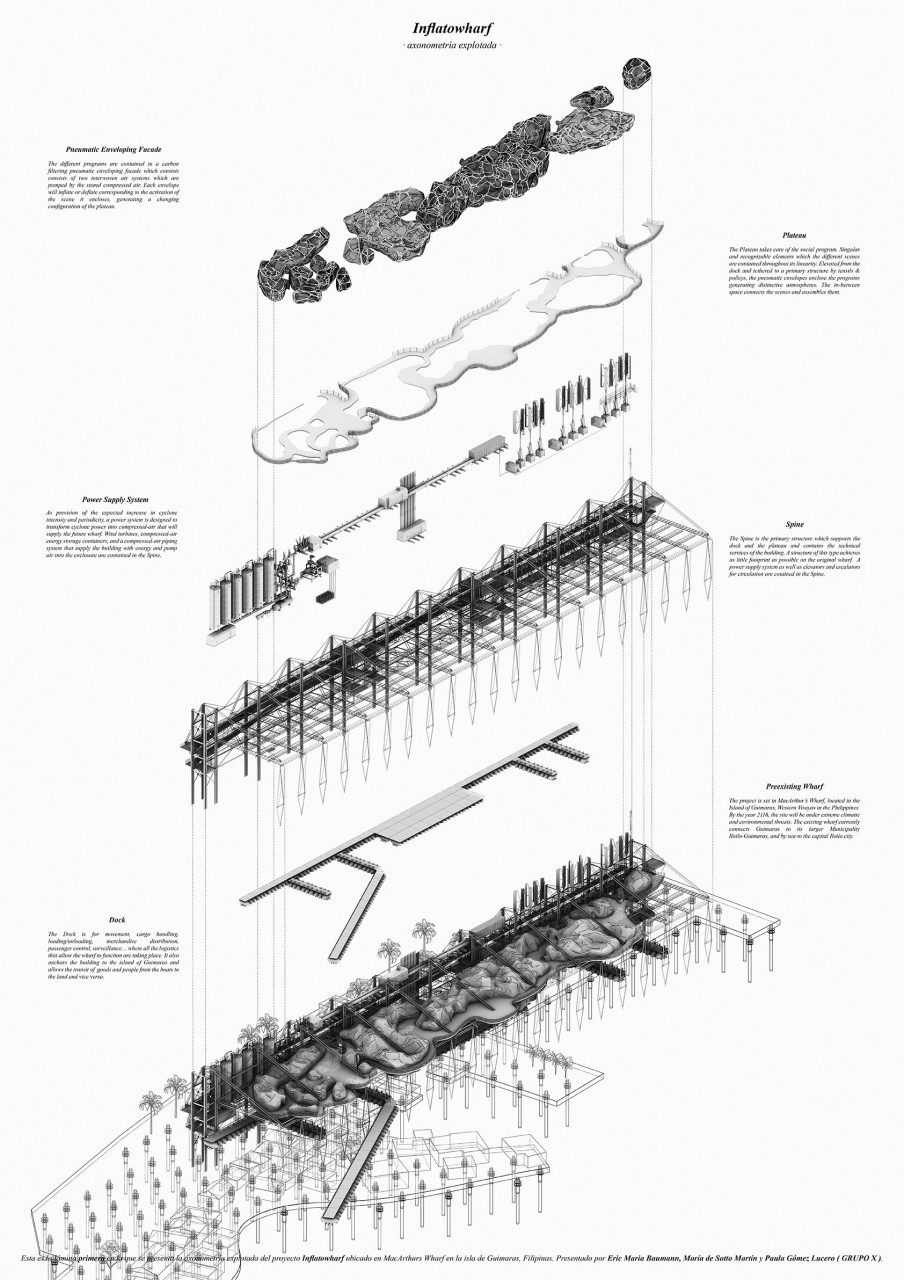
A carbon-filtering pneumatic facade is developed and prototyped. It consists of two interwoven air systems which are pumped by the stored compressed air. The first of the systems consists of an air-inflated net filled with low positive pressure for filtering carbon from the air. The second system consists of an air-supported structure which becomes the enclosure to the different programs, each of which will assume a specific compartmentalisation and organization according to its spatial needs.
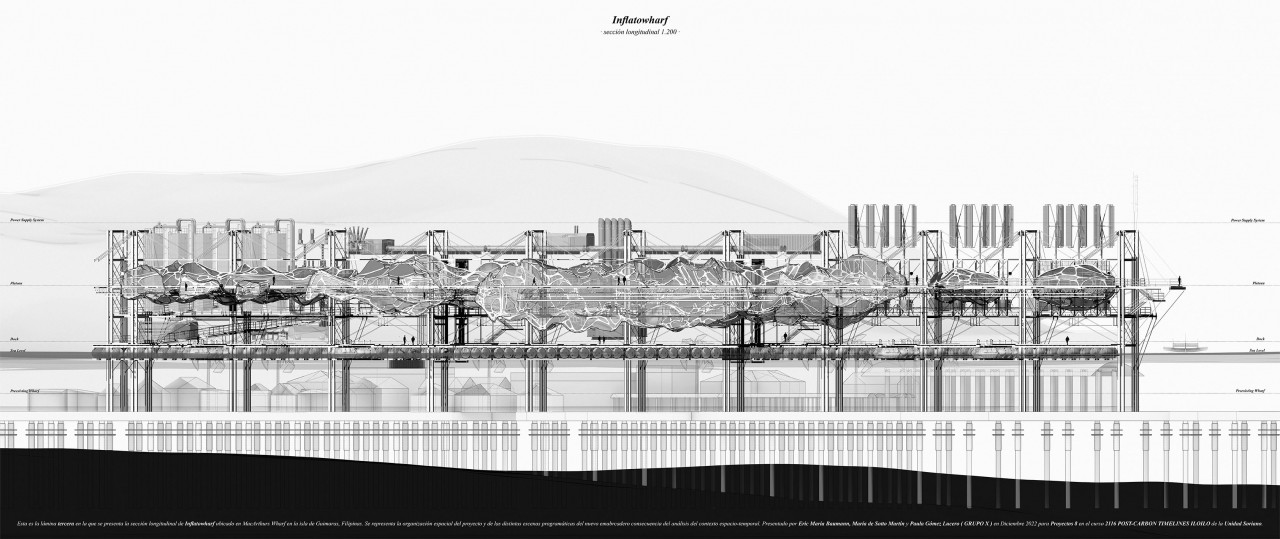
Three elements compose the new wharf: the Dock, the Spine and the Plateau.
The Spine is the primary structure which supports the dock and the plateau and contains the technical services of the building. A structure of this type achieves as little footprint as possible on the original wharf. Wind turbines, compressed-air energy storage containers, and a compressed-air piping system as well as elevators and escalators for circulation.
The Dock is for movement, cargo handling, loading/unloading, merchandise distribution, passenger control, … where all the logistics that allow the wharf to function are taking place. It also anchors the building to the island of Guimaras and allows the transit of goods and people from the boats to the land and vice versa.
The Plateau takes care of the social program. Singular and recognizable elements which the different scenes are contained throughout its linearity. Elevated from the dock and tethered to a primary structure by tensils & pulleys, the pneumatic envelopes enclose the programs generating distinctive atmospheres. Each envelope will inflate or deflate corresponding to the activation of the scene it encloses, generating a changing configuration of the plateau. The in-between space connects the scenes and assembles them together by allowing direct circulation between them.
The project proposes a multi programmatic wharf laced over the pre existing wharf, which lies flooded beneath, betting on the future of MacArthur's as a strategic connection point for the island of Guimarás.
A series of contextual analysis define the new scenery of MacArthur’s Wharf. The different data recorded assembles as a set of interactive sliders that measure threatening parameters such as the population’s exponential growth, rising sea level, periodicity and intensity of cyclones, tourism statistics, and fishing seasons.
The project works as a layered system where different scenes are intertwined, switched on and off. Relationships arise between them and between their users as an answer to the temporal condition of the site.
The project proposes to assume the pre-existing scene of MacArthur’s Wharf by taking on its preceding activities, making them compatible with the introduction of four new different scenes that result from the contextual analysis. The Commercial Scene consists of a Fish Market that exports 550.000 tons of fish daily; the Productive Scene includes a Mango Research Lab that protects the uniquely sweet flavored Guimaras Mangoes; and the Domestic Scene with permanent housing for cyclone refugees and temporary housing for fisherfolk and researchers.
In addition to these main scenes, another one related to energy generation is proposed. By taking advantage of the high wind potential of cyclones, the proposed infrastructure allows the stable generation of energy. This energy is transformed and stored as compressed air and can be released according to demand.
The latent energy crisis and re-evaluation of energy systems leads to a simultaneous rethinking of the physical enclosure. The inexpensive power and utility of air to create both structure and environmental moderation suggests new modes and means of climatic enclosures and a redefinition of the physical interaction between the architecture, the environment and human beings.
A carbon-filtering pneumatic facade is developed and prototyped. It consists of two interwoven air systems which are pumped by the stored compressed air. The first of the systems consists of an air-inflated net filled with low positive pressure for filtering carbon from the air. The second system consists of an air-supported structure which becomes the enclosure to the different programs, each of which will assume a specific compartmentalisation and organization according to its spatial needs.
Three elements compose the new wharf: the Dock, the Spine and the Plateau.
The Spine is the primary structure which supports the dock and the plateau and contains the technical services of the building. A structure of this type achieves as little footprint as possible on the original wharf. Wind turbines, compressed-air energy storage containers, and a compressed-air piping system as well as elevators and escalators for circulation.
The Dock is for movement, cargo handling, loading/unloading, merchandise distribution, passenger control, … where all the logistics that allow the wharf to function are taking place. It also anchors the building to the island of Guimaras and allows the transit of goods and people from the boats to the land and vice versa.
The Plateau takes care of the social program. Singular and recognizable elements which the different scenes are contained throughout its linearity. Elevated from the dock and tethered to a primary structure by tensils & pulleys, the pneumatic envelopes enclose the programs generating distinctive atmospheres. Each envelope will inflate or deflate corresponding to the activation of the scene it encloses, generating a changing configuration of the plateau. The in-between space connects the scenes and assembles them together by allowing direct circulation between them.




- 00 - Description
- 01 - Sliders
- 02 - Axo Explotada
- 03 - Planta 1.200
- 04 - Sección 1.200
- 05 - Visualización
- 06 - Prototipo
- 07 - Condición Temporal
- 08 - Imágenes
- 09 - Video