
= (Linear)
Linear. The architecture of a journey.
Three interventions located in Morocco, from the desert to the medina of Fez, a trip without a particular objective other than the act of traveling itself.
The projects’ aim is to connect with the land, and integrate in it in a way that facilitates its understanding by the visitor, or enhances the experience of the place in three specific moments of the journey:
The oasis - A Line On The Horizon:
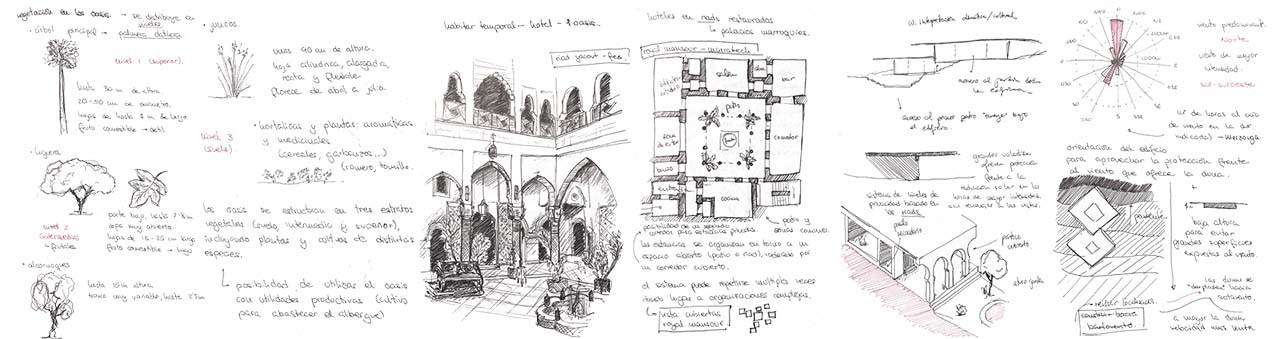
The project is located in a confluence point between the numerous routes that traverse the desert, with the intention of becoming a refuge and oasis from the extreme temperatures of the desert.
With that aim in mind, the limit strategies learned from traditional architecture are used, optimizing the ventilation with a fresh and humid garden centered around a pond. On top of this, the large. Overhangs and low height of the building offer protection against the intense solar radiation and the wind.
The hostel is structured in a double patio system, following the example of the ‘riads’ and palaces of arabic architecture. This provides a duality of concepts: public as opposed to private, fire as opposed to water…
The access to the oasis takes place below the building, emerging in the centre of the first courtyard, around which the public spaces are located, and in which the ‘amazigh’ drum nights are hosted.
Next, walking up the stairs in the intersection of the two blocks, one reaches the upper courtyard; the garden and pond space, around which the rooms are organized. These are found behind a porticoed hallway, which emphasizes the successive layers of privacy.
The gate - Magnificent:
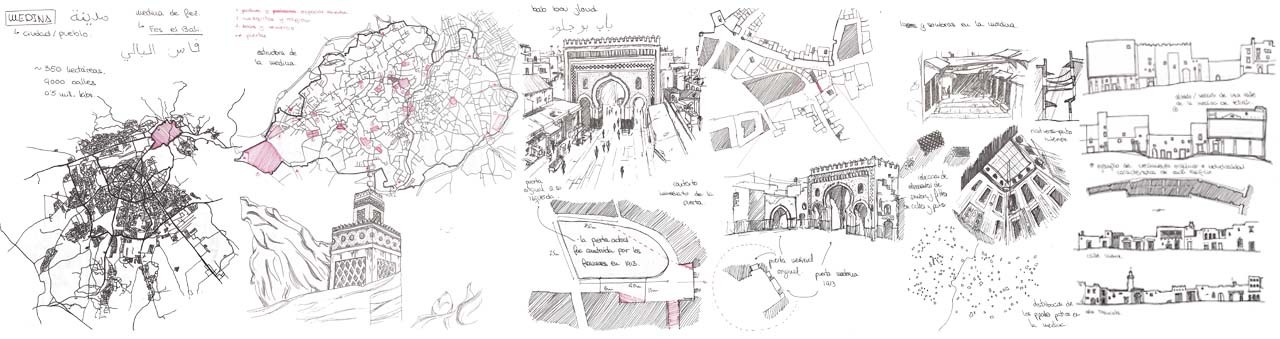
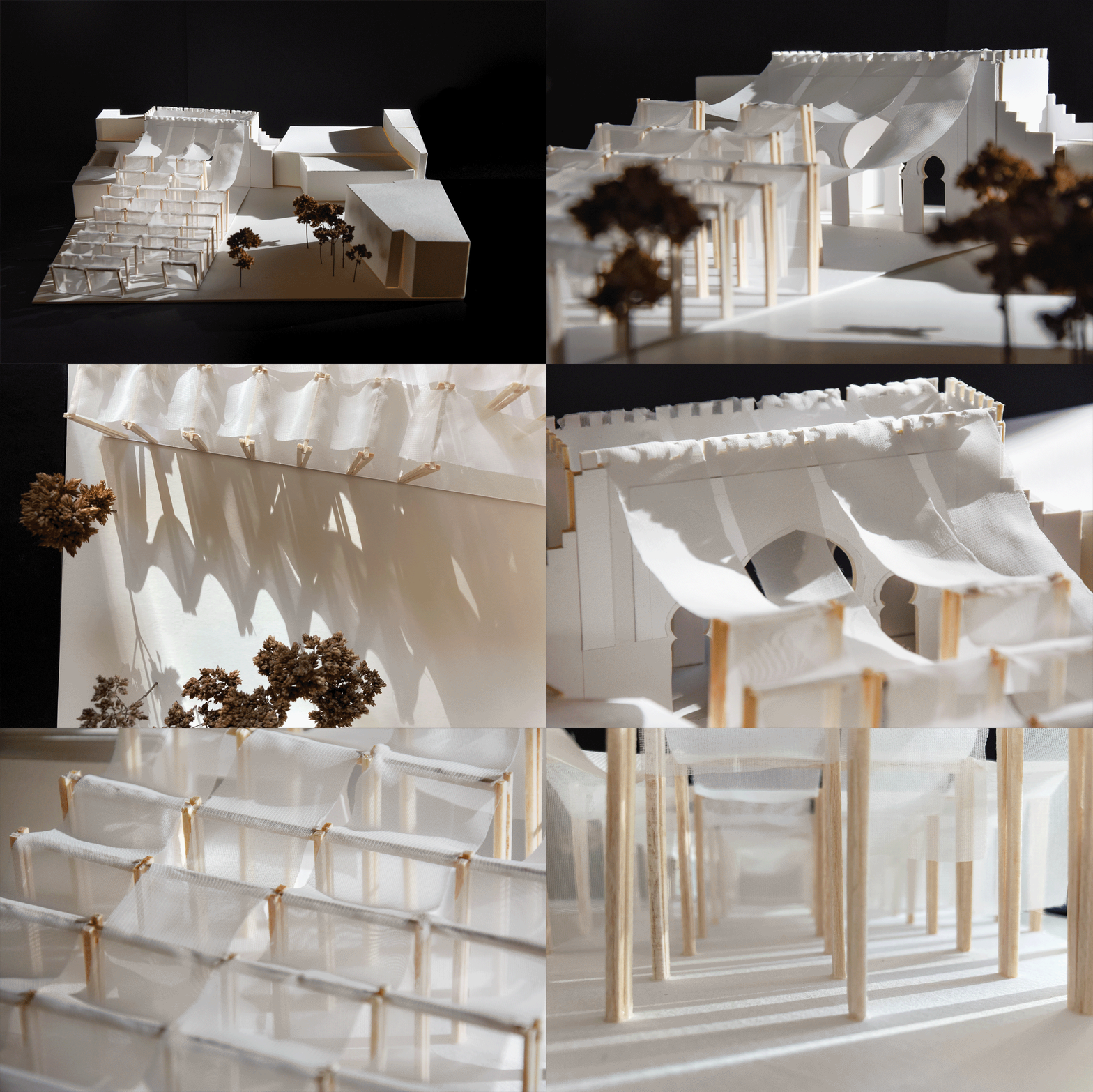
The proposal for the gate, located in front of the Bab Bou Jloud gate, consists of a gradient between the exterior of the city walls, open, vast and empty, and the interior, with its dense and complicated urban fabric and its solid buildings.
This gradient materializes in a textile intervention, contrasting with the mass of the arch and the urban fabric of the medina. This transition, light and semi transparent, acts as a filter which the visitor walks through, slowly uncovering the arch and the entrance to the medina as they traverse the successive layers of fabric.
The program is divided into two parts, with the exhibition space, theatre, and waiting area located under the textile structure; and the toilets and information office in the inside of the arch. This way, the existing construction is repurposed, creating a mix between lightness and mass, between new and ancient.
The pause - Fez (Being Born):
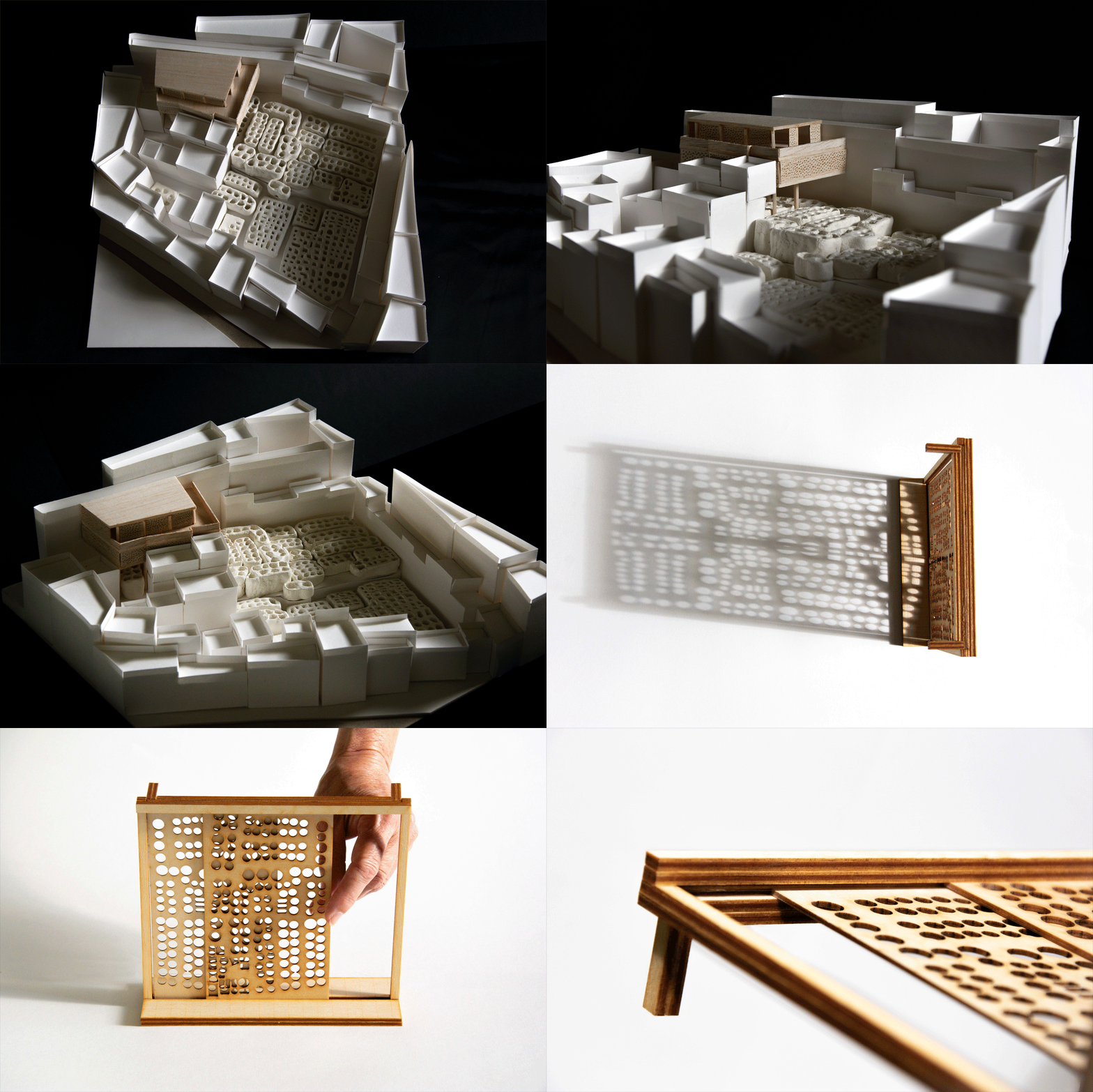
The tea house is located on the edge of the tanneries, elevated over the vats where the leather dyeing takes place, with a timber frame that gives it a light quality, and frees up the ground level to maintain the use of the tannery and the labor of its workers.
The structure responds to the modular dimensions dictated by the distance between the vats, and it is also connected and held by the surrounding buildings, becoming a part of the built context in a similar way to the wooden structures used for hanging and drying the leather.
For its envelope, movable lattices are used, combined with opaque panels for privacy. These allow for various degrees of ventilation depending on their position, along with shading the interior and casting a beautiful light and shade pattern based on the aerial view of the tannery.
The intervention is organized along two floors, slightly offset, to offer a terrace with a complete view of the tannery. The access to the building takes place in the first floor, through one of the surrounding balconies. The spaces inside are subdivided using the same system of movable panels and lattices.
Inside, we find a market space for the local producers to sell their products, along with an office and a small warehouse in the lower floor, and the tea rooms on the upper floor, open to the terrace, which offers a view of the surrounding architecture, the vats and the buildings that enclose the tannery.
“Through the walls and towers destined to crumble,
the tracery of a pattern so subtle it could escape the termites’ gnawing”
Three interventions located in Morocco, from the desert to the medina of Fez, a trip without a particular objective other than the act of traveling itself.
The projects’ aim is to connect with the land, and integrate in it in a way that facilitates its understanding by the visitor, or enhances the experience of the place in three specific moments of the journey:
The oasis - A Line On The Horizon:
The project is located in a confluence point between the numerous routes that traverse the desert, with the intention of becoming a refuge and oasis from the extreme temperatures of the desert.
With that aim in mind, the limit strategies learned from traditional architecture are used, optimizing the ventilation with a fresh and humid garden centered around a pond. On top of this, the large. Overhangs and low height of the building offer protection against the intense solar radiation and the wind.
The hostel is structured in a double patio system, following the example of the ‘riads’ and palaces of arabic architecture. This provides a duality of concepts: public as opposed to private, fire as opposed to water…
The access to the oasis takes place below the building, emerging in the centre of the first courtyard, around which the public spaces are located, and in which the ‘amazigh’ drum nights are hosted.
Next, walking up the stairs in the intersection of the two blocks, one reaches the upper courtyard; the garden and pond space, around which the rooms are organized. These are found behind a porticoed hallway, which emphasizes the successive layers of privacy.
The gate - Magnificent:
The proposal for the gate, located in front of the Bab Bou Jloud gate, consists of a gradient between the exterior of the city walls, open, vast and empty, and the interior, with its dense and complicated urban fabric and its solid buildings.
This gradient materializes in a textile intervention, contrasting with the mass of the arch and the urban fabric of the medina. This transition, light and semi transparent, acts as a filter which the visitor walks through, slowly uncovering the arch and the entrance to the medina as they traverse the successive layers of fabric.
The program is divided into two parts, with the exhibition space, theatre, and waiting area located under the textile structure; and the toilets and information office in the inside of the arch. This way, the existing construction is repurposed, creating a mix between lightness and mass, between new and ancient.
The pause - Fez (Being Born):
The tea house is located on the edge of the tanneries, elevated over the vats where the leather dyeing takes place, with a timber frame that gives it a light quality, and frees up the ground level to maintain the use of the tannery and the labor of its workers.
The structure responds to the modular dimensions dictated by the distance between the vats, and it is also connected and held by the surrounding buildings, becoming a part of the built context in a similar way to the wooden structures used for hanging and drying the leather.
For its envelope, movable lattices are used, combined with opaque panels for privacy. These allow for various degrees of ventilation depending on their position, along with shading the interior and casting a beautiful light and shade pattern based on the aerial view of the tannery.
The intervention is organized along two floors, slightly offset, to offer a terrace with a complete view of the tannery. The access to the building takes place in the first floor, through one of the surrounding balconies. The spaces inside are subdivided using the same system of movable panels and lattices.
Inside, we find a market space for the local producers to sell their products, along with an office and a small warehouse in the lower floor, and the tea rooms on the upper floor, open to the terrace, which offers a view of the surrounding architecture, the vats and the buildings that enclose the tannery.
“Through the walls and towers destined to crumble,
the tracery of a pattern so subtle it could escape the termites’ gnawing”






- 00 - Description
- 01 - oasis_sketches
- 02 - oasis_panels
- 03 - oasis_model
- 04 - gate_sketches
- 05 - gate_panel-1
- 06 - gate_panel-2
- 07 - gate_model
- 08 - pause_sketches
- 09 - pause_panels
- 10 - pause_models
- 11 - Video